Tag: UK

  • Why UK E-Learning Fails to Transfer into the Workplace

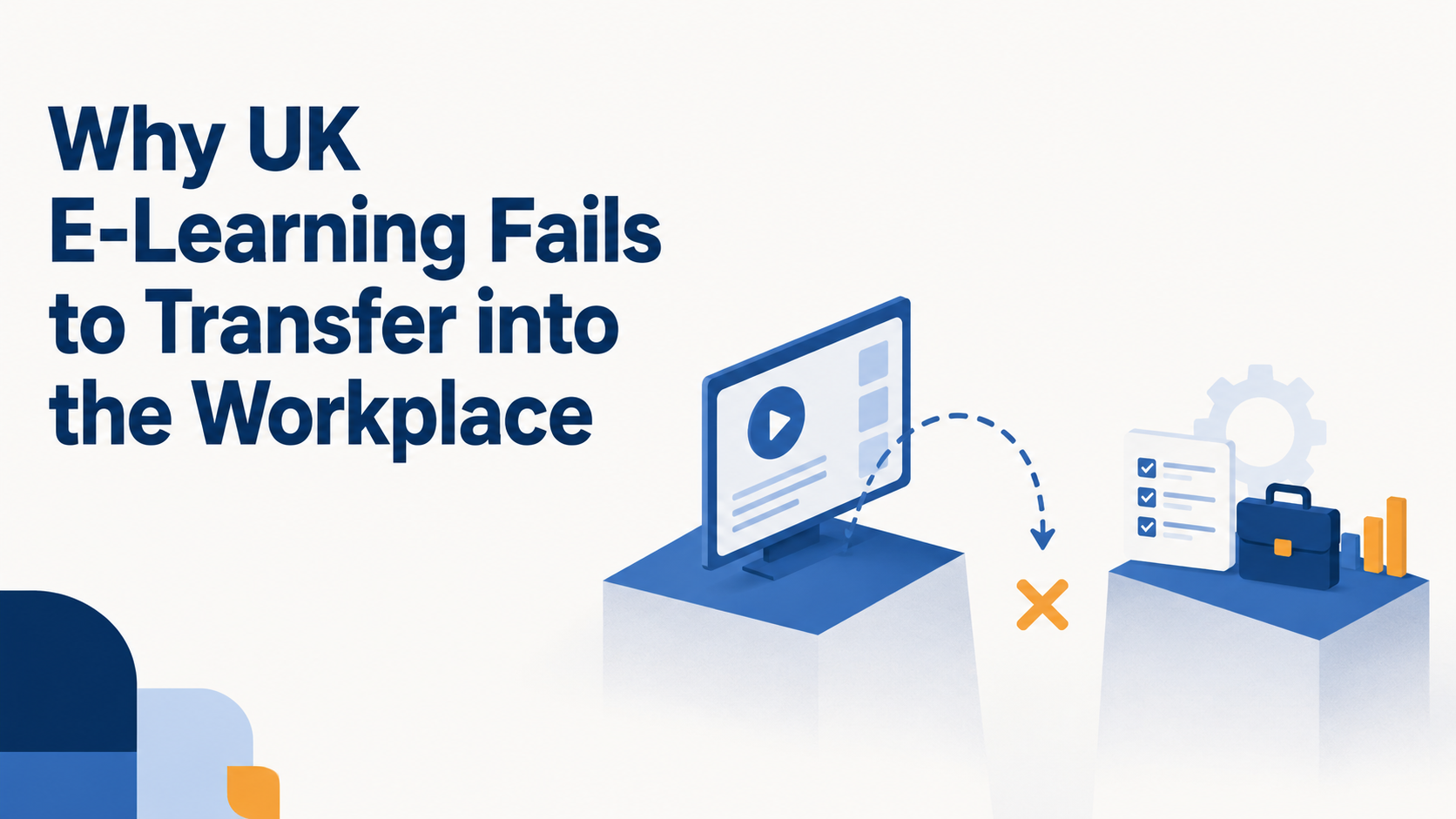
    Why UK E-Learning Fails to Transfer into the Workplace

    For many UK organisations, completing e-learning is easy to measure. You can see who logged in, who finished the module and who passed the assessment. The harder question comes later: does the employee actually do anything differently at work?

    Imagine a new starter completing data protection training on Friday. They achieve a high score, but a few weeks later they still handle personal information in the same way as before. The course delivered knowledge, but the learning did not transfer into day-to-day behaviour. That gap matters because training only creates business value when people can use what they have learnt.

    Learning transfer is the point where knowledge, skills and attitudes move from the training environment into real work. It can affect safety, compliance, productivity, customer service and performance. If your organisation is investing in e-learning, understanding why transfer breaks down should be part of the design process, not an afterthought.

    Learning Transfer Starts Before the Course

    A common mistake is to treat the course itself as the whole training intervention. The learner opens the module, completes the activities and passes the assessment. Everyone assumes the job is done.

    In practice, successful transfer involves several connected stages. Before training, employees need to understand why the learning matters, what they are expected to achieve and how it relates to their role. During training, they need useful information, realistic examples and opportunities to practise. Afterwards, they need the time, support and opportunity to apply the new behaviour.

    Over time, repeated application can turn a new skill into a normal part of the job. That is when training starts to influence performance rather than simply completion statistics.

    Why Good E-Learning Can Still Fail

    The most engaging course cannot compensate for poor conditions around it. Organisations often concentrate their effort on the part they can control most easily, the content. They spend time refining screens, assessments and interactions while giving less attention to what happens before and after the learner completes the course.

    This creates a familiar pattern. The learner understands the course, passes the quiz and then returns to a workplace that rewards the old way of working.

    For example, an employee may learn a new process through an interactive scenario but have no access to the required system when they return to their desk. A manager may complete leadership training but have no time allocated for coaching conversations. A safety course may explain the correct procedure, while the workplace lacks the equipment needed to follow it.

    The problem is not necessarily the quality of the course. The wider learning environment has not been designed to support transfer.

    Remove the Barriers That Stop People Applying Learning

    Learners can resist training for reasons that have little to do with the content itself. They may not see a personal benefit, lack confidence, worry about making mistakes or believe that the training conflicts with their priorities.

    The first step is to understand the barrier. Is the employee missing knowledge, or do they already know what to do? Are they lacking a skill, confidence or motivation? Is the requested behaviour realistic within their role?

    Context matters too. A new process may look sensible during training but feel impractical when an employee is dealing with a busy workload, customer demands or competing deadlines. Training should reflect the conditions in which people will actually use the learning.

    This is one reason scenario-based e-learning can be effective. Learners can practise decisions in situations that resemble their working environment, receive feedback and see the consequences of different choices before facing them on the job.

    Managers Have a Major Role After Training

    Line managers can make or break learning transfer. Employees are more likely to use new skills when their manager understands the purpose of the training and gives them opportunities to apply it.

    That support does not need to be complicated. A manager might discuss the learning during a one-to-one, observe a new behaviour, provide feedback or agree on a practical action for the employee to try during the following week.

    Managers also need the information and confidence to support the programme. If they have not been briefed, they may unintentionally undermine the training by continuing to encourage old processes or prioritising short-term output over the new behaviour.

    For larger organisations, this can be built into the learning journey through manager guides, follow-up activities, reminders and reporting through an LMS such as the Capytech LMS.

    Build the Workplace Conditions for Transfer

    Even motivated employees cannot apply learning if the organisation does not give them a fair opportunity to do so.

    Consider the practical requirements. Does the employee have access to the right software, equipment, information and documentation? Is there enough time to practise? Do policies support the behaviour being taught? Can subject matter experts or colleagues provide help when questions arise?

    These questions are particularly important for compliance and safety training. A learner who completes IOSH-approved training, for example, may understand the correct approach but still need suitable workplace procedures, equipment and management support to put that knowledge into practice. Capytech currently offers IOSH-approved online safety training for UK organisations. For a closer look, read our guide to IOSH courses for UK businesses.

    Training teams should therefore involve relevant stakeholders before launch. Managers, HR, subject matter experts and operational teams can identify barriers that may otherwise only become visible after the course has been completed.

    Measure More Than Completion and Quiz Scores

    Completion rates and assessment results are useful, but they do not prove learning transfer.

    A stronger evaluation process looks at what happens after training. Depending on the objective, this could include changes in error rates, audit findings, customer feedback, safety incidents, productivity measures or manager observations. Our guide to measuring e-learning ROI goes into more detail.

    The right measures should be linked to the original learning objective. If the aim is to improve phishing awareness, for example, the organisation could monitor reporting behaviour rather than relying only on a multiple-choice test. If the aim is better management practice, feedback from employees and managers may be more useful than a course score.

    Digital learning platforms can help bring completion data and follow-up information together. AI-powered learning tools can also provide additional practice and feedback, although technology should support the learning strategy rather than replace workplace support. Capytech’s UK offering includes AI-powered learning tools and the Capytech LMS capabilities designed to support wider learning programmes.

    A UK Example: From Compliance Training to Behaviour Change

    Consider a local council introducing updated data protection procedures. Employees complete an e-learning module covering the UK GDPR and the Data Protection Act 2018. They pass the assessment, so the training appears successful.

    However, the organisation wants more than evidence of completion. Before the course, managers explain why the changes matter and identify common risks in their teams. During the course, employees work through realistic scenarios involving personal data. Afterwards, managers reinforce the process during team meetings and check whether staff are following the updated procedures.

    The organisation then reviews relevant audit findings and recurring errors. If problems remain, the learning team can identify whether another course is actually needed or whether the barrier sits elsewhere, such as unclear procedures, limited access or a lack of management support.

    This approach turns e-learning from a one-off compliance task into part of a wider performance improvement process.

    Make Learning Transfer Part of the Design

    The most useful question is not simply, “Did employees complete the course?” It is, “What needs to happen for employees to use this learning successfully at work?”

    That means designing the journey before, during and after the course. Set clear objectives, explain the reason for the training, use realistic practice, involve managers and remove practical barriers. Give learners opportunities to apply their skills, then collect evidence of whether behaviour and performance have changed. Our guide to behaviour change training goes into more detail.

    Capytech supports UK organisations with custom e-learning, AI-powered learning tools, FastTrack development and the Capytech LMS. Its custom e-learning service includes interactive scenarios and AI-supported learning experiences, while FastTrack is designed to turn existing documents and policies into SCORM-ready e-learning quickly.

    Whether the subject is compliance, leadership, cybersecurity, health and safety or professional development, successful learning transfer depends on more than good content. When the course and the workplace work together, e-learning has a much better chance of changing behaviour and delivering a measurable return on investment.

    Frequently asked questions

    What is learning transfer?

    Learning transfer is the extent to which people apply what they learnt in training back on the job. It is the point of most workplace training, because learning that is never used produces no benefit.

    Why does training fail to transfer to the workplace?

    Common reasons are training that does not match the real job, no chance to practise soon afterwards, little support from managers and a workplace that still rewards the old way of working. Transfer depends as much on what happens after the course as on the course itself.

    How can managers support learning transfer?

    Managers can agree goals with the learner before the training, give them chances to use the new skills straight away and follow up with feedback in the weeks afterwards. Even a short conversation before and after a course helps people apply what they learnt.

    How do you measure learning transfer?

    Look for the target behaviours at work over the following weeks and months, through manager observation, short follow-up surveys, work samples or operational data. In the Kirkpatrick model this is level 3, behaviour.

    See your own training as e-learning, free

    Send us one document and we will turn it into an interactive demo module, so you can judge the quality before you spend anything.
  • Cyber Security Training for Employees: How to Make It Stick

    Cyber Security Training for Employees: How to Make It Stick

    This guide is about making cyber security training change what people do. If you need the basics first (who needs training, what it should cover, how often to refresh it and the records to keep), start with our guide to cyber security training for employees. Phishing is still by far the most common attack. The government’s Cyber Security Breaches Survey 2025/2026 found phishing affected 38% of businesses and 25% of charities in the past year, yet only 19% of businesses reported staff training or awareness raising.

    Delivering the training is the easy part. The hard part is getting people to pay attention, remember what they have learnt and apply it when a real threat appears. A course full of warnings and technical terms quickly becomes something employees click through just to complete. Training works when it feels relevant to people’s roles and gives them the confidence to make the right decision.

    Here are practical ways to make cyber security e-learning more engaging and help the learning stick.

    Start with situations employees recognise

    People are more likely to engage with training when they can see how it relates to their own work.

    Instead of presenting cyber security as a collection of technical rules, use examples that employees could realistically encounter. A finance employee might receive a convincing request to change a supplier’s bank details. A manager might receive a message asking them to approve an urgent payment. Someone working remotely could be targeted through a personal device or an unsecured network.

    The examples should reflect the systems, communication channels and responsibilities employees actually use.

    At the same time, make it clear that threats do not always look familiar. Attackers continually change their methods, so employees need principles they can apply to unfamiliar situations, as well as a handful of examples they recognise.

    Turn security lessons into stories

    Cyber security can seem abstract until employees understand what can happen when something goes wrong.

    A short story can make the consequences much easier to understand. For example, take a fictional UK organisation that receives a convincing phishing email. Show how one employee responds, how the attacker gains access, what happens next and how the incident affects the organisation.

    This approach connects an individual action with a wider outcome. It also gives learners a reason to remember the recommended behaviour instead of treating the course as another mandatory module.

    Show people what they should do

    A lot of cyber security advice focuses on what employees must avoid. Do not click the link. Do not open the attachment. Do not share your password.

    Those warnings have a place, but employees also need clear instructions about what to do instead.

    If an employee receives a suspicious email, where should they report it? What should they do if they have already clicked a link? Who should they contact if they believe their account has been compromised?

    Good training answers these questions in practical terms. The goal is to leave employees knowing what action to take.

    Let employees practise with realistic scenarios

    One of the most effective ways to make cyber security training memorable is to give people opportunities to practise.

    Interactive scenarios can put learners in realistic situations and ask them to make decisions. They might have to decide whether an email is legitimate, determine how to respond to a suspicious request or choose what to do after accidentally sharing information.

    The learner can then see the consequences of their decision and understand why another response would have been safer.

    This type of learning is particularly useful because employees apply what they learn as they go.

    Use video and interactive content where it adds value

    Video can break up text-heavy e-learning and make difficult concepts easier to explain. Short videos can introduce a scenario, demonstrate an attack or show the consequences of poor security behaviour.

    Interactive video can take this further by asking learners to make decisions during the content.

    The important point is not to add video simply because it is available. Every element should have a purpose. A short, well-designed interaction that reinforces a key behaviour is often more useful than a long video that learners passively watch.

    Give learners support when they need it

    Not everyone will have the same level of cyber security knowledge.

    Some employees may understand concepts quickly, while others may need an explanation in simpler terms or want to ask a question about a particular situation. AI-powered learning tools can provide additional support by allowing learners to ask questions in their own words and receive guidance while they are learning.

    An AI tutor can be particularly useful within e-learning because it provides another layer of support without requiring every learner to receive the same additional material.

    It works alongside your own experts and gives employees accessible help when they need it.

    Keep the learning manageable

    Cyber security covers a huge range of subjects. Trying to put everything into one course can make training difficult to complete and even harder to remember.

    A better approach is to focus on the behaviours that matter most to the learner’s role. Break larger subjects into shorter sections and introduce additional topics over time.

    For example, an organisation might cover phishing and password security first, followed by social engineering, data protection, device security and incident reporting.

    Shorter learning activities also make it easier to provide refresher training without asking employees to repeat an entire course.

    Make the personal benefits clear

    Cyber security training does not only protect an employer.

    The same skills can help employees protect their personal accounts, devices, finances and digital identity. Knowing how to identify a phishing message or create better password habits is useful outside working hours too.

    Making this connection can give employees another reason to take the training seriously. They are building digital habits that protect them at home as well as at work.

    Use gamification carefully

    Gamification can add energy to an e-learning course when it supports the learning and does not distract from it.

    Badges, progress indicators, points, challenges and friendly competition can encourage employees to complete activities and revisit important topics. A leaderboard might work well for some organisations, while others may prefer individual achievements. For a closer look, read our guide to using badges to boost engagement.

    The key is to make the rewards meaningful. Employees should be recognised for demonstrating good cyber security behaviour, not simply for clicking through content quickly.

    Build cyber security training into the UK compliance picture

    Cyber security training should also sit alongside an organisation’s wider responsibilities for protecting personal information.

    For organisations handling personal data, Article 32 of the UK GDPR requires appropriate technical and organisational measures to keep it secure, and the ICO’s accountability framework includes staff training and awareness. Training should help employees understand how their everyday behaviour can affect the confidentiality and security of information. Our guide to GDPR training for employees covers the data protection side.

    The right approach will depend on the organisation, its sector and the information it handles. A healthcare organisation, local authority and FTSE-listed company may face very different risks, for example.

    This is why cyber security training works best when it is tailored to your organisation and its risks.

    Outside data protection, cyber security training is usually company policy, as our guide to mandatory training for employees explains, although clients, insurers and contracts sometimes ask for evidence of it. For a free starting point, the NCSC’s Top Tips for Staff e-learning takes under 30 minutes and can be loaded into your own LMS. It covers the basics, so add training on your own systems, reporting routes and risks.

    Keep cyber security learning going throughout the year

    A single annual course is unlikely to create lasting behaviour.

    Cyber threats change, employees encounter new systems and people forget information they rarely use. Regular training and short refreshers help keep cyber security in people’s minds.

    Organisations can combine structured e-learning with short updates, scenario-based activities, phishing awareness exercises and targeted refreshers following an incident or emerging threat.

    Using an LMS such as the Capytech LMS can also help organisations manage learning, monitor completion and keep training records in one place. This makes it easier to build cyber security learning into an ongoing programme through the year.

    Between custom modules, short online courses work well as refreshers. Our 20 minute course on spotting deepfakes and AI scams covers the social engineering that AI has made easier, such as cloned voices, fake invoices and CEO fraud.

    Make the investment count

    People are an important part of an organisation’s security defences, but they can also introduce risk through simple mistakes. A rushed click, an incorrectly shared document or an overlooked warning can have consequences that extend far beyond the individual employee.

    That is why cyber security training deserves more than a basic compliance module that employees complete and forget.

    Well-designed custom e-learning can make security guidance relevant, practical and easier to remember. Combining realistic scenarios, interactive activities, useful feedback, AI-powered support and regular refreshers gives employees more opportunities to practise the behaviours that help protect the organisation.

    For UK organisations, the goal is straightforward: create cyber security training that people understand, remember and can apply when it matters.

    AI has made some old scams more convincing: cloned voices, deepfake video calls and fake invoices. Spotting Deepfakes and AI Scams is our 20 minute deepfake awareness course on the warning signs and what to do when something feels wrong, with an 8 question quiz and a certificate (£9 including VAT).

    Frequently asked questions

    How often should employees do cyber security training?

    There is no fixed legal interval, but once a year is a minimum for most organisations. Short, regular refreshers through the year, such as monthly tips or simulated phishing exercises, keep it fresh far better than a single annual course.

    What should cyber security awareness training cover?

    The essentials are spotting phishing, strong passwords and multi-factor authentication, safe use of email, devices and public wifi, handling data properly and reporting incidents quickly. Increasingly it should also cover what not to put into AI tools.

    Is cyber security training a legal requirement in the UK?

    There is no single law that requires it, but UK GDPR requires appropriate technical and organisational measures to keep personal data secure, and staff training is one of the measures regulators expect. Many clients and contracts also ask for evidence of it.

    Why do employees forget cyber security training?

    Usually because it is too long, too generic and delivered once a year. Training sticks when it uses realistic examples from people’s own jobs, lets them practise and is repeated in short bursts.

    See your own training as e-learning, free

    Send us one document and we will turn it into an interactive demo module, so you can judge the quality before you spend anything.

  • E-Learning Animation Mistakes for UK Training Teams

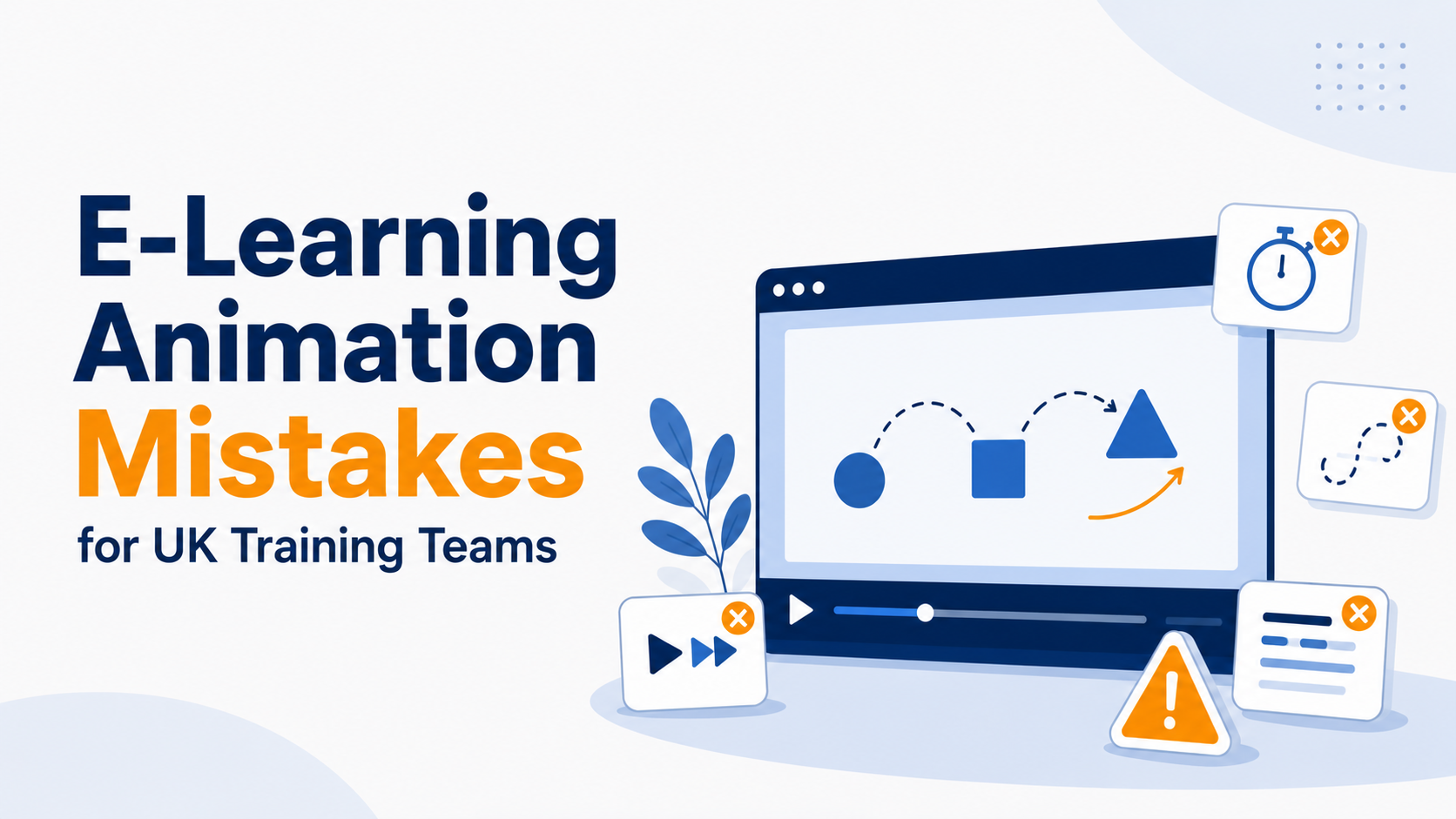
    E-Learning Animation Mistakes for UK Training Teams

    Animation can make e-learning easier to understand, particularly when learners need to grasp a process, system or idea that is difficult to explain with text alone. Used well, it can also add variety to workplace training and stop a module from becoming a sequence of static screens.

    But animation is not automatically effective just because it moves. For a UK organisation, whether you are developing compliance training for a local council, onboarding for a growing business or safety learning for a national workforce, every animated element should have a clear purpose. The right approach is to use motion to support learning, not to compete with it.

    Here are 10 common mistakes to avoid when using animation in e-learning.

    1. Making animations too long or complicated

    An animation should make a learning point easier to grasp, not turn a simple idea into a five-minute production.

    Long sequences can increase cognitive load and make it harder for learners to identify what matters. Where possible, keep each animation focused on one concept, process or decision.

    If a subject genuinely needs more explanation, consider breaking it into several shorter sections. This also makes it easier for employees to return to a specific topic later.

    2. Taking control away from the learner

    Self-paced learning works best when employees have some control over how they consume content. Animation should follow the same principle.

    Give learners sensible playback controls where appropriate, including pause, replay and rewind. Volume controls are also useful, particularly when employees may be completing training in an office, at home or in a shared workplace.

    Learner control can also support different levels of prior knowledge. Someone familiar with a process may want to move quickly, while a new starter may need to watch the explanation again.

    3. Letting visual effects become the main event

    Good animation does not need to look like a feature film. In corporate e-learning, the quality of the learning experience matters more than how many visual effects can be fitted onto the screen.

    Too many transitions, characters, colours or moving objects can pull attention away from the teaching point. A cleaner visual style is often more effective, especially for subjects such as compliance, policies or health and safety.

    The test is simple: if removing an animation would make the learning clearer, the animation probably needs reconsidering.

    4. Using a different visual style from the rest of the course

    Animation should feel like part of the course rather than something that has been dropped into it from somewhere else.

    Keep the visual language consistent across the module. Colours, typography, illustration styles, narration and tone should work together. The transition from an animated sequence back to an interaction, assessment or information screen should feel natural. For a closer look, read our guide to quality checks for e-learning.

    This is particularly important for bespoke e-learning because the course should reflect the organisation’s identity rather than looking like a collection of unrelated assets.

    5. Giving learners too much to process at once

    One of the easiest ways to weaken an animation is to put everything on screen simultaneously.

    A moving character, detailed diagram, background music, statistics, narration and paragraphs of text may all seem useful individually. Together, they can become distracting.

    Think about what the learner needs to see, hear and do at each point. If the narrator is explaining a process, the animation should reinforce that explanation rather than introduce several competing messages.

    6. Designing for the wrong audience

    An animation created for experienced managers will not necessarily work for apprentices or new employees. Equally, a highly simplified animation may frustrate a specialist audience.

    Before developing the animation, consider the learners’ existing knowledge, roles, working environment and likely expectations. A safety module for employees on a construction site, for example, may need a very different visual approach from leadership training for a professional services firm.

    Audience research can also help determine the right tone. The aim is to make the content accessible without making it feel childish or unnecessarily complicated.

    7. Forcing humour into the content

    Humour can work in e-learning, but it is difficult to get right across a diverse workforce.

    A joke that lands well with one group may fall flat with another. It can also distract from serious subjects, particularly where the training covers health and safety, conduct, data protection or other compliance requirements.

    If humour is used, it should support the learning rather than become the reason learners remember the animation. In many cases, a clear scenario or relatable workplace situation will create more engagement than a forced joke.

    8. Filling the screen with text

    Animation is a visual medium, so large blocks of text can defeat its purpose.

    Short labels, keywords and brief explanations can be useful. They can reinforce a message or make an important term easier to remember. However, if learners have to spend most of the animation reading paragraphs, they are likely to miss what is happening visually.

    A better approach is to decide what belongs in the narration, what should appear on screen and what the learner needs to interact with. Each element should have a job.

    9. Treating sound as an afterthought

    Animation is visual, but audio can add another layer of explanation and engagement.

    A well-produced voiceover can guide learners through a process, explain a diagram or provide context that would otherwise require more on-screen text. Carefully selected sound effects can also reinforce actions or transitions.

    Music should be used with restraint. It should not make narration difficult to hear or become repetitive during a longer learning sequence.

    For workplace learning, captions and transcripts should also be considered. They can support accessibility and make content more practical for employees who cannot or do not want to use audio. Our guide to designing for different learning preferences goes into more detail.

    10. Using local references that do not travel well

    UK e-learning should feel relevant to its audience, but there is a difference between making content relatable and filling it with niche references.

    An example based on a recognisable UK workplace situation can help learners understand a concept. However, slang, regional jokes or references that only make sense to one department or location can quickly date a course or exclude part of the workforce.

    For organisations operating across England, Scotland, Wales and Northern Ireland, this deserves particular attention. Keep examples familiar enough to feel relevant while making sure the underlying lesson remains clear to everyone.

    A UK-specific consideration: accessibility and compliance

    Accessibility should be considered from the storyboard stage, rather than added after the animation has been produced.

    Think about captions, transcripts, colour contrast, readable text, keyboard access and whether important information is communicated through movement alone. Reduced-motion considerations may also be appropriate for some learners.

    UK organisations also need to consider how personal information is handled when digital learning collects or processes learner data. The UK’s data protection framework is based on the UK GDPR and Data Protection Act 2018, so any learner data captured by a wider e-learning system should be handled appropriately. The wider point is that animation should form part of an accessible, well-designed learning experience, rather than being treated as a standalone visual extra.

    How to get more from animation in e-learning

    The most effective animations start with the learning objective. Before deciding what should move, ask what the learner needs to understand, remember or do differently after watching it.

    That might mean using a short animated explanation to simplify a complex process, a scenario to show the consequences of a workplace decision, or motion graphics to highlight information that would otherwise be difficult to visualise.

    For UK organisations developing bespoke training, animation can be combined with branching scenarios, interactive activities and AI-powered learning tools to create more personalised learning experiences. Capytech’s UK e-learning service, for example, includes bespoke animation as part of custom digital learning development. 

    Animation can also sit alongside a wider learning ecosystem. Organisations using an LMS can combine animated modules with assessments, reporting, instructor-led sessions and other forms of training. Capytech’s UK LMS offering supports SCORM, xAPI, video and other learning content alongside AI-powered learning features. 

    The goal is not to animate everything. It is to use animation where movement makes the learning clearer, more memorable or more engaging.

    Avoid these common mistakes, keep the learner at the centre of the design, and animation can become a valuable part of an effective UK e-learning programme.

    Frequently asked questions

    How long should an e-learning animation be?

    Keep animations short and focused on a single idea, usually well under two minutes. A 2014 study of online course videos by Philip Guo and colleagues found that viewers’ engagement dropped sharply once videos ran past about six minutes.

    Do e-learning animations need captions?

    Yes, if they include speech. WCAG accessibility guidelines require captions for prerecorded audio in video, and captions also help people watching without sound. Provide a transcript or text alternative for important visual information too.

    When should you use animation instead of video in e-learning?

    Animation works well for processes, concepts and things you cannot film easily, such as what happens inside a machine or how data moves. Real video is often better for showing people, places and real tasks.

    Should learners be able to pause and replay animations?

    Yes. Learners take in information at different speeds, and giving them control to pause, replay and skip helps understanding. Accessibility guidelines also expect users to be able to pause moving content.

    See your own training as e-learning, free

    Send us one document and we will turn it into an interactive demo module, so you can judge the quality before you spend anything.
  • How to Set the Right E-Learning Quiz Pass Mark in the UK 

    How to Set the Right E-Learning Quiz Pass Mark in the UK 

    Imagine an organisation rolling out mandatory safety training to 500 employees. A learner scores 80% on the final quiz, but the questions they got wrong relate to a high-risk procedure. Should they automatically pass?

    This is why choosing a pass mark for an e-learning quiz should involve more than selecting the default percentage in your LMS. The right threshold depends on what learners need to know, how difficult the assessment is, and what could happen if they get an important question wrong.

    An 80% pass mark might be appropriate for one course and completely unsuitable for another. So how do you decide?

    Begin With What Learners Need to Achieve

    The starting point should always be the learning objectives.

    Before writing the quiz, define what learners should know, understand or be able to do by the end of the training. The assessment should then test those outcomes directly.

    For example, if a course teaches employees how to identify phishing emails, the quiz should assess whether they can recognise the warning signs and respond correctly. Asking questions about minor details that do not relate to the learning objectives will tell you very little about actual competence.

    A useful sequence is to establish the learning objectives first, design assessment questions around those objectives, and then develop the course content that prepares learners for the assessment.

    This approach also makes quiz results more useful. Whether you are delivering training through the Capytech LMS or another learning platform, you can use assessment data to identify areas where learners may need additional support.

    Consider Risk Before Setting the Percentage

    Once your questions are written and aligned with the learning objectives, you can decide how demanding the pass mark needs to be.

    Not every question has the same importance. Consider the difference between training employees to use a new internal software application and training them to operate potentially dangerous equipment.

    Getting a software question wrong might mean the learner needs more practice. Getting a safety procedure wrong could contribute to a serious workplace incident.

    For higher-risk training, a higher level of demonstrated understanding may be appropriate. This is particularly relevant to organisations delivering health and safety training where competence has real-world consequences. Training aligned with HSE expectations, or specialised safety programmes such as IOSH-approved training, should be designed with the consequences of incorrect behaviour in mind.

    Difficulty matters too. A quiz where almost every question tests basic recall should not necessarily have the same pass mark as an assessment requiring learners to apply knowledge to realistic situations.

    Make the Pass Mark Fit the Purpose

    There is no universal percentage that works for every e-learning course.

    The right pass mark should reflect the purpose of the training, the difficulty of the assessment, the importance of the knowledge being tested and the level of risk involved.

    For example, a short awareness module might use a different threshold from a course designed to demonstrate practical competence. Similarly, training supporting a regulated qualification may have assessment requirements that are set by the relevant awarding or regulatory framework rather than by the organisation delivering the e-learning.

    Where training forms part of an Ofqual-regulated qualification, for example, the relevant qualification and awarding organisation requirements should take precedence. For internal workplace training, organisations generally have more flexibility to establish a suitable threshold.

    Check That the Assessment Is Fair

    A high pass mark does not automatically create a better assessment.

    If learners repeatedly fail, ask whether the problem is the pass mark, the course content or the questions themselves. Poorly worded questions, ambiguous answers or content that does not adequately prepare learners can make an assessment harder without making it more meaningful.

    Review quiz performance regularly. Look for questions that almost everyone gets wrong, as well as questions that everyone answers correctly. These patterns can indicate that a question needs to be rewritten or that the learning content needs improvement.

    AI-powered learning tools and data from an LMS can also support this review by helping learning teams identify recurring knowledge gaps and areas that may need further development.

    Be Clear About Expectations

    Learners should know the pass mark before they begin the assessment.

    This is particularly important when a high score is required or when failing means repeating part or all of the course. Clear expectations allow learners to understand what is required and encourage them to pay attention to the material rather than simply aiming to complete the module.

    The same principle applies when training is delivered through a wider learning programme. Whether your organisation uses custom e-learning, FastTrack or the Capytech LMS, assessment requirements should be clear and consistent.

    Review Your Pass Mark Over Time

    Setting a pass mark should not be a one-off decision.

    Once a course has been delivered to a reasonable number of learners, review the results. If most learners are failing particular questions, investigate why. If nearly everyone achieves 100%, consider whether the assessment is sufficiently testing the intended learning objectives.

    For UK employers, this can form part of a wider learning and development cycle. Assessment results can help inform refresher training, skills development and workforce capability, alongside approaches such as those promoted by CIPD and Investors in People.

    The aim is not to make quizzes unnecessarily difficult. It is to make sure that a pass genuinely means something.

    There Is No Magic Number

    An 80% default pass mark may be convenient, but convenience is not a good reason to use it for every course.

    A better approach is to start with the learning objectives, assess the importance and risk associated with the subject, consider the difficulty of the questions and make sure the assessment provides a fair measure of learning.

    For a UK organisation, the final threshold should also take account of any relevant qualification, awarding body or sector requirements.

    When the pass mark is designed around the purpose of the training, quiz results become more useful for both learners and learning teams. They provide a clearer indication of whether the training has achieved what it was designed to achieve.

    Frequently asked questions

    What is a good pass mark for an e-learning quiz?

    There is no single right number. Many organisations use 70 to 80 percent for general knowledge checks, but the pass mark should reflect what learners must be able to do and the risk if they get it wrong.

    Should compliance training have a higher pass mark?

    Often, yes. Where a mistake could cause harm, a breach or a fine, a higher pass mark makes sense, and some organisations require every question on critical points to be answered correctly. Low risk awareness training can use a lower threshold.

    How many attempts should learners get at an e-learning quiz?

    Most workplace courses allow more than one attempt, because the aim is learning rather than catching people out. Give feedback after each attempt and consider drawing questions from a bank so learners cannot simply memorise answers.

    How do you know if a pass mark is set correctly?

    Review the results after launch. If almost everyone passes first time the questions may be too easy, and if many fail the same question it may be unclear or the content may not cover it. Adjust questions as well as the threshold.

    See your own training as e-learning, free

    Send us one document and we will turn it into an interactive demo module, so you can judge the quality before you spend anything.
  • Using Kolb’s Learning Cycle for UK Workplace E-Learning

    Using Kolb’s Learning Cycle for UK Workplace E-Learning

    Imagine a new employee joining an NHS Trust, local council or private business. They can read a policy, complete a quiz and score 100%, but what happens when they face the same situation at work? Knowing the information is one thing. Knowing how to use it under pressure is another.

    This is where experiential learning becomes useful. David Kolb’s learning theory, first developed in the 1980s, puts experience and reflection at the centre of the learning process. While the theory and its associated learning styles have attracted criticism over the years, the underlying cycle still offers useful ideas for designing practical workplace e-learning.

    Rather than treating online training as a process of reading information and answering questions, organisations can design learning around four connected activities: experiencing something, reflecting on it, making sense of it and trying again in a new situation.

    What Is Kolb’s Experiential Learning Cycle?

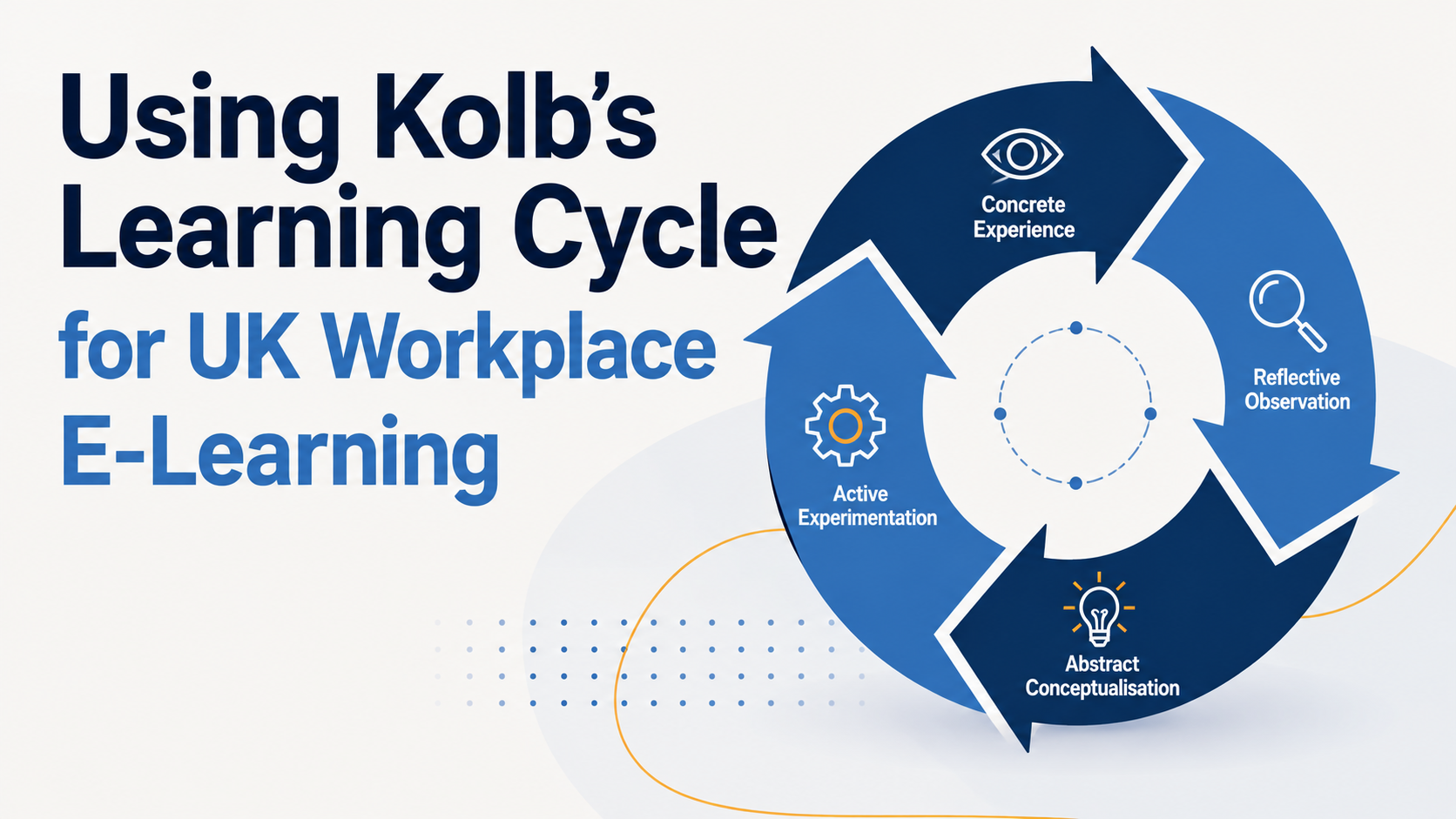
    Kolb’s model describes learning as a continuous cycle rather than a single event. A learner starts with an experience, thinks about what happened, develops an understanding or principle, and then tests that understanding through further action.

    The four stages are:

    Concrete Experience, where the learner encounters or performs an activity.

    Reflective Observation, where they consider what happened and why.

    Abstract Conceptualisation, where they develop an explanation, principle or broader understanding.

    Active Experimentation, where they apply that understanding to another situation.

    The important point for e-learning designers is that learners do not have to stop at knowledge acquisition. Digital training can give people opportunities to practise, reflect, receive feedback and apply what they have learnt.

    Start With a Realistic Learning Experience

    The first stage is Concrete Experience. In a traditional setting, this could involve a practical workshop, laboratory exercise, fieldwork or workplace task.

    Online learning cannot always reproduce a physical environment, but it can create realistic experiences through well-designed digital activities.

    A safety course, for example, might place an employee in a simulated workplace and ask them to identify hazards. A customer service programme could present a difficult conversation and ask the learner to decide how to respond. A management course might put a new supervisor into a scenario involving poor performance or team conflict.

    Video, animation, interactive exercises and branching scenarios can all help create this experience. Capytech’s custom e-learning approach can also incorporate AI-powered scenarios and interactive practice, allowing learners to make decisions rather than simply watch a presentation.

    For UK organisations, this could be particularly useful when training involves situations that are difficult, expensive or risky to reproduce in real life.

    Give Learners Time to Think About What Happened

    Experiencing a scenario is only the beginning. Kolb’s second stage, Reflective Observation, asks learners to consider the experience and examine their own decisions.

    What went well? What could have been handled differently? Which part of the situation was difficult? What information was missing?

    E-learning can support this through reflective questions, written responses, discussion activities, learner journals and facilitated forums. A course might ask an employee to explain why they selected a particular response before showing them an expert explanation.

    Social learning can add another dimension. Learners can compare their approaches with colleagues, discuss different outcomes and receive guidance from a tutor or subject matter expert.

    This is especially useful in management, leadership and behavioural training, where there may not be one simple answer to a workplace problem.

    Turn Reflection Into Understanding

    The third stage, Abstract Conceptualisation, is where the learner begins to form a broader understanding from the experience.

    Instead of simply remembering that one answer was correct, they start to understand the principle behind it.

    For example, a learner who has completed a difficult employee conversation might begin to recognise the importance of preparation, active listening and clear communication. A learner completing safety training might identify patterns that help them recognise hazards before an incident occurs.

    Digital learning can support this process with explanations, expert commentary, tutorials, reference materials and interactive activities. The aim is to help learners connect their experience with a wider concept that they can use elsewhere.

    This is also where instructional design matters. Content should not simply tell learners what they should know. It should help them understand why the knowledge matters and how it relates to their role.

    Put the Learning Into Practice

    Active Experimentation is the point at which the learner tests their new understanding.

    This could be as simple as completing another scenario with different circumstances. It could also involve a more complex simulation in which decisions lead to different outcomes.

    Consider a manager who has just completed training on handling difficult conversations. Rather than ending the module with a multiple-choice test, the next activity could present a different employee situation and ask the manager to choose an approach.

    The learner can then see the consequences of that decision, receive feedback and try again.

    Gamification can strengthen this stage by introducing challenges, scores, progress indicators or scenario-based goals. Used thoughtfully, these elements can make practice more engaging without turning the learning into a game for its own sake.

    Capytech’s custom e-learning services support features such as branching scenarios, gamification and AI-supported learning experiences, making this type of practical application possible within digital training.

    A UK Workplace Example: From Compliance to Behaviour

    Consider a UK organisation introducing workplace health and safety training.

    A conventional online course might explain the relevant procedures, show a few videos and finish with a knowledge test. That approach can confirm whether employees remember information, but it may not show whether they can apply it.

    A Kolb-inspired approach could begin with a realistic workplace scenario. The learner identifies a hazard and chooses what to do. They then review the consequences of their decision and reflect on what they might have missed.

    The course introduces the relevant safety principles and explains why the correct approach matters. The learner then faces a new scenario and applies those principles again. For a closer look, read our guide to applying Merrill’s principles.

    For health and safety programmes, this practical approach can sit alongside formal requirements and recognised training. Capytech provides online IOSH-approved safety training for UK organisations, with digital delivery allowing employees to complete learning without always requiring a classroom session. For a closer look, read our guide to IOSH training for UK teams online.

    The same principle can apply to leadership, customer service, data protection and other areas where workplace behaviour matters as much as knowledge.

    Kolb and Modern UK E-Learning Platforms

    A learning cycle also becomes easier to manage when the technology supports more than course completion.

    An LMS can provide the central environment for delivering activities, recording progress and identifying where learners need additional support. Capytech’s UK LMS offering includes features such as AI scenario creation, learner analytics, mobile access and support for different learning environments.

    For example, an organisation could use an LMS to deliver a scenario-based module, record assessment results, provide additional learning to employees who need it and track completion across departments.

    AI-powered learning tools can add further interaction. An AI Tutor can answer learner questions, while AI-driven scenarios can give employees opportunities to practise decisions in a more conversational setting.

    The technology should support the learning objective, though. Adding AI or gamification simply because it is available does not automatically make a course better. The experience still needs to reflect what learners actually need to do in their jobs.

    Where Kolb’s Model Works Best

    Kolb’s cycle is particularly relevant when learners need to apply knowledge rather than simply recall it.

    It can work well for leadership development, customer service, workplace safety, compliance, technical procedures and other subjects where decisions and behaviour are important.

    It is also useful for blended learning. An online module could provide the initial scenario and theory, followed by a workshop where employees discuss their experiences and practise the skill with colleagues. The learning platform can then provide follow-up activities to reinforce the behaviour.

    For organisations supporting continuing professional development, this creates a stronger connection between formal training and everyday work.

    Is Kolb’s Theory Still Useful?

    Kolb’s learning theory should not be treated as a perfect formula for how every individual learns. The learning-style element of the wider model has been questioned, and learners should not necessarily be placed into fixed categories.

    The more useful lesson is the emphasis on learning through experience, reflection, understanding and practice.

    For UK L&D teams, that provides a practical way to ask a simple question: does this training give employees enough opportunity to do something with what they have learnt?

    A course can contain accurate information and still have little effect on workplace behaviour. Adding realistic scenarios, reflection, explanation and repeated practice can make the connection between training and performance much stronger.

    Whether an organisation is developing bespoke e-learning, delivering IOSH-approved safety training or managing learning through an LMS, Kolb’s cycle can provide a useful framework for thinking about that connection.

    The goal is not to follow the model rigidly. It is to design learning that gives people a chance to experience, think, understand and practise, then take those lessons back into their working lives.

    Frequently asked questions

    What is Kolb’s learning cycle?

    Kolb’s experiential learning cycle, published by David Kolb in 1984, describes learning as four stages: concrete experience, reflective observation, abstract conceptualisation and active experimentation. People have an experience, reflect on it, draw a conclusion and then try it out, which starts the cycle again.

    How do you apply Kolb’s learning cycle in e-learning?

    Open with a realistic scenario so learners have an experience, then ask them to reflect on what happened and why. Introduce the principle or rule that explains it, and finish with a new situation where they apply it. Branching scenarios and short reflection questions work well for each stage.

    Why is Kolb’s learning cycle important for workplace training?

    It shows that people learn more from doing and reflecting than from being told. That suits adults at work, who bring their own experience and need to apply learning to real tasks rather than simply recall facts.

    Is Kolb’s reflective cycle the same as the Gibbs reflective cycle?

    No. Graham Gibbs built on Kolb’s work in 1988 with a six stage cycle (description, feelings, evaluation, analysis, conclusion and action plan) that structures reflection on a single event. Kolb’s cycle describes how learning happens overall, while Gibbs gives a step by step way to reflect.

    See your own training as e-learning, free

    Send us one document and we will turn it into an interactive demo module, so you can judge the quality before you spend anything.
  • Bloom’s Taxonomy for UK Workplace E-Learning Design

    Bloom’s Taxonomy for UK Workplace E-Learning Design

    Good workplace learning does more than help people remember information. It should give employees the confidence to apply new knowledge, solve problems, make informed decisions, and improve the way they work every day. That is why many UK organisations use instructional design frameworks that focus on measurable learning outcomes rather than simply delivering content. Our guide to Gagné’s nine events of instruction goes into more detail.

    Bloom’s Taxonomy remains one of the most widely recognised models for achieving this. Whether you are developing compliance training for an NHS Trust, onboarding new employees in a growing business, or creating leadership programmes for a national organisation, the framework provides a practical way to structure learning that builds competence over time.

    What Is Bloom’s Taxonomy?

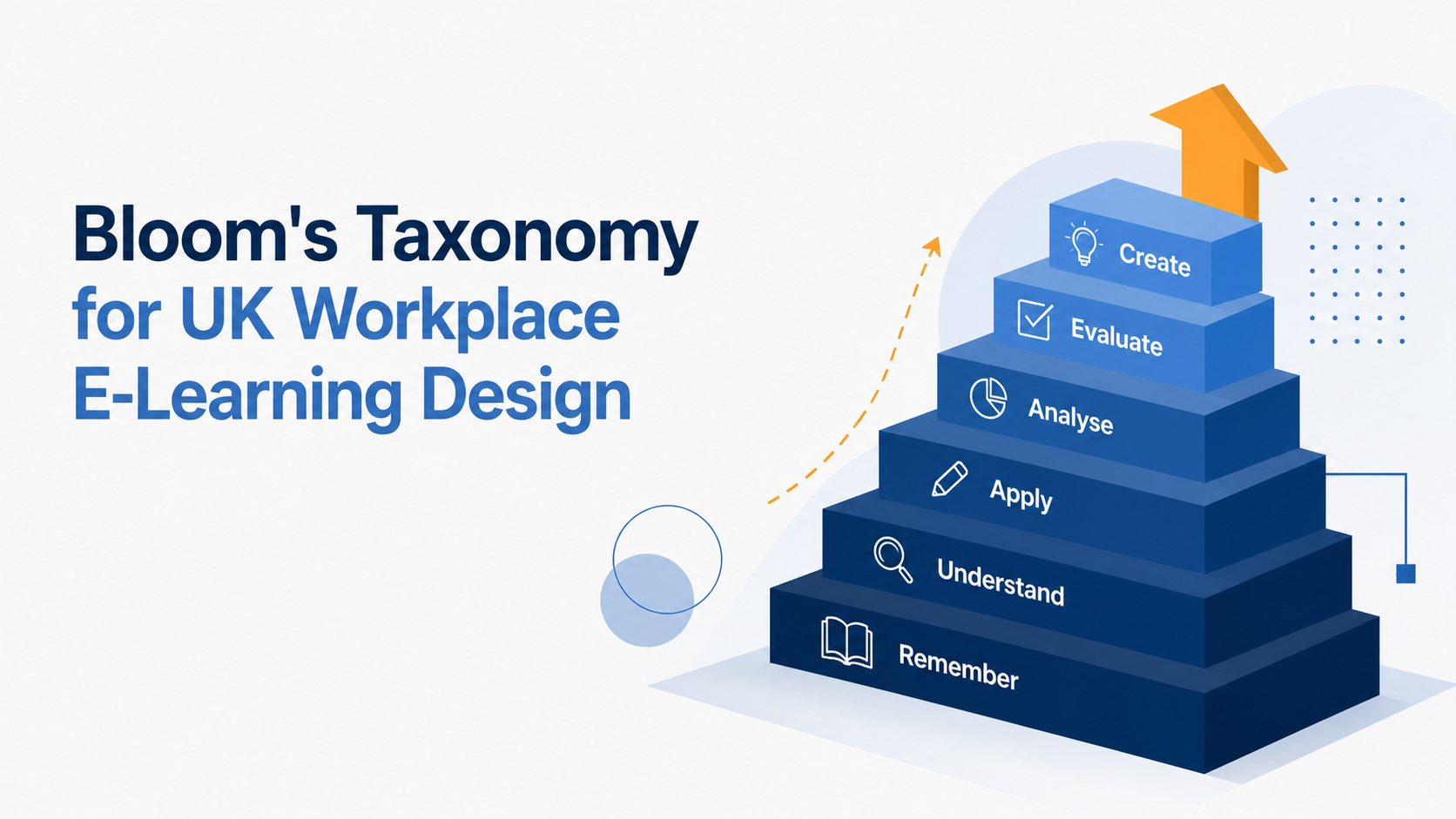
    Originally introduced in 1956 and revised in 2001, Bloom’s Taxonomy categorises learning into six progressive levels. Each stage represents a deeper level of understanding and capability, helping instructional designers create courses that move learners beyond memorising facts.

    The six stages are remembering, understanding, applying, analysing, evaluating, and creating.

    Although these stages are often presented as a hierarchy, they should not be viewed as a rigid sequence. Experienced employees may already possess the knowledge required at the earlier stages, allowing training to focus on higher-order thinking and workplace performance.

    For organisations investing in bespoke e-learning, Bloom’s Taxonomy offers a reliable structure for defining learning objectives, selecting suitable activities, and measuring success.

    Start With Clear Learning Outcomes

    One of the biggest strengths of Bloom’s Taxonomy is its ability to shape meaningful learning objectives.

    Rather than creating content because information needs to be shared, instructional designers begin by asking what learners should actually be able to do once the course is complete. This keeps training aligned with business objectives and helps organisations evaluate whether learning has translated into improved performance.

    For example, an induction programme should not simply expect employees to recall company policies. It should prepare them to apply those policies confidently in day-to-day situations.

    Building Knowledge That Lasts

    The first two levels, remembering and understanding, establish the foundations for future learning.

    Remembering focuses on retaining essential facts, terminology and procedures. Interactive media, short videos, diagrams and knowledge checks all help reinforce memory.

    Understanding moves learners beyond recall. At this stage they should be able to explain concepts in their own words, compare ideas, summarise information and recognise why procedures matter.

    Making content relevant is especially important here. Employees are more likely to retain knowledge when examples reflect realistic workplace situations rather than abstract theory.

    Turning Learning Into Practical Skills

    The third level, applying, is where training begins to influence workplace behaviour.

    Learners use their knowledge to complete tasks, follow procedures or solve familiar problems. Scenario-based learning is particularly effective because it mirrors situations employees are likely to encounter in their roles.

    A customer service adviser, for example, might practise responding to difficult conversations. A finance employee could complete realistic exercises based on internal approval processes. The objective is to build confidence before employees face these situations in real working environments.

    Developing Critical Thinking

    As learners become more capable, Bloom’s Taxonomy encourages them to think more critically.

    The analysing stage asks learners to identify patterns, examine evidence and determine why something has happened. Rather than following instructions, they investigate problems and identify relationships between different pieces of information.

    Evaluating builds on this by requiring learners to make informed judgements. Employees compare options, justify recommendations and explain the reasoning behind their decisions, even when there is no single correct answer.

    These higher-order skills are particularly valuable in leadership development, project management, healthcare, risk management and professional services, where sound judgement often matters as much as technical knowledge.

    Supporting Innovation Through Creation

    The highest level of Bloom’s Taxonomy is creating.

    Here, learners combine everything they have learnt to produce something new. That could involve designing a process, writing guidance, improving a workflow, proposing a new service or developing training materials for colleagues.

    For organisations investing in long-term capability, this stage represents genuine learning transfer. Employees are no longer following established processes. They are contributing ideas that improve the organisation itself.

    Applying Bloom’s Taxonomy in UK Organisations

    Many UK employers combine Bloom’s Taxonomy with practical workplace learning rather than relying solely on digital courses.

    Blended learning programmes often include mentoring, coaching, workplace practice and collaborative projects alongside e-learning. This approach supports continuous development while allowing employees to apply new knowledge in real situations.

    It also aligns well with guidance promoted by professional bodies such as the CIPD, which encourages organisations to measure learning through improved capability and business outcomes rather than course completion alone.

    For regulated sectors, including health and social care, construction and financial services, this approach helps ensure employees can demonstrate competence, not simply complete mandatory training.

    Bloom’s Taxonomy and Compliance Training

    Compliance training often receives criticism because employees see it as a box-ticking exercise. Bloom’s Taxonomy helps change that mindset.

    For example, training covering the UK GDPR and the Data Protection Act 2018 should not end with learners remembering legal definitions. Employees should understand how the legislation applies to their role, recognise potential risks, analyse realistic scenarios and make appropriate decisions when handling personal information.

    The same principle applies to health and safety training, safeguarding, equality training and cyber security awareness. Effective learning prepares employees to respond correctly when real situations arise, not simply answer multiple-choice questions.

    This is one reason many organisations pair frameworks such as Bloom’s Taxonomy with interactive custom e-learning, AI-powered learning tools and practical workplace activities that reinforce decision-making over time.

    Breaking Down the Cognitive Levels in Digital Learning

    It helps to see what each level looks like inside a digital module.

    Remembering focuses on retention. Clear text summaries, diagrams, explanatory audio and knowledge-check quizzes help staff recall internal policies, health and safety guidelines or product details. For a closer look, read our guide to overlearning in e-learning.

    Understanding asks staff to interpret what information means for their daily roles. Interactive modules, contextual examples and practical summaries help learners explain or compare core concepts accurately.

    Applying is where training starts to change behaviour. Branching scenarios and practical simulations let staff apply procedures, use software systems or handle routine customer interactions safely.

    Analysing requires a deeper look at complex topics. Advanced scenarios help learners break down multi-step problems, identify root causes and compare alternative approaches, which matters for technical decisions and risk assessments.

    Evaluating asks learners to make sound judgements where there is no straightforward answer, and to justify their choices against industry standards, internal guidelines or legal constraints.

    Creating is the highest level. Learners use what they know to draft new strategies, refine team workflows or design process improvements.

    Aligning Bloom’s Taxonomy With UK Compliance and Apprenticeships

    Mandatory updates on UK GDPR, the Data Protection Act 2018 or HSE safety regulations need more than surface memory. Staff must understand the concepts well enough to apply them correctly and avoid regulatory breaches.

    Organisations using the UK Apprenticeship Levy, or offering TQUK-accredited programmes, can also use the taxonomy to map training modules to the Knowledge, Skills and Behaviours (KSBs) an apprenticeship standard requires. That makes the training easier to evidence in internal reviews and inspections.

    Why Bloom’s Taxonomy Still Matters

    Despite being developed decades ago, Bloom’s Taxonomy continues to provide a practical framework for designing effective workplace learning.

    Its value lies in keeping training focused on outcomes rather than content alone. Instead of asking what information should be included, instructional designers ask what learners should be capable of doing afterwards.

    For organisations developing custom e-learning, implementing the Capytech LMS, or introducing AI-powered learning experiences, Bloom’s Taxonomy provides a proven structure that supports measurable learning, improved workplace performance and continuous professional development.

    When combined with thoughtful instructional design and opportunities for real-world practice, it helps transform training from a one-off event into lasting organisational capability.

    Frequently asked questions

    What is Bloom’s taxonomy?

    Bloom’s taxonomy is a way of classifying levels of thinking, first published by a group led by Benjamin Bloom in 1956. The revised version from 2001, by Lorin Anderson and David Krathwohl, uses six levels: remember, understand, apply, analyse, evaluate and create.

    What is Bloom’s taxonomy used for in training?

    It helps designers write clear learning objectives and match activities and assessments to the level of thinking the job really needs. A role that only needs recall can be trained differently from one that needs judgement and problem solving.

    How do you use Bloom’s taxonomy in assessment?

    Match each question to the level in the objective. Recall can be tested with simple multiple choice, but applying, analysing and evaluating need scenario questions where learners make decisions in a realistic situation.

    What are Bloom’s taxonomy verbs?

    They are action verbs linked to each level, such as list and define for remembering, explain for understanding, use and demonstrate for applying, compare for analysing, justify for evaluating and design for creating. Using them makes objectives observable and easier to assess.

    See your own training as e-learning, free

    Send us one document and we will turn it into an interactive demo module, so you can judge the quality before you spend anything.

  • Closing Knowledge, Skills and Motivation Gaps in UK Training

    Closing Knowledge, Skills and Motivation Gaps in UK Training

    Every successful workplace learning programme begins with a simple question. Why do employees need this training in the first place?

    Many organisations invest significant time and budget into e-learning without first identifying the real performance issue they are trying to solve. The result is often a course that delivers information but fails to change behaviour or improve performance. Whether you are training new starters, supporting compliance, or introducing new processes, understanding the gap you are trying to close should always come before designing the learning experience. For a closer look, read our guide to behaviour change in the workplace.

    Start by Identifying the Real Performance Gap

    When someone is not performing as expected, the answer is not always more training. In many cases, people already know what to do but choose not to do it, or they understand the theory but have not developed the confidence to apply it consistently.

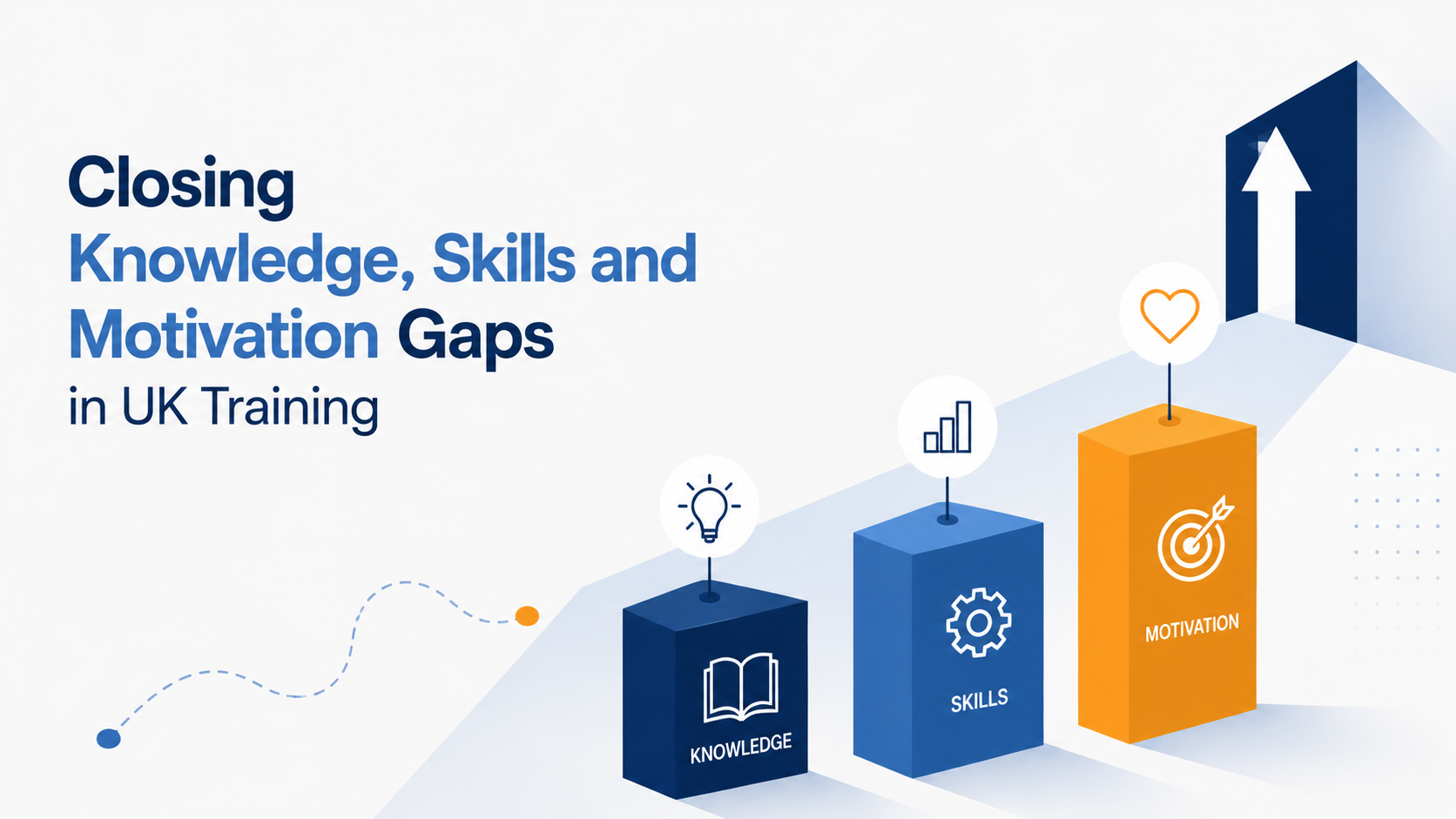
    Most workplace learning challenges fall into one of three areas. People either need new knowledge, they need to build practical skills, or they need stronger motivation to put what they already know into practice. Identifying which of these applies will shape every decision you make about the course, from the content to the activities and assessments.

    When Employees Need Better Knowledge

    A knowledge gap exists when learners need information they do not currently have. This often happens during onboarding, when introducing new products or services, or when communicating changes to legislation, internal policies, or business procedures. Our guide to planning employee onboarding training goes into more detail.

    However, providing facts alone rarely changes workplace performance. Employees are much more likely to remember information when they understand how it applies to their day-to-day responsibilities.

    For example, a sales team does not simply need a list of product features. They need to understand which customer problems the product solves, which conversations it supports, and how those benefits can be explained confidently during a sales meeting. Knowledge becomes more valuable when learners can see how to use it in realistic situations.

    Skills Require Practice, Not Just Information

    One of the most common mistakes in digital learning is treating skills as though they are simply another form of knowledge.

    A useful way to tell the difference is to ask whether learners can perform successfully immediately after receiving the information. If they need repeated practice before becoming competent, the gap is one of skill rather than knowledge.

    Presentation techniques, leadership conversations, customer service, software systems and safety procedures all require learners to apply what they have learnt. Reading about these activities is only the starting point. Confidence develops through realistic practice, feedback and repetition.

    This is why effective custom e-learning often includes branching scenarios, simulations and interactive exercises rather than relying solely on text or video content.

    Motivation Can Be the Missing Piece

    Sometimes employees already have the knowledge and the ability to perform well, yet their behaviour does not change.

    This motivation gap is frequently overlooked because it cannot be solved simply by adding more content. The underlying issue may be uncertainty about why a change is happening, lack of confidence, resistance to new ways of working, or limited understanding of how the change benefits both the organisation and the individual.

    Employees may also lose focus over time or become disengaged if previous training felt irrelevant.

    In these situations, the learning experience should explain the purpose behind the change, demonstrate its value, and encourage participation through relevant examples and engaging interactions. When people understand the reasons for change, they are far more likely to adopt new behaviours.

    Choosing the Right Learning Approach

    Once you have identified the type of gap, selecting the appropriate learning methods becomes much easier.

    Knowledge-based learning benefits from clear explanations, practical examples and opportunities to apply information in realistic contexts.

    Skills development should include activities that allow learners to practise repeatedly before applying their learning in the workplace. Interactive scenarios, simulations and AI-powered learning tools can all help learners build confidence in a safe environment. Our guide to Kolb’s learning cycle goes into more detail.

    Motivation-focused learning requires a different emphasis. The content should connect organisational objectives with individual benefits, explain expectations clearly and create an engaging experience that keeps learners involved from beginning to end.

    The most effective programmes often combine all three approaches because workplace performance rarely depends on a single factor.

    A UK Compliance Perspective

    Many UK organisations deliver mandatory training covering areas such as health and safety, information security and data protection. While these subjects often appear to focus on compliance, simply providing information is rarely enough.

    For example, employees handling personal information need to understand not only the principles of the UK GDPR and the Data Protection Act 2018, but also how to apply those principles in everyday situations. Similarly, health and safety training should help employees recognise hazards and make safe decisions rather than memorising regulations.

    This practical approach aligns with guidance from organisations such as the CIPD and the HSE, both of which promote learning that supports real workplace performance instead of simple knowledge recall.

    Designing Training That Delivers Results

    Successful e-learning is not measured by course completion alone. Its value comes from helping people perform better at work.

    Before creating any learning programme, spend time identifying whether the challenge is a lack of knowledge, a shortage of practical skills, or a problem with motivation. Once that question has been answered, every aspect of the learning design becomes more focused and more effective.

    Whether you are developing compliance training, leadership programmes or custom digital learning, matching the learning strategy to the actual performance gap gives learners a far better chance of applying what they have learnt and delivering measurable improvements across the organisation.

    Frequently asked questions

    What is a performance gap?

    A performance gap is the difference between what people are doing now and what the organisation needs them to do. Identifying the cause of the gap is the first step, because not every gap can be fixed with training.

    How do you tell if a problem is knowledge, skills or motivation?

    Ask whether the person could do the task if their job depended on it. If they could not, it is a knowledge or skills gap: knowledge if they do not know what to do, skills if they know but cannot yet do it well. If they could but do not, the cause is motivation or the environment.

    Can training fix a motivation gap?

    Only partly. Training can explain why something matters and build confidence, but motivation is also shaped by managers, workload, incentives and culture. If those work against the behaviour, training alone will not change it.

    What is a training needs analysis?

    A training needs analysis looks at the skills and knowledge a role needs, compares them with what people can currently do and identifies the gaps. It helps you decide what training is needed, who needs it and whether training is the right answer at all.

    See your own training as e-learning, free

    Send us one document and we will turn it into an interactive demo module, so you can judge the quality before you spend anything.
  • Writing Effective Learning Objectives for UK Workplace Training

    Writing Effective Learning Objectives for UK Workplace Training

    Many UK organisations invest in workplace learning with clear business goals in mind. They may want to improve compliance, develop leadership skills, reduce errors or help teams adopt new systems. Yet many training programmes fall short because employees are never told exactly what success looks like.

    That is where learning objectives make a difference. A well-written learning objective sets a clear expectation from the beginning. It explains what learners should be able to do after completing the course and gives trainers a practical way to measure whether the learning has achieved its purpose. Whether you are creating custom e-learning, delivering IOSH-approved safety training or rolling out courses through the Capytech LMS, clear objectives provide the foundation for effective learning.

    Start with the Outcome, Not the Content

    Many organisations begin by thinking about what information they want to include in a course. A better approach is to decide what learners should be capable of doing when the training finishes.

    For example, imagine a customer service programme. A vague objective might read:

    “After completing this course, you will understand good customer service.”

    Although this sounds reasonable, it is difficult to measure. How do you prove someone understands a topic?

    A stronger objective focuses on observable behaviour instead:

    “After completing this course, you will be able to resolve common customer enquiries using the organisation’s approved service process.”

    This version makes expectations clear and provides a practical standard against which performance can be assessed.

    Why Good Learning Objectives Matter

    Well-defined learning objectives benefit both learners and organisations.

    Learners understand why they are completing the training and what they are expected to achieve. This often increases engagement because the purpose of the course is obvious from the outset.

    For course designers, learning objectives help shape every decision. They influence the content, activities, assessments and scenarios that appear throughout the programme, reducing unnecessary material and keeping the course focused.

    They also make it easier to evaluate return on investment. When objectives describe measurable behaviours, organisations can compare employee performance before and after training instead of relying only on completion rates.

    What Makes a Strong Learning Objective?

    Effective learning objectives share several characteristics.

    They are specific enough that learners know exactly what success looks like. They use straightforward language that avoids misunderstanding and focuses on a single outcome. They are realistic, taking account of the learner’s experience and available time. Most importantly, they can be measured through observation, assessment or practical application.

    If an objective tries to cover too many skills, it is usually better to divide it into several smaller objectives. This approach works particularly well in modern microlearning programmes, where each short module focuses on one measurable outcome before moving to the next.

    A Practical Method for Writing Learning Objectives

    Creating effective objectives becomes much easier when you follow a logical process.

    Begin by understanding the organisational goal. Perhaps the business wants managers to conduct better performance reviews or reduce workplace incidents. That business objective should inform the training, but it should not become the learning objective itself.

    Next, think about the learners. Consider their existing knowledge, daily responsibilities and the level of improvement that is realistic.

    Finally, describe one behaviour the learner should demonstrate after training. Choose language that can be observed or assessed rather than words that describe internal understanding.

    Using Bloom’s Taxonomy to Choose Better Action Verbs

    Bloom’s Taxonomy remains one of the most widely used frameworks for writing learning objectives. Originally developed by educational psychologist Benjamin Bloom and later revised, it helps instructional designers match objectives to different levels of learning.

    Each level suggests action verbs that are easier to assess than broad terms such as “know” or “understand”.

    The six levels are:

    Remember focuses on recalling information, such as company procedures or safety rules. Multiple-choice assessments often work well for this level.

    Understand involves explaining ideas or describing processes. Learners might summarise a policy or explain how a product works.

    Apply asks learners to use new knowledge in practical situations. For example, they may complete a task using newly introduced software or follow a revised operating procedure.

    Analyse requires learners to examine information, identify patterns or compare options. A manager interviewing candidates or reviewing workplace data would be working at this level.

    Evaluate involves making informed judgements. Learners may assess risks, review business performance or recommend improvements based on evidence.

    Create represents the highest level, where learners produce something original. This could include writing a project plan, designing a customer journey or preparing a marketing proposal.

    Selecting the right action verb makes objectives clearer and makes assessment much easier.

    Align Learning Objectives with UK Workplace Requirements

    Many UK organisations deliver training that supports legal or professional responsibilities. In these situations, learning objectives should reflect the standards employees are expected to meet in their roles.

    For example, compliance programmes may support responsibilities under the UK GDPR and the Data Protection Act 2018, while health and safety training may reinforce HSE guidance. Leadership programmes often align with frameworks promoted by the CIPD, helping organisations develop consistent management capability.

    Connecting learning objectives to recognised UK standards helps learners understand why the training matters and provides managers with meaningful measures of success.

    Write Objectives Before Building the Course

    One of the most common mistakes in e-learning development is writing learning objectives after the content has already been created.

    The opposite approach produces better results. Define the objectives first, then build every activity, assessment and scenario around them.

    This keeps the course focused and avoids adding content that does not contribute to the intended outcome. It also makes future updates easier because every part of the programme has a clear purpose.

    Whether you are developing a custom e-learning solution or delivering training through the Capytech LMS, strong learning objectives provide a clear direction from the first planning meeting through to learner assessment.

    Final Thoughts

    Learning objectives may only take a short time to write, but they influence every stage of course development. They give learners a clear destination, help designers make better content decisions and allow organisations to measure whether training has delivered real improvements.

    When objectives are specific, measurable and centred on learner performance, workplace training becomes easier to evaluate and far more likely to produce lasting results.

    Frequently asked questions

    What is the difference between learning objectives and learning outcomes?

    A learning objective states what the training is designed to achieve, written from the learner’s point of view before the course is built. A learning outcome describes what the learner can actually do once the training is finished, and is what you assess. In practice, well written objectives become the outcomes you measure.

    How do you write a good learning objective?

    Start with who the learner is, then use a single action verb that can be observed, the conditions they will work under and the standard they must meet. For example: by the end of the module, a supervisor will be able to complete a risk assessment for a new task using the company template, with no hazards missed. Avoid verbs such as understand or know, because you cannot see or measure them.

    How many learning objectives should a course have?

    Most short workplace modules work best with three to five objectives. If you have many more, the course is probably trying to do too much and should be split into smaller modules.

    How do you use Bloom’s taxonomy to write learning objectives?

    Bloom’s taxonomy gives you action verbs for each level of thinking, from remembering and understanding up to analysing, evaluating and creating. Choose the level the job really needs, then pick a verb from it, such as identify for recall or prioritise for evaluation. Our guide to Bloom’s taxonomy for workplace e-learning shows how.

    See your own training as e-learning, free

    Send us one document and we will turn it into an interactive demo module, so you can judge the quality before you spend anything.

  • The ADDIE Model for Instructional Design in UK Workplace Learning

    The ADDIE Model for Instructional Design in UK Workplace Learning

    Many UK organisations are investing more in digital learning, whether they are onboarding new employees, delivering compliance training or supporting professional development. Yet successful e-learning is about much more than attractive content. Without a structured design process, even well-produced courses can fail to improve knowledge or change behaviour.

    That is why instructional design models remain an important part of learning and development. Among the best known is the ADDIE model, a practical framework that helps organisations plan, build, deliver and improve learning programmes. Although it has existed for decades, it continues to support modern e-learning projects across both the public and private sectors.

    Why instructional design still matters

    Instructional design is the process of creating learning experiences that help people gain knowledge and apply it in their day-to-day work. Effective learning does not happen by chance. Every decision, from course structure to assessment methods, should support a clear learning objective.

    Rather than following guesswork, learning teams use instructional design models to organise the development process. ADDIE remains one of the most widely recognised because it provides a logical framework while allowing flexibility throughout a project. For a closer look, read our guide to using Gagné’s nine events.

    What does ADDIE stand for?

    ADDIE represents five connected stages of instructional design:

    Analyse

    Design

    Develop

    Implement

    Evaluate

    Although these stages are often shown in sequence, they are not intended to be completed only once. Most modern learning projects revisit earlier stages as new information becomes available, making ADDIE compatible with iterative development methods.

    Starting with analysis

    Strong e-learning begins with understanding the problem that needs solving. Before any content is written, organisations should identify the skills gap, define measurable learning objectives and understand what learners already know.

    This stage also involves understanding the audience. Employees in an NHS Trust, for example, will have different learning needs and expectations from staff working in a manufacturing business or local council. Their experience, motivation and working environment should all influence the final course design.

    Analysis should also consider how success will be measured. Whether the aim is improved compliance, better customer service or increased productivity, learning outcomes need to support wider organisational goals.

    Many organisations also assess internal capability during this phase. Deciding which work should be completed in-house and which elements are better delivered by a specialist e-learning partner can save both time and cost.

    Designing an effective learning experience

    Once the objectives are clear, attention turns to designing the learning journey.

    Subject matter experts help ensure technical accuracy, while instructional designers create the overall structure, learner flow and assessment strategy. This is also the stage where decisions are made about learning approaches, such as microlearning, blended learning or scenario-based activities.

    Existing training resources may be suitable for updating rather than replacing entirely. New visual assets, videos, animations or interactive elements can then be produced where required. Wireframes, storyboards and prototypes help gather feedback before full development begins, reducing unnecessary revisions later.

    Bringing the course to life

    The development phase transforms the design into a working e-learning course.

    Content is written, interactive exercises are created and assessments are built into the learner experience. Practical scenarios, knowledge checks and quizzes all help reinforce learning and encourage learners to apply what they have learnt.

    Quality assurance also becomes a priority at this stage. Courses should be tested across different browsers, devices and accessibility settings to ensure learners receive a consistent experience.

    For organisations developing bespoke learning programmes, this is often where AI-powered learning tools can support faster content production while maintaining instructional quality. Platforms such as the Capytech LMS can also simplify course management, learner tracking and reporting once development is complete.

    Rolling out training successfully

    A well-designed course still needs careful implementation.

    Learners need clear communication about why the training matters, how it supports their role and what is expected of them. Managers and senior leaders often play an important role by encouraging participation and reinforcing learning after completion.

    Some organisations begin with a pilot group before launching to the wider workforce. Feedback from early users can identify usability issues or content improvements before a full rollout.

    It is also important to remove barriers that could prevent successful completion, whether those involve technical access, digital confidence or scheduling training around operational demands.

    Measuring success and improving future learning

    Evaluation should not be treated as the final box to tick. Instead, it provides evidence that helps improve both the current course and future learning projects.

    Completion rates and quiz scores offer useful information, but they tell only part of the story. Organisations should also look for changes in workplace behaviour, operational performance and business outcomes. Learner feedback adds valuable context, but measurable improvements against the original objectives provide the strongest indication of success.

    Many organisations continue monitoring performance weeks or months after training to understand whether knowledge has been retained and applied in practice.

    ADDIE in a UK learning and compliance environment

    UK organisations often need to balance learning quality with regulatory responsibilities. During the analysis and design stages, it is sensible to consider how learner information will be collected, stored and reported in line with the UK GDPR and the Data Protection Act 2018.

    For regulated sectors, learning content may also need to align with guidance from bodies such as the HSE, Ofqual or the CIPD, depending on the subject area. Building these requirements into the project from the beginning reduces the need for significant revisions later.

    Where organisations are delivering workplace safety programmes, structured instructional design also supports the development of high-quality IOSH-approved safety training that is both engaging and compliant.

    Is ADDIE still relevant?

    Some people argue that ADDIE belongs to a more traditional approach to learning design because agile development encourages continuous iteration rather than fixed project stages.

    In practice, however, the two approaches work well together. Few learning teams follow ADDIE as a strict linear process. Instead, they revisit earlier stages whenever testing, stakeholder feedback or learner insights suggest improvements.

    The framework simply provides a logical order for making decisions. It ensures learning objectives come before content creation, learner needs are understood before development begins, and evaluation informs future improvements.

    A practical framework that continues to deliver

    The popularity of ADDIE comes from its simplicity rather than rigid rules. It gives organisations a reliable structure for planning learning projects while leaving enough flexibility to adapt throughout development.

    Whether you are creating compliance training, leadership programmes or technical learning, the ADDIE model helps keep learners, business objectives and measurable outcomes at the centre of every decision. Combined with custom e-learning, modern learning platforms and AI-supported development, it remains one of the most effective frameworks for producing learning that delivers lasting results.

    Frequently asked questions

    What does ADDIE stand for?

    ADDIE stands for Analysis, Design, Development, Implementation and Evaluation, the five stages of building a training programme. It grew out of work at Florida State University for the US military in the 1970s and is still the most widely used instructional design framework.

    How do you apply the ADDIE model to workplace training?

    Start by analysing the performance problem and the learners, then design objectives and assessments before building anything. Develop the materials, roll them out with support for managers and learners, and evaluate whether behaviour and results changed so you can improve the next version.

    Is ADDIE still relevant?

    Yes, as long as it is not run as a rigid one way process. Most teams now loop through design, development and review in short cycles, testing early versions with real learners. The value of ADDIE is that it forces you to analyse the need and plan the evaluation before spending money on content.

    What is the difference between ADDIE and SAM?

    SAM, the Successive Approximation Model created by Michael Allen, is a more iterative alternative that builds quick prototypes and refines them through repeated review. ADDIE is more sequential. In practice many projects borrow from both, using ADDIE’s structure with SAM style prototyping.

    Is ADDIE the same as DSAT?

    They are close relatives. The Defence Systems Approach to Training used across UK Defence follows a similar cycle of analysis, design, delivery and assurance, with set documents at each stage. Our guide to JSP 822 and DSAT explains how it works for defence suppliers.

    See your own training as e-learning, free

    Send us one document and we will turn it into an interactive demo module, so you can judge the quality before you spend anything.

  • Using Gagné’s Nine Events for Better UK E-Learning Design

    Using Gagné’s Nine Events for Better UK E-Learning Design

    Many UK organisations invest in workplace learning with a clear goal, helping employees perform better in their roles. Yet even well-designed digital training can struggle if learners lose interest, forget key information, or cannot apply what they have learnt once they return to work.

    That is why instructional design frameworks remain so valuable. Rather than focusing only on attractive visuals or technology, they provide a structured way to guide learners from first engagement through to long-term knowledge retention. One of the most widely used frameworks is Robert Gagné’s Nine Events of Instruction, a model that continues to shape effective e-learning design across corporate learning, higher education and professional development in the UK. For a closer look, read our guide to ADDIE for instructional design.

    Why Gagné’s instructional model still matters

    Educational psychologist Robert Gagné developed his instructional model around the way adults process and retain information. Instead of treating learning as a single event, he proposed a sequence of instructional activities that help learners build understanding step by step.

    Although the framework was created long before digital learning became common, its principles translate exceptionally well to modern online training. Whether you are creating compliance training, onboarding programmes or leadership development, the model provides a logical structure that supports learner engagement from beginning to end.

    Rather than viewing these as rigid rules, many instructional designers use Gagné’s nine events as a flexible framework that can be adapted to different audiences, industries and learning platforms.

    Building engagement before teaching begins

    The first stage is attracting learners’ attention. If learners begin a course distracted or unconvinced of its value, everything that follows becomes more difficult.

    Attention can be captured long before the course opens. A short introduction from a manager, a realistic workplace problem, or an intriguing question in a launch email can all prepare learners for what is ahead. Once inside the course, storytelling, animation, scenarios or surprising statistics can encourage learners to focus.

    The next step is making expectations clear. Learners should understand not only what they will study, but why it matters to their own role. Explaining the practical benefits creates stronger motivation than simply listing learning objectives. It also helps to explain how progress will be measured throughout the course.

    Connecting new knowledge with existing experience

    Adults rarely begin training with no previous knowledge. One of Gagné’s strengths is recognising that learners understand new ideas more easily when they connect them to experiences they already have.

    This can be achieved through reflective questions, short knowledge checks or realistic workplace examples before introducing new material. Asking learners to think about previous situations encourages them to build on familiar concepts instead of memorising isolated facts.

    Once that foundation has been established, the main learning content can be introduced. Information should be organised into manageable sections rather than presented as long blocks of text. Short learning modules, interactive media and carefully paced explanations help learners absorb information without becoming overloaded.

    Supporting learners as they practise

    Presenting information is only part of effective learning. Learners also need guidance that helps them apply new knowledge correctly.

    Scenario-based learning is particularly useful because it allows people to make decisions in situations that mirror real working environments. Worked examples, practical demonstrations and hints throughout the course all reduce uncertainty while building confidence.

    Learners should then have opportunities to demonstrate what they have understood. Interactive exercises, branching scenarios, simulations and quizzes encourage active participation instead of passive reading. The more learners retrieve and apply information, the more likely they are to remember it later.

    Feedback and assessment should work together

    Immediate feedback is one of the greatest strengths of digital learning. Rather than simply telling learners whether an answer is correct, good feedback explains why an answer is right or wrong and provides additional context where needed.

    As learners progress, formal assessment confirms whether the intended learning outcomes have been achieved. These assessments should reflect real workplace performance rather than testing memory alone. If the aim is to improve decision making or practical skills, assessments should mirror those expectations.

    Combining regular feedback with meaningful assessment gives learners confidence while helping organisations measure the effectiveness of their training programmes.

    Helping learning continue after the course ends

    Completing an e-learning course should not mark the end of the learning process.

    The final stage of Gagné’s model focuses on helping learners retain and apply their knowledge. Refresher resources, searchable learning libraries, follow-up activities and practical workplace tasks all reinforce learning after formal training has finished.

    Modern learning platforms also make it easier for employees to revisit short learning modules whenever they need a reminder. This ongoing access helps reduce knowledge decay and encourages continuous improvement rather than one-off completion.

    Applying Gagné’s model in UK workplace learning

    For UK employers, Gagné’s framework works particularly well alongside modern digital learning strategies. Organisations developing training for sectors such as healthcare, manufacturing, financial services or local government often combine the model with custom e-learning, scenario-based learning and AI-powered learning tools to create more engaging experiences.

    For regulated industries, training also needs to support wider organisational responsibilities. Whether developing health and safety programmes, compliance learning or management development, courses should reflect UK employment law and, where personal information is processed, comply with the UK GDPR and the Data Protection Act 2018.

    Many learning and development teams also use this structured approach when supporting wider professional development initiatives recognised by organisations such as the CIPD or when building evidence for Investors in People accreditation. The framework provides consistency while remaining flexible enough for different learning objectives.

    Bringing the nine events together

    Gagné’s Nine Events of Instruction remain popular because they focus on how people actually learn rather than how technology works.

    The framework encourages designers to gain attention, provide meaningful guidance, create opportunities for practice, deliver useful feedback and reinforce learning long after a course has ended. Combined with thoughtful instructional design and modern digital learning techniques, these principles continue to help UK organisations create training that employees remember and use in their everyday work.

    Whether you are developing onboarding, compliance programmes or specialist workplace training, Gagné’s model offers a practical foundation for creating learning experiences that achieve measurable results.

    Frequently asked questions

    What are Gagné’s nine events of instruction?

    They are: gain attention, inform learners of the objectives, stimulate recall of prior learning, present the content, provide learning guidance, elicit performance (practice), provide feedback, assess performance, and enhance retention and transfer to the job. Following them in order gives each lesson a clear structure from start to finish.

    Who was Robert Gagné?

    Robert Gagné was an American educational psychologist whose book The Conditions of Learning, first published in 1965, set out the nine events. He also worked on training design for the US military, which is why the model is so practical.

    How do you use Gagné’s nine events in e-learning?

    Use them as a checklist for each lesson: open with a question or scenario, state the objectives, link to what learners already know, then present content with examples. Add practice with feedback, a short assessment and a final step that connects the lesson to the learner’s job.

    How do Gagné’s nine events compare with Merrill’s principles?

    Gagné gives a step by step sequence for a single lesson, while Merrill’s First Principles centre the whole course on real tasks. They work well together. See our guide to Merrill’s principles of instruction.

    See your own training as e-learning, free

    Send us one document and we will turn it into an interactive demo module, so you can judge the quality before you spend anything.