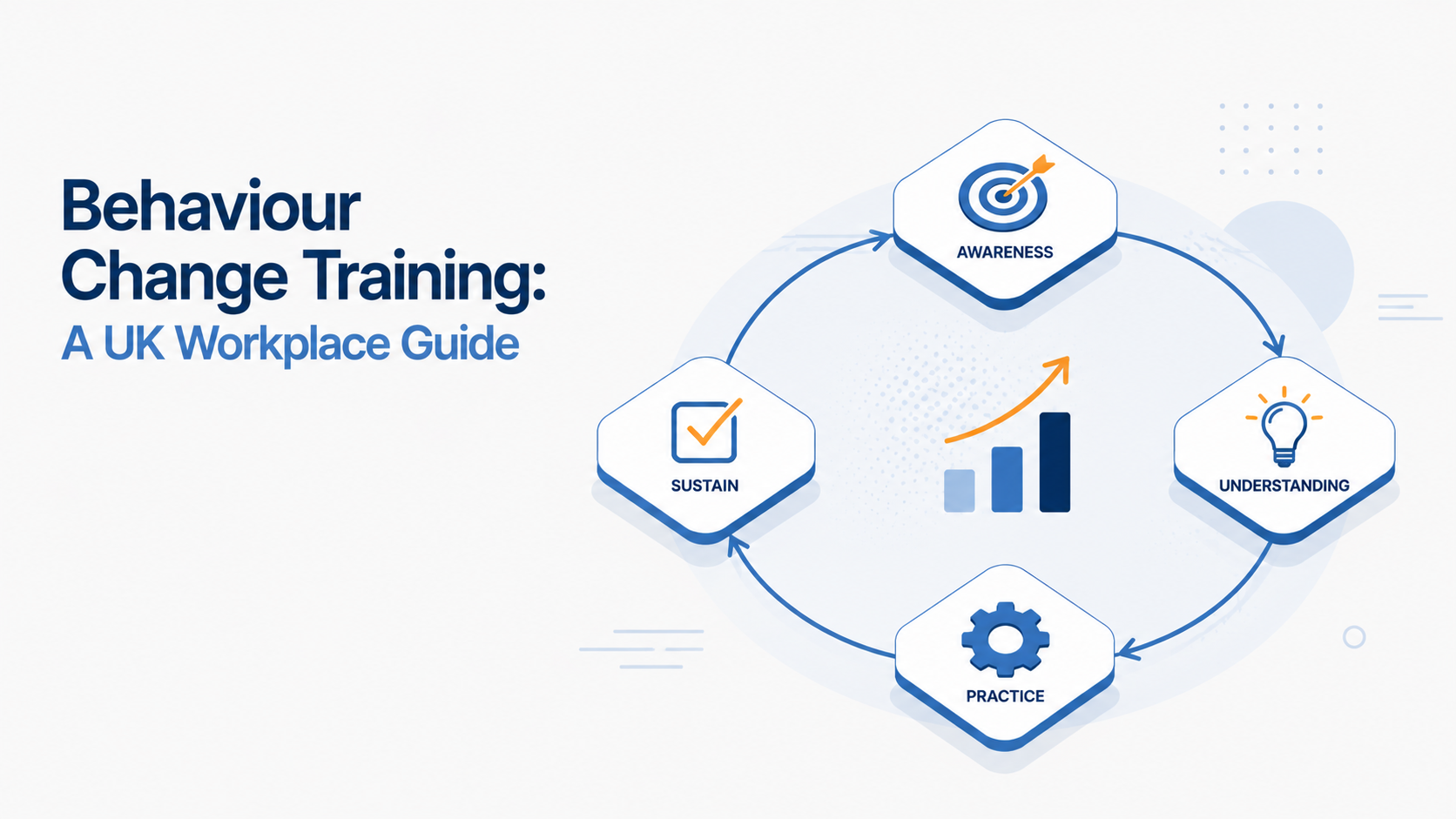

Many UK organisations invest heavily in learning and development, yet still struggle to see meaningful changes in workplace behaviour. Employees complete courses, pass assessments, and receive certificates, but old habits often return within weeks.
Whether you’re introducing new safety procedures, improving customer service standards, or supporting management development, the real measure of success is what people do differently afterwards. Training can start that process, but lasting behaviour change requires a broader approach.
Define the Behaviour Before Designing the Training
One of the most common mistakes in workplace learning is focusing on content before identifying the behaviour that needs to change.
Before creating a course, take time to analyse the gap between current and desired performance. What specific actions need to improve? Which behaviours are creating risk, reducing productivity, or affecting customer outcomes?
Starting with clear behavioural objectives helps ensure training addresses the real issue rather than simply increasing knowledge. Employees may already know what they should do. The challenge is often helping them apply that knowledge consistently in their day-to-day work.
Make Learning Relevant to Everyday Work
People are more likely to change their behaviour when they can see a direct connection between the training and their role.
Generic learning programmes often struggle to gain engagement because employees cannot see how the content applies to their responsibilities. Using realistic workplace scenarios, role-specific examples, and practical activities helps learners understand how the desired behaviour fits into their daily routines.
This is particularly important for compliance, health and safety, and management training, where employees need to apply learning immediately rather than simply remember information for a test.
Build a Workplace Culture That Supports Learning
Training cannot operate in isolation. The wider culture of the organisation plays a significant role in determining whether behavioural change lasts.
When leaders actively support learning, discuss development goals, and demonstrate expected behaviours themselves, employees are more likely to follow suit. Organisations that treat learning as an ongoing process tend to achieve stronger outcomes than those that view training as a one-off event.
This is one reason why frameworks promoted by organisations such as the CIPD and Investors in People place strong emphasis on continuous development rather than isolated training interventions.
Reinforce Learning After the Course Ends
Completing a course should not mark the end of the learning journey.
Employees need opportunities to revisit key concepts, refresh their knowledge, and reinforce new behaviours over time. Without reinforcement, people naturally revert to familiar habits.
Digital learning platforms can help by providing ongoing access to training materials, refresher modules, and supporting resources. Organisations using custom e-learning and learning management systems often find that regular reinforcement significantly improves long-term retention and application.
Microlearning can be particularly effective. Short, focused learning experiences are easier to revisit and fit naturally into busy working schedules.
Deliver Learning at the Point of Need
Timing has a major influence on behavioural change.
Employees are often most receptive to learning when they face a challenge or need to perform a task immediately. Providing learning resources at the point of need allows individuals to access guidance when it is most relevant.
For example, a manager preparing for a difficult performance conversation may benefit more from a five-minute refresher module accessed that morning than from a workshop completed six months earlier.
This just-in-time approach helps bridge the gap between learning and action, making behaviour change more likely.
Encourage Peer Learning and Knowledge Sharing
Workplace behaviour is strongly influenced by colleagues.
When employees see peers adopting new practices and achieving positive results, they are more likely to follow the same approach. Encouraging teams to share experiences, discuss lessons learnt, and highlight successful outcomes can strengthen the impact of formal training programmes.
Knowledge sharing also helps embed learning into everyday conversations rather than limiting it to scheduled training sessions.
Use Managers to Support Behaviour Change
Line managers have a greater influence on behaviour than most training programmes.
Managers observe performance, identify barriers, and provide ongoing coaching. Their involvement helps employees understand whether they are meeting expectations and where improvements are still needed.
For this reason, managers should be involved before, during, and after training takes place. Clear communication about expected behaviours, combined with regular feedback, creates accountability and keeps development on track.
Without that support, even well-designed learning programmes can struggle to achieve lasting results.
A UK Compliance Perspective
For organisations operating in the UK, behaviour change is often linked directly to compliance and risk management.
Health and safety training, for example, must lead to safe working practices rather than simply course completion. The same principle applies to data protection training, where organisations need employees to follow procedures that support compliance with the UK GDPR and the Data Protection Act 2018.
Regulators and inspectors are increasingly interested in evidence that learning translates into workplace practice. Measuring behavioural outcomes, rather than attendance alone, provides a stronger indication of training effectiveness.
Turning Learning Into Lasting Results
The most effective workplace training programmes focus on what happens after learning, not just during it.
Successful behaviour change starts with clear objectives, relevant content, and strong leadership support. It continues through reinforcement, timely learning opportunities, knowledge sharing, and regular feedback from managers.
Training remains an important part of the process, but lasting change comes from creating an environment where employees can practise, apply, and strengthen new behaviours over time. When those elements work together, organisations are far more likely to see measurable improvements in performance.
See your own training as e-learning, free
Send us one document and we will turn it into an interactive demo module, so you can judge the quality before you spend anything.