Tag: training

  • Hybrid Workplace Training Strategies for UK Organisations

    Hybrid Workplace Training Strategies for UK Organisations

    For many UK organisations, hybrid working is no longer an experiment. Teams may be based across Manchester, Birmingham, London or elsewhere in the country, with employees dividing their working week between home and the workplace. That flexibility can support productivity and employee wellbeing, but it also changes how people learn.

    Training that worked well when everyone was in the same office from Monday to Friday may not work as effectively when employees have different schedules, locations and levels of access to colleagues. Learning and development teams therefore need to rethink not just where training happens, but how learning fits into everyday working life.

    The good news is that hybrid working does not require organisations to abandon established training objectives. It does mean adapting the way those objectives are delivered. The following strategies provide a practical starting point for building a training and development approach that works for a UK hybrid workforce.

    Make digital learning part of the core training strategy

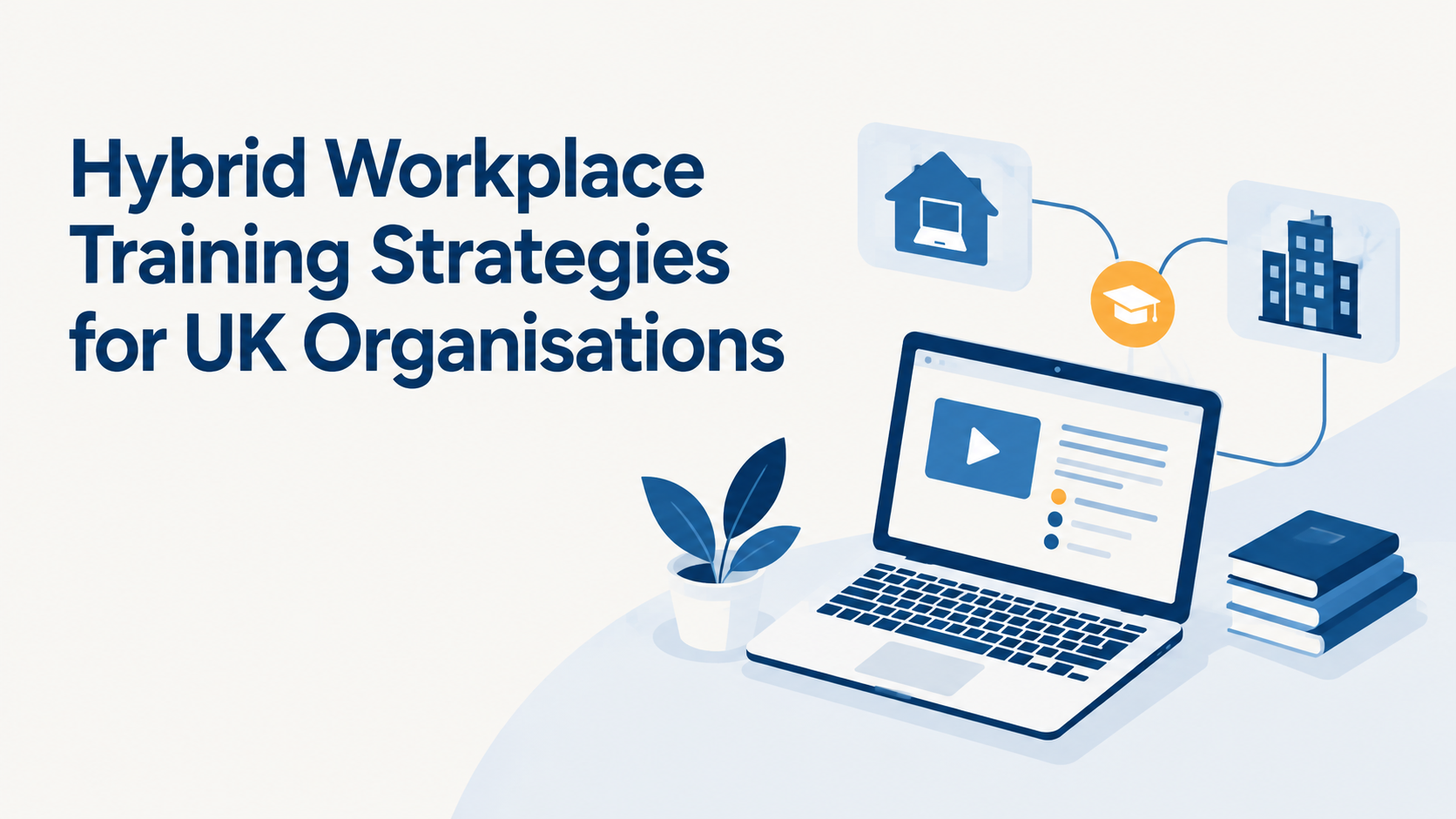
    E-learning is well suited to hybrid working because employees can access training without needing to be in the same location at the same time. A member of staff working from home in Leeds can complete the same course as a colleague working from an office in Bristol, without either having to attend a training room.

    If your organisation has limited digital learning provision, this is a good time to expand it. Custom e-learning can be particularly useful for mandatory training, compliance topics, onboarding, product knowledge and role-specific development.

    An LMS such as the Capytech LMS can also provide a central place to assign courses, monitor progress and manage learning across distributed teams.

    Digital learning does not have to mean replacing every other form of training. A blended approach can combine e-learning with virtual sessions, coaching, workshops and face-to-face activities where they add value.

    Be more selective about face-to-face training

    Hybrid working does not mean that classroom training has no place. In fact, bringing people together occasionally can be useful, particularly when the objective involves collaboration, discussion or team development.

    The key is to consider why people need to be physically present.

    If employees are attending a session simply to sit through information that could be delivered through an e-learning course, the arrangement may not make much sense. Online learning can provide the information beforehand, leaving face-to-face time for practical activities, problem-solving and discussion.

    This approach can also make office-based training days more worthwhile. Rather than asking employees to travel to a training centre for content they could complete online, organisations can reserve in-person sessions for activities that genuinely benefit from being together.

    Give managers the skills to lead hybrid teams

    Managers have an important role in making hybrid working successful, yet managing a distributed team can require a different approach from managing people who are always in the same office.

    A manager cannot rely on seeing employees at their desks or observing how they spend each working day. Instead, performance needs to be assessed through objectives, outcomes and the quality of work produced.

    Manager development should therefore cover areas such as setting expectations, giving feedback, supporting remote employees, managing workloads and maintaining team connection.

    Training can also help managers recognise proximity bias. This occurs when employees who are physically present are more visible to managers and may therefore receive more attention or be perceived more positively than colleagues working remotely.

    For a hybrid workforce to work fairly, managers need to focus on contribution and results rather than visibility.

    Strengthen communication across locations

    Communication becomes more important when colleagues are not always working together at the same time.

    Employees may need to become more comfortable with asynchronous communication, where a response is not expected immediately. They may also need stronger written communication skills, particularly when using email, messaging platforms or project management tools.

    Written messages can easily sound different from how they were intended. Training can help employees communicate clearly, choose the right channel and understand when a discussion is better handled through a call or meeting.

    Organisations should also establish clear expectations around communication. For example, employees should know which messages require an immediate response and which can be dealt with later. This can reduce unnecessary meetings and help protect focused working time.

    Build learning into the working week

    One of the common problems with workplace training is finding time to complete it. This can become even more difficult in a hybrid environment, where employees may already be balancing meetings, deadlines and work across different locations.

    Training should therefore be treated as part of the working week rather than something employees are expected to squeeze in around everything else.

    Shorter learning activities can help. Instead of expecting employees to complete a lengthy course in one sitting, organisations can divide content into manageable modules that fit naturally into the working day.

    Fasttrack-style learning approaches and AI-powered learning tools can also support more targeted learning, helping employees access relevant information without spending unnecessary time searching through large amounts of content.

    Managers have a role here too. If training is a stated priority but employees are never given time to complete it, participation will inevitably suffer.

    Make accessibility a standard requirement

    Greater reliance on digital learning makes accessibility even more important.

    E-learning should be designed so that people with different abilities and learning needs can access and understand the content. This includes considering readable text, appropriate contrast, captions, keyboard navigation, audio alternatives and clear course structures.

    Accessibility should not be treated as an optional addition at the end of course development. It should be considered from the beginning.

    For UK organisations, this also fits into wider expectations around equality, inclusion and reasonable adjustments. Training teams should consider accessibility alongside their broader organisational policies and responsibilities.

    Personalise learning around the learner

    A hybrid workforce is unlikely to have a single learning requirement. Employees may work in different functions, have different levels of experience and need different types of support.

    A new employee may need introductory training, while an experienced team member may only need a refresher. A manager may need leadership development, while someone working in a technical role may require specialised skills training.

    Personalising learning according to role, experience or skills level can make training more relevant and engaging.

    This does not necessarily mean creating a completely different course for every employee. Even relatively simple changes, such as assigning different learning pathways or recommending specific modules, can make the experience more relevant.

    An LMS can help organisations manage these different learning paths while giving L&D teams a clearer view of participation and completion.

    Rethink onboarding for hybrid employees

    Starting a new job is challenging enough without adding the difficulty of working remotely several days a week.

    New starters need more than access to policies and a list of online courses. They need to understand how the organisation works, who they should contact, what is expected of them and how they fit into their team.

    Hybrid onboarding should therefore combine structured digital learning with opportunities to meet colleagues and managers.

    An organisation could use e-learning to introduce policies, systems, processes and essential knowledge before using live sessions for questions, introductions and practical activities.

    This is particularly useful for organisations recruiting employees who may rarely visit a central office. A well-designed onboarding programme can help new starters build confidence and connections even when much of their work takes place remotely.

    Encourage employees to take ownership of learning

    Hybrid working requires a degree of trust. The same principle should apply to professional development.

    Employees should have opportunities to take responsibility for their own learning, rather than relying entirely on managers or L&D teams to tell them what to study and when.

    That does not mean leaving employees to work everything out themselves. Organisations still need to provide suitable learning content, clear development pathways and guidance.

    A strong learning culture gives employees the freedom to identify development needs and access appropriate resources, while managers provide support and direction.

    This approach can also complement established UK development frameworks, including professional development programmes, apprenticeships and learning linked to organisational skills requirements.

    Consider UK compliance and learning requirements

    Hybrid training also needs to fit within the wider UK regulatory environment.

    Where training involves personal data, organisations should consider the requirements of the UK GDPR and the Data Protection Act 2018. This can be particularly relevant when an LMS stores employee records, assessment results or training histories.

    Mandatory training also needs to reflect the requirements of the organisation and its sector. Health and safety learning, for example, should align with relevant UK requirements and guidance from the Health and Safety Executive (HSE).

    For organisations involved in regulated education or training, bodies such as Ofqual, OfS and ESFA may also be relevant depending on the type of provision being delivered.

    The practical point is simple: moving training online does not remove the organisation’s responsibilities. The delivery method changes, but the underlying requirements still need to be considered.

    For safety-focused organisations, specialised options such as IOSH-approved training can also form part of a wider digital learning programme. Where professional development is required, accredited provision such as a TQUK-accredited Level 5 Diploma may provide a more structured route.

    Keep reviewing what works

    There is no single formula for hybrid workplace training. What works for a 500-person FTSE business may not suit a local council, NHS Trust or smaller organisation.

    Learning teams should regularly review participation, completion rates, learner feedback and evidence of improved performance. They should also speak to managers and employees about where training is helping and where it is creating unnecessary friction.

    Technology, working patterns and business requirements will continue to change. Training strategies need to change with them.

    The strongest approach is not to design a hybrid learning strategy once and leave it untouched. Build a flexible model, measure how well it works and make improvements over time.

    For UK organisations, the aim is not simply to move classroom training online. It is to create a learning experience that fits the way people actually work, wherever they are based.

    See your own training as e-learning, free

    Send us one document and we will turn it into an interactive demo module, so you can judge the quality before you spend anything.


  • How Overlearning Improves E-Learning Outcomes in the UK

    How Overlearning Improves E-Learning Outcomes in the UK

    Think about the last time you drove a familiar route. You probably did not consciously plan every turn, check every road sign or think about how to operate the pedals. Much of the process happens automatically because you have repeated it so many times.

    That is the basic idea behind overlearning. In workplace training, the aim is not simply to help someone pass a course or demonstrate a skill once. The aim is to help them remember what they have learnt and apply it confidently when it matters, whether that is following a safety procedure, handling a difficult customer or making a decision under pressure.

    For UK organisations investing in e-learning, this distinction matters. A learner completing a course is not necessarily evidence that the training has changed behaviour. To improve performance, training needs to go beyond initial understanding and give learners enough opportunities to practise, revisit and apply what they have learnt.

    What does overlearning actually mean?

    Learning something and overlearning it are not quite the same thing.

    When a learner understands a new concept or successfully completes a task during training, you know they can do it at that particular point in time. You do not necessarily know whether they will still remember it several weeks or months later.

    That is where overlearning comes in. It involves continuing to practise and reinforce a skill after the learner has reached an initial level of competence. With enough repetition, the knowledge or behaviour becomes easier to recall and apply, often with much less conscious effort.

    In workplace learning, this connects closely with knowledge retention. An employee might score highly on an online assessment on Friday, but what happens when they need that knowledge in three months?

    For organisations, that gap can have real consequences. Forgotten procedures can affect productivity, customer service, quality, compliance and safety. The objective is therefore not simply course completion. It is longer-term capability.

    Why repetition helps people perform under pressure

    Sport provides plenty of examples of overlearning. Athletes practise the same movements repeatedly so that they can execute them when they are tired, distracted or under pressure.

    The same principle applies in the workplace.

    Consider a health and safety procedure. An employee may understand the correct process after completing an online module. That is useful, but understanding is only the starting point. If the procedure is rarely used, parts of it may be forgotten. Regular practice, realistic scenarios and short refresher activities can make recall much more reliable.

    Musicians work in a similar way. A professional does not stop practising a piece of music as soon as they can play it correctly. Continued practice helps make the performance more consistent, even when concentration is affected by nerves or other distractions.

    Actors provide another example. Learning lines is only one part of preparing for a performance. They repeatedly rehearse dialogue, movement, timing and emotional responses until these elements can be performed naturally.

    The same approach can be applied to e-learning. Learners should have opportunities to use knowledge, make decisions and practise skills, rather than simply read information and answer a quiz at the end.

    Turning overlearning into better e-learning

    The good news is that overlearning does not mean making every course longer. In many cases, it means changing what happens before, during and after the main learning experience.

    Use spaced repetition rather than one-off revision

    One of the simplest approaches is to revisit important information at intervals.

    Instead of presenting a concept once and moving on, bring it back later in the course or through follow-up learning. The gap between repetitions can gradually increase, giving learners opportunities to retrieve information rather than simply recognise it.

    This could be particularly useful for areas where employees need to remember procedures, terminology or key principles over an extended period.

    Short follow-up activities can often achieve more than another long course. A few minutes of targeted practice can remind learners of the information without taking them away from their normal work for an extended period.

    Give learners opportunities to practise

    Overlearning depends on active participation. Learners need to do something with the information they have been given.

    Scenarios are particularly useful here. Instead of asking an employee to select a definition from a list, present a situation they might actually encounter at work and ask them to decide what to do next.

    For more complex subjects, branching scenarios can take this further. The learner makes a decision, sees the consequence and then responds to the next development. This creates repeated opportunities to apply knowledge rather than simply recall it.

    For example, customer service training could present an increasingly difficult customer interaction. A safety course could ask learners to identify hazards and choose an appropriate response. Leadership training could ask managers how they would respond to a difficult conversation.

    Keep learning focused

    Trying to teach too many unrelated subjects at once can make retention harder.

    A course should have a clear purpose and a manageable set of learning objectives. If employees need to learn several different skills, consider whether they should be taught and reinforced separately.

    This also makes it easier to measure whether the training has achieved its purpose. If the objective is clear, you can test whether learners can actually perform the required task rather than relying solely on a general end-of-course score.

    What happens after the course matters too

    One of the easiest ways to introduce overlearning into a training strategy is to stop treating course completion as the finish line.

    A follow-up activity a few weeks after training can ask learners to recall key information, solve a new scenario or demonstrate that they still understand the required process.

    For example, an organisation could send a short knowledge check four weeks after a compliance course. Employees who struggle with particular areas could then receive targeted refresher content.

    This approach also gives learning teams better information about the effectiveness of their training. If learners consistently forget the same part of a course, that may indicate that the content, assessment or practical application needs to change.

    Refresher training should be part of the plan

    Employees can sometimes resist refresher training because they feel they have already completed the course.

    That reaction is understandable, particularly when the refresher simply repeats the original content. A better approach is to make follow-up learning short, relevant and practical.

    Instead of asking employees to sit through the same hour-long module, use a short scenario, knowledge check, animation or practical exercise that focuses on the areas most likely to be forgotten.

    An LMS such as the Capytech LMS can support this type of ongoing learning by giving organisations a way to manage training, monitor learner activity and deliver additional learning after the initial course.

    The same principle can be applied to custom e-learning, where the content and reinforcement activities are designed around the organisation’s actual processes, systems and workplace situations.

    Overlearning and UK workplace training

    For UK organisations, repeated learning can be particularly useful where training is linked to safety, compliance or professional standards.

    Health and safety training, for example, should not be viewed simply as an annual tick-box exercise. Where employees need to respond correctly to hazards or established procedures, regular reinforcement can help keep the required behaviours familiar.

    The same applies to organisations managing personal data under the UK GDPR and Data Protection Act 2018. An employee may understand data protection principles when completing a course, but practical decisions about emails, access permissions, personal information and data sharing arise during normal working life.

    Refresher learning and scenario-based practice can help connect the rules to those everyday decisions.

    The approach can also support structured development programmes, including apprenticeships and qualifications. Where training needs to build lasting workplace capability rather than short-term assessment performance, repeated practice has an important role to play.

    Measuring whether learning has actually lasted

    Overlearning changes the question organisations should ask about e-learning.

    Instead of asking only, “Did employees complete the course?”, ask, “Can employees still apply what they learnt when they need it?”

    There are several ways to investigate this. Learning teams can use delayed knowledge checks, scenario assessments, manager feedback, workplace observations and performance data.

    For safety training, this might mean looking at whether employees correctly identify hazards. For customer service training, it could involve monitoring relevant quality measures. For management development, it might mean gathering feedback on whether managers are applying the behaviours covered by the programme.

    The most appropriate measurement will depend on the training objective. The important point is that assessment should not end when the learner closes the course.

    From knowing something to being able to do it

    The value of overlearning is straightforward. Knowing how to perform a task once is useful. Being able to perform it accurately weeks or months later is far more valuable.

    For UK organisations, e-learning can provide the foundation for this approach, but the course itself should be only one part of the learning journey. Practical scenarios, spaced repetition, follow-up assessments and targeted refresher training can all help turn short-term understanding into lasting capability.

    Whether you are developing custom e-learning, safety training or a wider digital learning programme, think beyond course completion. The real measure of success is what employees remember and how confidently they use that knowledge at work.

    See your own training as e-learning, free

    Send us one document and we will turn it into an interactive demo module, so you can judge the quality before you spend anything.
  • The Hidden Cost of Outdated Policy Training in the UK

    The Hidden Cost of Outdated Policy Training in the UK

    A policy can change in a matter of weeks, but what happens to the e-learning course built around the old version?

    Consider a UK organisation that updates its data protection policy after reviewing how employees handle personal information. The new policy is approved, circulated internally and added to the document library. However, the mandatory e-learning course still teaches the previous process. Employees complete their training, managers see a 100% completion rate, and the organisation appears compliant. In reality, the training is already out of date.

    This gap between the policy employees should follow and the training they actually receive can create financial, operational and compliance risks. For organisations in regulated sectors, keeping learning content aligned with current policies is not simply an L&D task. It is part of maintaining effective governance.

    When Compliance Training Falls Behind

    Many organisations treat e-learning development as a one-off project. A policy document is converted into a course, the course is approved, launched and then left on the LMS for several years.

    The problem starts when the underlying policy changes.

    UK organisations may need to respond to changes involving the UK GDPR, the Data Protection Act 2018, employment law, Health and Safety Executive guidance or sector-specific requirements. Financial services firms may also need to reflect changes from the Financial Conduct Authority, while healthcare and education organisations have their own regulatory expectations.

    If the policy changes but the course does not, employees can end up following two different versions of the same process. The result is a compliance gap that may remain invisible until an audit, incident or internal review exposes it.

    The Business Cost of Training the Wrong Information

    Outdated training creates more than an administrative headache. It can increase the risk of mistakes, weaken compliance controls and make it harder to demonstrate that employees received appropriate instruction.

    Imagine a workplace incident in which an employee follows a procedure taught in mandatory training, but that procedure was replaced six months earlier. Completion records may prove that the employee completed training, but they do not necessarily demonstrate that the organisation provided accurate and current guidance.

    The same issue can arise after a data breach or regulatory investigation. If an organisation cannot show that its training reflected its current policies and responsibilities, its training records may provide much less value than expected.

    This is particularly important for organisations that need to demonstrate effective compliance rather than simply produce a list of completed courses.

    Outdated Training Also Slows Down the Business

    The impact is not limited to legal or regulatory risk.

    When employees are trained using old procedures, managers often have to correct mistakes themselves. They explain the new process in team meetings, answer repeated questions and provide informal retraining because the official course cannot be trusted.

    Over time, this creates unnecessary work and sends the wrong message about the value of training. If employees know that the mandatory course contains information that no longer applies, they are less likely to take future learning seriously.

    L&D teams can then spend more time correcting outdated content than developing learning that improves performance.

    A UK Approach to Keeping Policy Training Current

    The answer is not to rebuild an entire e-learning programme every time a policy changes. What organisations need is a practical way to update learning content without turning every amendment into a lengthy development and procurement project.

    This is particularly relevant for UK organisations managing frequent policy or regulatory changes. A small change to a procedure should not require months of planning before employees can be given the correct information.

    A good policy-training process should connect the source document, learning content and LMS. When a policy changes, the training team should be able to identify the affected module, update the relevant content, obtain the required subject matter expert approval and publish the revised version quickly.

    How Capytech FastTrack Helps Close the Gap

    Capytech FastTrack is designed for organisations that need to turn policy documents into interactive e-learning quickly and keep that content current.

    Instead of treating every update as a separate development project, FastTrack uses a subscription model. Capytech can convert policy documents and other source material into SCORM-ready e-learning, with rapid updates available when the underlying content changes. The current UK service states that FastTrack modules can be deployed in around 3 to 5 business days, with text updates available within 48 hours for subscription clients.

    That makes it particularly suitable for areas such as HR policies, IT security, codes of conduct and compliance training, where content may need regular revision.

    The content can then be delivered through an existing LMS or through Capytech’s AI-powered LMS, which provides centralised compliance tracking and reporting.

    Keep Training Aligned With the Policy

    Keeping policy training current is ultimately about more than updating text. It is about making sure employees receive the right information at the right time and that the organisation can demonstrate what training was provided.

    For a UK employer, that could mean updating a data protection module after a policy revision, refreshing health and safety content when procedures change, or revising financial services training following a regulatory update.

    The key is to build content maintenance into the learning strategy from the beginning. A policy should not be considered finished when the e-learning course goes live. It should be treated as a living piece of training content that can change as the organisation, its policies and its regulatory responsibilities change.

    With custom e-learning, an LMS and a rapid update service such as FastTrack, organisations can reduce the risk of employees being trained on yesterday’s policy and give L&D and compliance teams greater confidence that their learning content reflects the current position.

    Turn your policies into training people remember

    Send us one policy or procedure and we will turn it into an interactive demo module, free, so you can judge the quality first.

  • How to Make Cybersecurity Training Stick in the UK

    How to Make Cybersecurity Training Stick in the UK

    Cybersecurity training is now a regular part of working life for many UK employees. Whether someone works from an office in Manchester, remotely from home, or across multiple sites, they are likely to encounter phishing emails, suspicious links, unsafe file sharing or attempts to obtain sensitive information.

    The challenge is not simply delivering cybersecurity training. It is getting people to pay attention, remember what they have learnt and apply it when a real threat appears. A course full of warnings and technical terminology can quickly become something employees click through just to complete. Effective training should instead feel relevant to their role and give them the confidence to make the right decision.

    Here are practical ways to make cybersecurity e-learning more engaging and help the learning stick.

    Start with situations employees recognise

    People are more likely to engage with training when they can see how it relates to their own work.

    Instead of presenting cybersecurity as a collection of technical rules, use examples that employees could realistically encounter. A finance employee might receive a convincing request to change a supplier’s bank details. A manager might receive a message asking them to approve an urgent payment. Someone working remotely could be targeted through a personal device or an unsecured network.

    The examples should reflect the systems, communication channels and responsibilities employees actually use.

    At the same time, make it clear that threats do not always look familiar. Attackers continually change their methods, so employees need principles they can apply to unfamiliar situations, rather than simply learning to recognise a handful of examples.

    Turn security lessons into stories

    Cybersecurity can seem abstract until employees understand what can happen when something goes wrong.

    A short story can make the consequences much easier to understand. For example, take a fictional UK organisation that receives a convincing phishing email. Show how one employee responds, how the attacker gains access, what happens next and how the incident affects the organisation.

    This approach connects an individual action with a wider outcome. It also gives learners a reason to remember the recommended behaviour instead of treating the course as another mandatory module.

    Show people what they should do

    A lot of cybersecurity advice focuses on what employees must avoid. Do not click the link. Do not open the attachment. Do not share your password.

    Those warnings have a place, but employees also need clear instructions about what to do instead.

    If an employee receives a suspicious email, where should they report it? What should they do if they have already clicked a link? Who should they contact if they believe their account has been compromised?

    Good training answers these questions in practical terms. The goal is to leave employees knowing what action to take, not simply knowing what behaviour to avoid.

    Let employees practise with realistic scenarios

    One of the most effective ways to make cybersecurity training memorable is to give people opportunities to practise.

    Interactive scenarios can put learners in realistic situations and ask them to make decisions. They might have to decide whether an email is legitimate, determine how to respond to a suspicious request or choose what to do after accidentally sharing information.

    The learner can then see the consequences of their decision and understand why another response would have been safer.

    This type of learning is particularly useful because employees are not simply reading about cybersecurity. They are applying it.

    Use video and interactive content where it adds value

    Video can break up text-heavy e-learning and make difficult concepts easier to explain. Short videos can introduce a scenario, demonstrate an attack or show the consequences of poor security behaviour.

    Interactive video can take this further by asking learners to make decisions during the content.

    The important point is not to add video simply because it is available. Every element should have a purpose. A short, well-designed interaction that reinforces a key behaviour is often more useful than a long video that learners passively watch.

    Give learners support when they need it

    Not everyone will have the same level of cybersecurity knowledge.

    Some employees may understand concepts quickly, while others may need an explanation in simpler terms or want to ask a question about a particular situation. AI-powered learning tools can provide additional support by allowing learners to ask questions in their own words and receive guidance while they are learning.

    An AI tutor can be particularly useful within e-learning because it provides another layer of support without requiring every learner to receive the same additional material.

    The aim is not to replace human expertise. It is to give employees accessible help when they need it.

    Keep the learning manageable

    Cybersecurity covers a huge range of subjects. Trying to put everything into one course can make training difficult to complete and even harder to remember.

    A better approach is to focus on the behaviours that matter most to the learner’s role. Break larger subjects into shorter sections and introduce additional topics over time.

    For example, an organisation might cover phishing and password security first, followed by social engineering, data protection, device security and incident reporting.

    Shorter learning activities also make it easier to provide refresher training without asking employees to repeat an entire course.

    Make the personal benefits clear

    Cybersecurity training does not only protect an employer.

    The same skills can help employees protect their personal accounts, devices, finances and digital identity. Knowing how to identify a phishing message or create better password habits is useful outside working hours too.

    Making this connection can give employees another reason to take the training seriously. They are not simply completing a requirement for their employer. They are developing digital habits that can benefit them personally.

    Use gamification carefully

    Gamification can add energy to an e-learning course when it supports the learning rather than distracting from it.

    Badges, progress indicators, points, challenges and friendly competition can encourage employees to complete activities and revisit important topics. A leaderboard might work well for some organisations, while others may prefer individual achievements.

    The key is to make the rewards meaningful. Employees should be recognised for demonstrating good cybersecurity behaviour, not simply for clicking through content quickly.

    Build cybersecurity training into the UK compliance picture

    Cybersecurity training should also sit alongside an organisation’s wider responsibilities for protecting personal information.

    For organisations handling personal data, the UK GDPR and Data Protection Act 2018 provide an important context for data protection and security. Training should help employees understand how their everyday behaviour can affect the confidentiality and security of information.

    The right approach will depend on the organisation, its sector and the information it handles. A healthcare organisation, local authority and FTSE-listed company may face very different risks, for example.

    This is why cybersecurity training should be tailored rather than treated as a generic compliance exercise.

    Keep cybersecurity learning going throughout the year

    A single annual course is unlikely to create lasting behaviour.

    Cyber threats change, employees encounter new systems and people forget information they rarely use. Regular training and short refreshers help keep cybersecurity in people’s minds.

    Organisations can combine structured e-learning with short updates, scenario-based activities, phishing awareness exercises and targeted refreshers following an incident or emerging threat.

    Using an LMS such as the Capytech LMS can also help organisations manage learning, monitor completion and keep training records in one place. This makes it easier to build cybersecurity learning into an ongoing programme rather than treating it as a once-a-year task.

    Make the investment count

    People are an important part of an organisation’s security defences, but they can also introduce risk through simple mistakes. A rushed click, an incorrectly shared document or an overlooked warning can have consequences that extend far beyond the individual employee.

    That is why cybersecurity training deserves more than a basic compliance module that employees complete and forget.

    Well-designed custom e-learning can make security guidance relevant, practical and easier to remember. Combining realistic scenarios, interactive activities, useful feedback, AI-powered support and regular refreshers gives employees more opportunities to practise the behaviours that help protect the organisation.

    For UK organisations, the goal is straightforward: create cybersecurity training that people understand, remember and can apply when it matters.

    See your own training as e-learning, free

    Send us one document and we will turn it into an interactive demo module, so you can judge the quality before you spend anything.
  • E-Learning Animation Mistakes for UK Training Teams

    E-Learning Animation Mistakes for UK Training Teams

    Animation can make e-learning easier to understand, particularly when learners need to grasp a process, system or idea that is difficult to explain with text alone. Used well, it can also add variety to workplace training and stop a module from becoming a sequence of static screens.

    But animation is not automatically effective just because it moves. For a UK organisation, whether you are developing compliance training for a local council, onboarding for a growing business or safety learning for a national workforce, every animated element should have a clear purpose. The right approach is to use motion to support learning, not to compete with it.

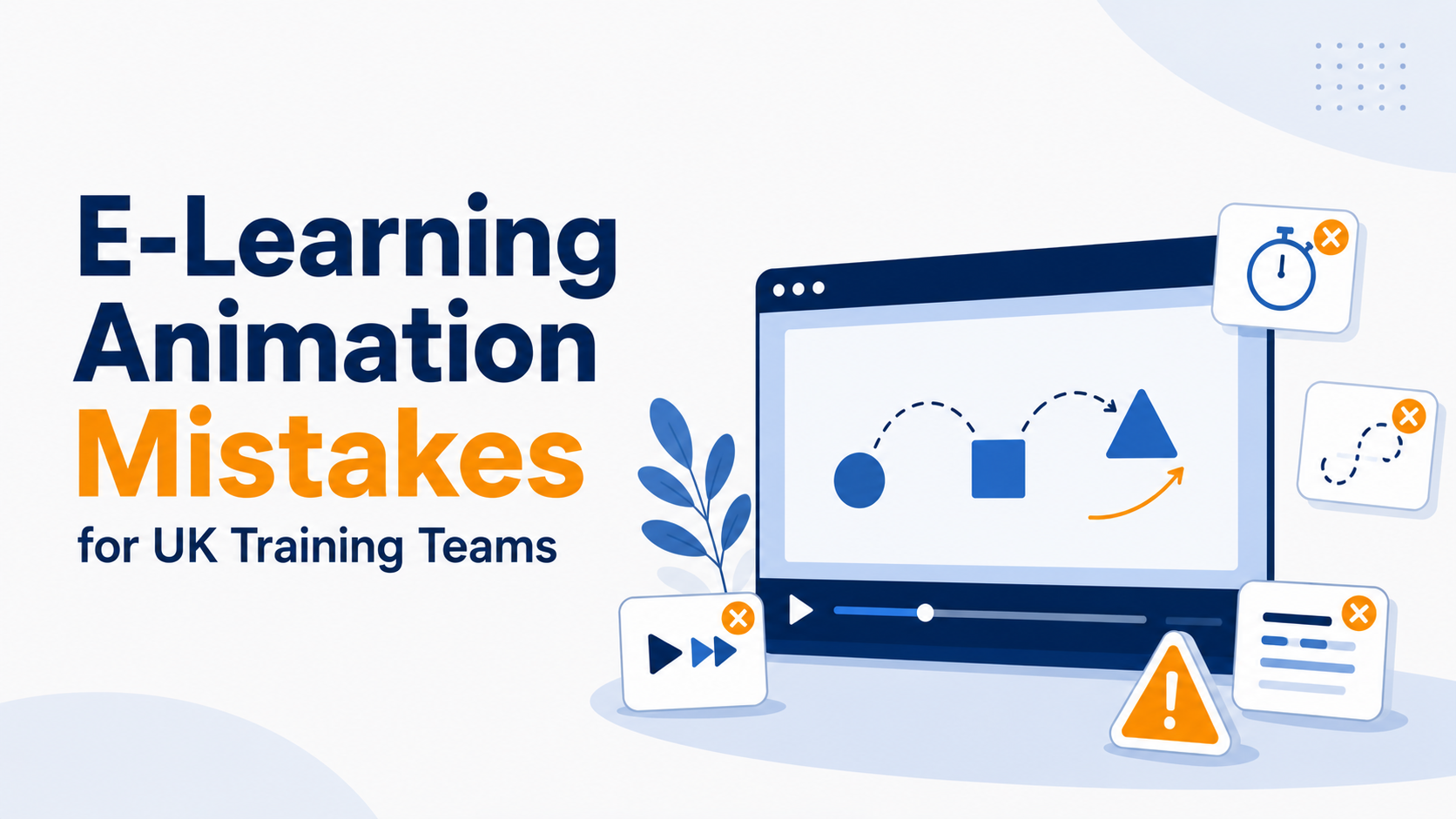
    Here are 10 common mistakes to avoid when using animation in e-learning.

    1. Making animations too long or complicated

    An animation should make a learning point easier to grasp, not turn a simple idea into a five-minute production.

    Long sequences can increase cognitive load and make it harder for learners to identify what matters. Where possible, keep each animation focused on one concept, process or decision.

    If a subject genuinely needs more explanation, consider breaking it into several shorter sections. This also makes it easier for employees to return to a specific topic later.

    2. Taking control away from the learner

    Self-paced learning works best when employees have some control over how they consume content. Animation should follow the same principle.

    Give learners sensible playback controls where appropriate, including pause, replay and rewind. Volume controls are also useful, particularly when employees may be completing training in an office, at home or in a shared workplace.

    Learner control can also support different levels of prior knowledge. Someone familiar with a process may want to move quickly, while a new starter may need to watch the explanation again.

    3. Letting visual effects become the main event

    Good animation does not need to look like a feature film. In corporate e-learning, the quality of the learning experience matters more than how many visual effects can be fitted onto the screen.

    Too many transitions, characters, colours or moving objects can pull attention away from the teaching point. A cleaner visual style is often more effective, especially for subjects such as compliance, policies or health and safety.

    The test is simple: if removing an animation would make the learning clearer, the animation probably needs reconsidering.

    4. Using a different visual style from the rest of the course

    Animation should feel like part of the course rather than something that has been dropped into it from somewhere else.

    Keep the visual language consistent across the module. Colours, typography, illustration styles, narration and tone should work together. The transition from an animated sequence back to an interaction, assessment or information screen should feel natural.

    This is particularly important for bespoke e-learning because the course should reflect the organisation’s identity rather than looking like a collection of unrelated assets.

    5. Giving learners too much to process at once

    One of the easiest ways to weaken an animation is to put everything on screen simultaneously.

    A moving character, detailed diagram, background music, statistics, narration and paragraphs of text may all seem useful individually. Together, they can become distracting.

    Think about what the learner needs to see, hear and do at each point. If the narrator is explaining a process, the animation should reinforce that explanation rather than introduce several competing messages.

    6. Designing for the wrong audience

    An animation created for experienced managers will not necessarily work for apprentices or new employees. Equally, a highly simplified animation may frustrate a specialist audience.

    Before developing the animation, consider the learners’ existing knowledge, roles, working environment and likely expectations. A safety module for employees on a construction site, for example, may need a very different visual approach from leadership training for a professional services firm.

    Audience research can also help determine the right tone. The aim is to make the content accessible without making it feel childish or unnecessarily complicated.

    7. Forcing humour into the content

    Humour can work in e-learning, but it is difficult to get right across a diverse workforce.

    A joke that lands well with one group may fall flat with another. It can also distract from serious subjects, particularly where the training covers health and safety, conduct, data protection or other compliance requirements.

    If humour is used, it should support the learning rather than become the reason learners remember the animation. In many cases, a clear scenario or relatable workplace situation will create more engagement than a forced joke.

    8. Filling the screen with text

    Animation is a visual medium, so large blocks of text can defeat its purpose.

    Short labels, keywords and brief explanations can be useful. They can reinforce a message or make an important term easier to remember. However, if learners have to spend most of the animation reading paragraphs, they are likely to miss what is happening visually.

    A better approach is to decide what belongs in the narration, what should appear on screen and what the learner needs to interact with. Each element should have a job.

    9. Treating sound as an afterthought

    Animation is visual, but audio can add another layer of explanation and engagement.

    A well-produced voiceover can guide learners through a process, explain a diagram or provide context that would otherwise require more on-screen text. Carefully selected sound effects can also reinforce actions or transitions.

    Music should be used with restraint. It should not make narration difficult to hear or become repetitive during a longer learning sequence.

    For workplace learning, captions and transcripts should also be considered. They can support accessibility and make content more practical for employees who cannot or do not want to use audio.

    10. Using local references that do not travel well

    UK e-learning should feel relevant to its audience, but there is a difference between making content relatable and filling it with niche references.

    An example based on a recognisable UK workplace situation can help learners understand a concept. However, slang, regional jokes or references that only make sense to one department or location can quickly date a course or exclude part of the workforce.

    For organisations operating across England, Scotland, Wales and Northern Ireland, this deserves particular attention. Keep examples familiar enough to feel relevant while making sure the underlying lesson remains clear to everyone.

    A UK-specific consideration: accessibility and compliance

    Accessibility should be considered from the storyboard stage, rather than added after the animation has been produced.

    Think about captions, transcripts, colour contrast, readable text, keyboard access and whether important information is communicated through movement alone. Reduced-motion considerations may also be appropriate for some learners.

    UK organisations also need to consider how personal information is handled when digital learning collects or processes learner data. The UK’s data protection framework is based on the UK GDPR and Data Protection Act 2018, so any learner data captured by a wider e-learning system should be handled appropriately. The wider point is that animation should form part of an accessible, well-designed learning experience, rather than being treated as a standalone visual extra.

    How to get more from animation in e-learning

    The most effective animations start with the learning objective. Before deciding what should move, ask what the learner needs to understand, remember or do differently after watching it.

    That might mean using a short animated explanation to simplify a complex process, a scenario to show the consequences of a workplace decision, or motion graphics to highlight information that would otherwise be difficult to visualise.

    For UK organisations developing bespoke training, animation can be combined with branching scenarios, interactive activities and AI-powered learning tools to create more personalised learning experiences. Capytech’s UK e-learning service, for example, includes bespoke animation as part of custom digital learning development. 

    Animation can also sit alongside a wider learning ecosystem. Organisations using an LMS can combine animated modules with assessments, reporting, instructor-led sessions and other forms of training. Capytech’s UK LMS offering supports SCORM, xAPI, video and other learning content alongside AI-powered learning features. 

    The goal is not to animate everything. It is to use animation where movement makes the learning clearer, more memorable or more engaging.

    Avoid these common mistakes, keep the learner at the centre of the design, and animation can become a valuable part of an effective UK e-learning programme.

    See your own training as e-learning, free

    Send us one document and we will turn it into an interactive demo module, so you can judge the quality before you spend anything.

  • How to Set the Right E-Learning Quiz Pass Mark in the UK 

    How to Set the Right E-Learning Quiz Pass Mark in the UK 

    Imagine an organisation rolling out mandatory safety training to 500 employees. A learner scores 80% on the final quiz, but the questions they got wrong relate to a high-risk procedure. Should they automatically pass?

    This is why choosing a pass mark for an e-learning quiz should involve more than selecting the default percentage in your LMS. The right threshold depends on what learners need to know, how difficult the assessment is, and what could happen if they get an important question wrong.

    An 80% pass mark might be appropriate for one course and completely unsuitable for another. So how do you decide?

    Begin With What Learners Need to Achieve

    The starting point should always be the learning objectives.

    Before writing the quiz, define what learners should know, understand or be able to do by the end of the training. The assessment should then test those outcomes directly.

    For example, if a course teaches employees how to identify phishing emails, the quiz should assess whether they can recognise the warning signs and respond correctly. Asking questions about minor details that do not relate to the learning objectives will tell you very little about actual competence.

    A useful sequence is to establish the learning objectives first, design assessment questions around those objectives, and then develop the course content that prepares learners for the assessment.

    This approach also makes quiz results more useful. Whether you are delivering training through the Capytech LMS or another learning platform, you can use assessment data to identify areas where learners may need additional support.

    Consider Risk Before Setting the Percentage

    Once your questions are written and aligned with the learning objectives, you can decide how demanding the pass mark needs to be.

    Not every question has the same importance. Consider the difference between training employees to use a new internal software application and training them to operate potentially dangerous equipment.

    Getting a software question wrong might mean the learner needs more practice. Getting a safety procedure wrong could contribute to a serious workplace incident.

    For higher-risk training, a higher level of demonstrated understanding may be appropriate. This is particularly relevant to organisations delivering health and safety training where competence has real-world consequences. Training aligned with HSE expectations, or specialised safety programmes such as IOSH-approved training, should be designed with the consequences of incorrect behaviour in mind.

    Difficulty matters too. A quiz where almost every question tests basic recall should not necessarily have the same pass mark as an assessment requiring learners to apply knowledge to realistic situations.

    Make the Pass Mark Fit the Purpose

    There is no universal percentage that works for every e-learning course.

    The right pass mark should reflect the purpose of the training, the difficulty of the assessment, the importance of the knowledge being tested and the level of risk involved.

    For example, a short awareness module might use a different threshold from a course designed to demonstrate practical competence. Similarly, training supporting a regulated qualification may have assessment requirements that are set by the relevant awarding or regulatory framework rather than by the organisation delivering the e-learning.

    Where training forms part of an Ofqual-regulated qualification, for example, the relevant qualification and awarding organisation requirements should take precedence. For internal workplace training, organisations generally have more flexibility to establish a suitable threshold.

    Check That the Assessment Is Fair

    A high pass mark does not automatically create a better assessment.

    If learners repeatedly fail, ask whether the problem is the pass mark, the course content or the questions themselves. Poorly worded questions, ambiguous answers or content that does not adequately prepare learners can make an assessment harder without making it more meaningful.

    Review quiz performance regularly. Look for questions that almost everyone gets wrong, as well as questions that everyone answers correctly. These patterns can indicate that a question needs to be rewritten or that the learning content needs improvement.

    AI-powered learning tools and data from an LMS can also support this review by helping learning teams identify recurring knowledge gaps and areas that may need further development.

    Be Clear About Expectations

    Learners should know the pass mark before they begin the assessment.

    This is particularly important when a high score is required or when failing means repeating part or all of the course. Clear expectations allow learners to understand what is required and encourage them to pay attention to the material rather than simply aiming to complete the module.

    The same principle applies when training is delivered through a wider learning programme. Whether your organisation uses custom e-learning, Fasttrack or the Capytech LMS, assessment requirements should be clear and consistent.

    Review Your Pass Mark Over Time

    Setting a pass mark should not be a one-off decision.

    Once a course has been delivered to a reasonable number of learners, review the results. If most learners are failing particular questions, investigate why. If nearly everyone achieves 100%, consider whether the assessment is sufficiently testing the intended learning objectives.

    For UK employers, this can form part of a wider learning and development cycle. Assessment results can help inform refresher training, skills development and workforce capability, alongside approaches such as those promoted by CIPD and Investors in People.

    The aim is not to make quizzes unnecessarily difficult. It is to make sure that a pass genuinely means something.

    There Is No Magic Number

    An 80% default pass mark may be convenient, but convenience is not a good reason to use it for every course.

    A better approach is to start with the learning objectives, assess the importance and risk associated with the subject, consider the difficulty of the questions and make sure the assessment provides a fair measure of learning.

    For a UK organisation, the final threshold should also take account of any relevant qualification, awarding body or sector requirements.

    When the pass mark is designed around the purpose of the training, quiz results become more useful for both learners and learning teams. They provide a clearer indication of whether the training has achieved what it was designed to achieve.

    See your own training as e-learning, free

    Send us one document and we will turn it into an interactive demo module, so you can judge the quality before you spend anything.
  • Using Kolb’s Learning Cycle for UK Workplace E-Learning

    Using Kolb’s Learning Cycle for UK Workplace E-Learning

    Imagine a new employee joining an NHS Trust, local council or private business. They can read a policy, complete a quiz and score 100%, but what happens when they face the same situation at work? Knowing the information is one thing. Knowing how to use it under pressure is another.

    This is where experiential learning becomes useful. David Kolb’s learning theory, first developed in the 1980s, puts experience and reflection at the centre of the learning process. While the theory and its associated learning styles have attracted criticism over the years, the underlying cycle still offers useful ideas for designing practical workplace e-learning.

    Rather than treating online training as a process of reading information and answering questions, organisations can design learning around four connected activities: experiencing something, reflecting on it, making sense of it and trying again in a new situation.

    What Is Kolb’s Experiential Learning Cycle?

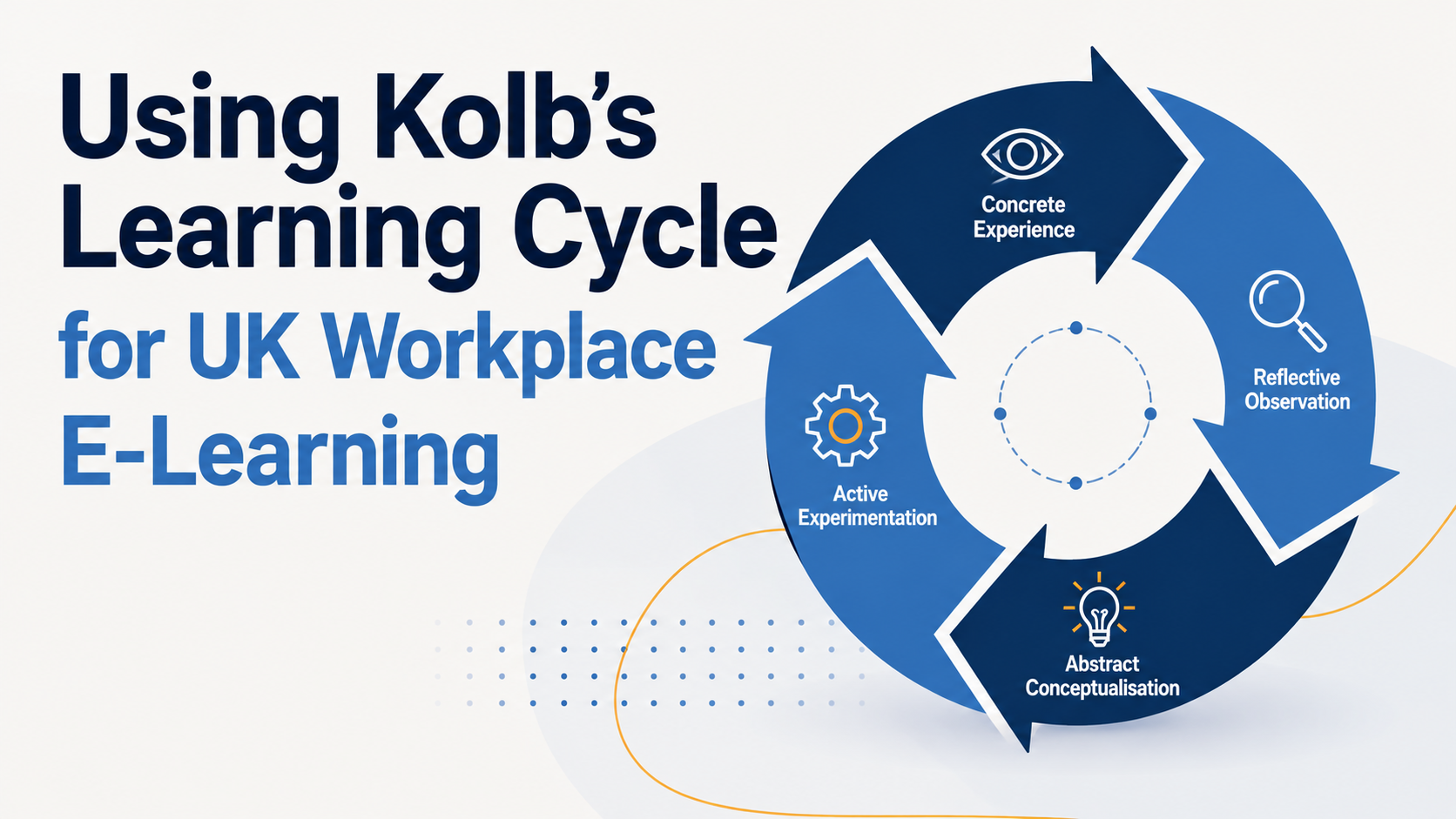
    Kolb’s model describes learning as a continuous cycle rather than a single event. A learner starts with an experience, thinks about what happened, develops an understanding or principle, and then tests that understanding through further action.

    The four stages are:

    Concrete Experience, where the learner encounters or performs an activity.

    Reflective Observation, where they consider what happened and why.

    Abstract Conceptualisation, where they develop an explanation, principle or broader understanding.

    Active Experimentation, where they apply that understanding to another situation.

    The important point for e-learning designers is that learners do not have to stop at knowledge acquisition. Digital training can give people opportunities to practise, reflect, receive feedback and apply what they have learnt.

    Start With a Realistic Learning Experience

    The first stage is Concrete Experience. In a traditional setting, this could involve a practical workshop, laboratory exercise, fieldwork or workplace task.

    Online learning cannot always reproduce a physical environment, but it can create realistic experiences through well-designed digital activities.

    A safety course, for example, might place an employee in a simulated workplace and ask them to identify hazards. A customer service programme could present a difficult conversation and ask the learner to decide how to respond. A management course might put a new supervisor into a scenario involving poor performance or team conflict.

    Video, animation, interactive exercises and branching scenarios can all help create this experience. Capytech’s custom e-learning approach can also incorporate AI-powered scenarios and interactive practice, allowing learners to make decisions rather than simply watch a presentation.

    For UK organisations, this could be particularly useful when training involves situations that are difficult, expensive or risky to reproduce in real life.

    Give Learners Time to Think About What Happened

    Experiencing a scenario is only the beginning. Kolb’s second stage, Reflective Observation, asks learners to consider the experience and examine their own decisions.

    What went well? What could have been handled differently? Which part of the situation was difficult? What information was missing?

    E-learning can support this through reflective questions, written responses, discussion activities, learner journals and facilitated forums. A course might ask an employee to explain why they selected a particular response before showing them an expert explanation.

    Social learning can add another dimension. Learners can compare their approaches with colleagues, discuss different outcomes and receive guidance from a tutor or subject matter expert.

    This is especially useful in management, leadership and behavioural training, where there may not be one simple answer to a workplace problem.

    Turn Reflection Into Understanding

    The third stage, Abstract Conceptualisation, is where the learner begins to form a broader understanding from the experience.

    Instead of simply remembering that one answer was correct, they start to understand the principle behind it.

    For example, a learner who has completed a difficult employee conversation might begin to recognise the importance of preparation, active listening and clear communication. A learner completing safety training might identify patterns that help them recognise hazards before an incident occurs.

    Digital learning can support this process with explanations, expert commentary, tutorials, reference materials and interactive activities. The aim is to help learners connect their experience with a wider concept that they can use elsewhere.

    This is also where instructional design matters. Content should not simply tell learners what they should know. It should help them understand why the knowledge matters and how it relates to their role.

    Put the Learning Into Practice

    Active Experimentation is the point at which the learner tests their new understanding.

    This could be as simple as completing another scenario with different circumstances. It could also involve a more complex simulation in which decisions lead to different outcomes.

    Consider a manager who has just completed training on handling difficult conversations. Rather than ending the module with a multiple-choice test, the next activity could present a different employee situation and ask the manager to choose an approach.

    The learner can then see the consequences of that decision, receive feedback and try again.

    Gamification can strengthen this stage by introducing challenges, scores, progress indicators or scenario-based goals. Used thoughtfully, these elements can make practice more engaging without turning the learning into a game for its own sake.

    Capytech’s custom e-learning services support features such as branching scenarios, gamification and AI-supported learning experiences, making this type of practical application possible within digital training.

    A UK Workplace Example: From Compliance to Behaviour

    Consider a UK organisation introducing workplace health and safety training.

    A conventional online course might explain the relevant procedures, show a few videos and finish with a knowledge test. That approach can confirm whether employees remember information, but it may not show whether they can apply it.

    A Kolb-inspired approach could begin with a realistic workplace scenario. The learner identifies a hazard and chooses what to do. They then review the consequences of their decision and reflect on what they might have missed.

    The course introduces the relevant safety principles and explains why the correct approach matters. The learner then faces a new scenario and applies those principles again.

    For health and safety programmes, this practical approach can sit alongside formal requirements and recognised training. Capytech provides online IOSH-approved safety training for UK organisations, with digital delivery allowing employees to complete learning without always requiring a classroom session.

    The same principle can apply to leadership, customer service, data protection and other areas where workplace behaviour matters as much as knowledge.

    Kolb and Modern UK E-Learning Platforms

    A learning cycle also becomes easier to manage when the technology supports more than course completion.

    An LMS can provide the central environment for delivering activities, recording progress and identifying where learners need additional support. Capytech’s UK LMS offering includes features such as AI scenario creation, learner analytics, mobile access and support for different learning environments.

    For example, an organisation could use an LMS to deliver a scenario-based module, record assessment results, provide additional learning to employees who need it and track completion across departments.

    AI-powered learning tools can add further interaction. An AI Tutor can answer learner questions, while AI-driven scenarios can give employees opportunities to practise decisions in a more conversational setting.

    The technology should support the learning objective, though. Adding AI or gamification simply because it is available does not automatically make a course better. The experience still needs to reflect what learners actually need to do in their jobs.

    Where Kolb’s Model Works Best

    Kolb’s cycle is particularly relevant when learners need to apply knowledge rather than simply recall it.

    It can work well for leadership development, customer service, workplace safety, compliance, technical procedures and other subjects where decisions and behaviour are important.

    It is also useful for blended learning. An online module could provide the initial scenario and theory, followed by a workshop where employees discuss their experiences and practise the skill with colleagues. The learning platform can then provide follow-up activities to reinforce the behaviour.

    For organisations supporting continuing professional development, this creates a stronger connection between formal training and everyday work.

    Is Kolb’s Theory Still Useful?

    Kolb’s learning theory should not be treated as a perfect formula for how every individual learns. The learning-style element of the wider model has been questioned, and learners should not necessarily be placed into fixed categories.

    The more useful lesson is the emphasis on learning through experience, reflection, understanding and practice.

    For UK L&D teams, that provides a practical way to ask a simple question: does this training give employees enough opportunity to do something with what they have learnt?

    A course can contain accurate information and still have little effect on workplace behaviour. Adding realistic scenarios, reflection, explanation and repeated practice can make the connection between training and performance much stronger.

    Whether an organisation is developing bespoke e-learning, delivering IOSH-approved safety training or managing learning through an LMS, Kolb’s cycle can provide a useful framework for thinking about that connection.

    The goal is not to follow the model rigidly. It is to design learning that gives people a chance to experience, think, understand and practise, then take those lessons back into their working lives.

    See your own training as e-learning, free

    Send us one document and we will turn it into an interactive demo module, so you can judge the quality before you spend anything.
  • Transforming UK Workforce Training with Bloom’s Taxonomy

    Transforming UK Workforce Training with Bloom’s Taxonomy

    Welcome to the second installment in our guide to key instructional design frameworks for digital learning. In this post, we explore Bloom’s Taxonomy, a foundational pedagogical model widely used across the UK education and corporate sectors. From FTSE 100 businesses in London to NHS Trusts and regional councils, structuring training around clear cognitive steps is essential for building real workplace capability.

    UK organisations face continuous pressure to reskill employees, ensure compliance with evolving domestic standards, and deliver measurable ROI on learning programs. By aligning digital content with Bloom’s Taxonomy, learning teams can move beyond simple tick-box exercises. This approach creates structured pathways that turn basic recall into practical, on-the-job competence.

    Understanding the Framework: Six Levels of Learning

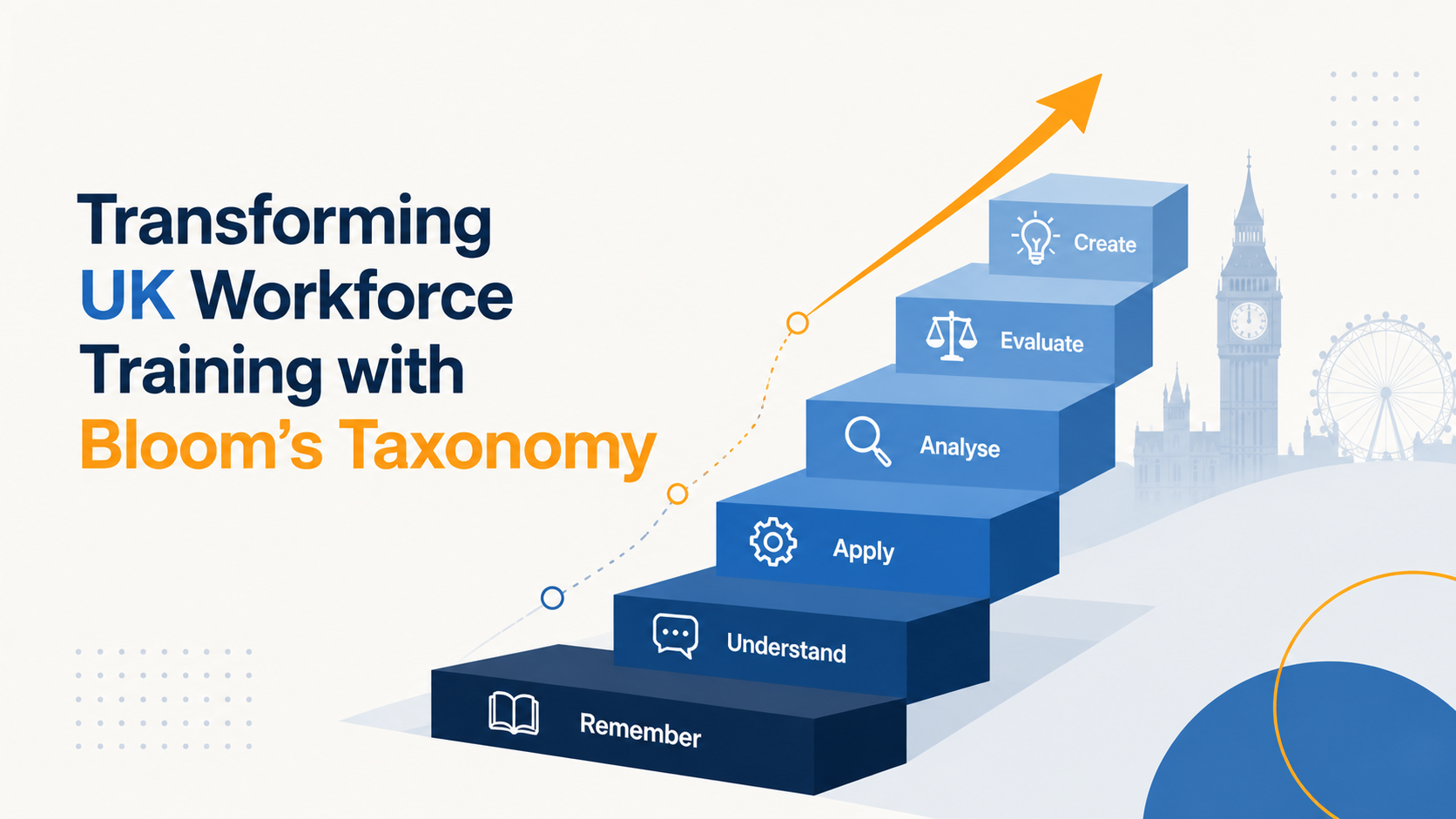
    Created in 1956 and revised in 2001, the model outlines six progressive stages of cognitive development. Learners build mastery at lower tiers before moving to advanced applications.

    • Remembering: Retrieving relevant facts, definitions, or core information.
    • Understanding: Grasping the meaning of material and explaining concepts in context.
    • Applying: Using knowledge in new situations, tasks, or realistic scenarios.
    • Analysing: Breaking down information to explore relationships and underlying causes.
    • Evaluating: Making informed judgements based on criteria and standards.
    • Creating: Combining elements to generate new ideas, workflows, or solutions.

    The primary goal in corporate training is to move employees past mere recall and understanding. High-performing organisations rely on higher-tier skills to drive innovation, improve risk management, and foster sharper critical thinking.

    How Bloom’s Taxonomy Enhances Course Development

    As a structured development framework, this model helps instructional designers craft target learning outcomes. Clear objectives ensure digital training directly matches both learner requirements and business goals.

    The framework also offers a reliable benchmark for measuring training performance. By matching assessment strategies directly to the intended cognitive level, organisations gain clearer insights into true skill acquisition.

    Flexible Implementation Across Skill Levels

    Although the stages build on one another sequentially, employees do not always need to start at the bottom. Experienced staff often already possess foundational knowledge.

    In these cases, digital modules should skip basic retention exercises and focus directly on analysis, evaluation, and problem-solving.

    Breaking Down the Cognitive Levels in Digital Learning

    Level 1: Remembering

    This foundational stage focuses on information retention. In digital training, key tools include clear text summaries, diagrams, explanatory audio, and knowledge-check quizzes. Typical outcomes include recalling internal policies, health and safety guidelines, or product details.

    Level 2: Understanding

    Understanding goes beyond basic memory. It requires staff to interpret what information means for their daily roles. Interactive modules, contextual examples, and practical summaries help bridge this gap, enabling staff to explain or compare core concepts accurately.

    Level 3: Applying

    Effective corporate training aims to influence real-world behaviour. At this stage, learners put theory into practice. Branching scenarios and practical simulations allow staff to apply procedures, use software systems, or handle routine customer interactions safely.

    Level 4: Analysing

    Analysis requires a deeper examination of complex topics. Advanced scenarios help learners break down multi-step problems, identify root causes, and compare alternative approaches. This level is vital for roles requiring sound technical decisions or risk assessments.

    Level 5: Evaluating

    At the evaluation stage, staff assess situations and make sound judgements without straightforward answers. Training at this level presents nuanced challenges, requiring learners to justify their choices against industry standards, internal guidelines, or legal constraints.

    Level 6: Creating

    The highest level challenges learners to synthesise their knowledge to build original solutions. Digital activities at this tier prompt users to draft new strategies, refine team workflows, or design process improvements that boost operational efficiency.

    Aligning Bloom’s Taxonomy with UK Compliance and Apprenticeships

    In the UK, integrating this framework helps align corporate training with formal regulatory standards. For instance, mandatory updates on UK GDPR, the Data Protection Act 2018, or HSE safety regulations require more than surface memory. Staff must understand concepts deeply enough to apply them correctly and prevent regulatory breaches.

    Furthermore, organisations using the UK Apprenticeship Levy or offering TQUK-accredited programmes can use Bloom’s Taxonomy to map training modules directly to required Knowledge, Skills, and Behaviours (KSBs). This ensures smooth compliance during internal reviews and Ofsted inspections.

    Maximising Impact Beyond Digital Modules

    To get the best results from this model, digital modules should form part of a broader learning strategy. Combining custom digital courses with mentor support, practical workplace tasks, and platforms like the Capytech LMS creates a complete environment for continuous development.

    See your own training as e-learning, free

    Send us one document and we will turn it into an interactive demo module, so you can judge the quality before you spend anything.
  • Closing Knowledge, Skills and Motivation Gaps in UK Training

    Closing Knowledge, Skills and Motivation Gaps in UK Training

    Every successful workplace learning programme begins with a simple question. Why do employees need this training in the first place?

    Many organisations invest significant time and budget into e-learning without first identifying the real performance issue they are trying to solve. The result is often a course that delivers information but fails to change behaviour or improve performance. Whether you are training new starters, supporting compliance, or introducing new processes, understanding the gap you are trying to close should always come before designing the learning experience.

    Start by Identifying the Real Performance Gap

    When someone is not performing as expected, the answer is not always more training. In many cases, people already know what to do but choose not to do it, or they understand the theory but have not developed the confidence to apply it consistently.

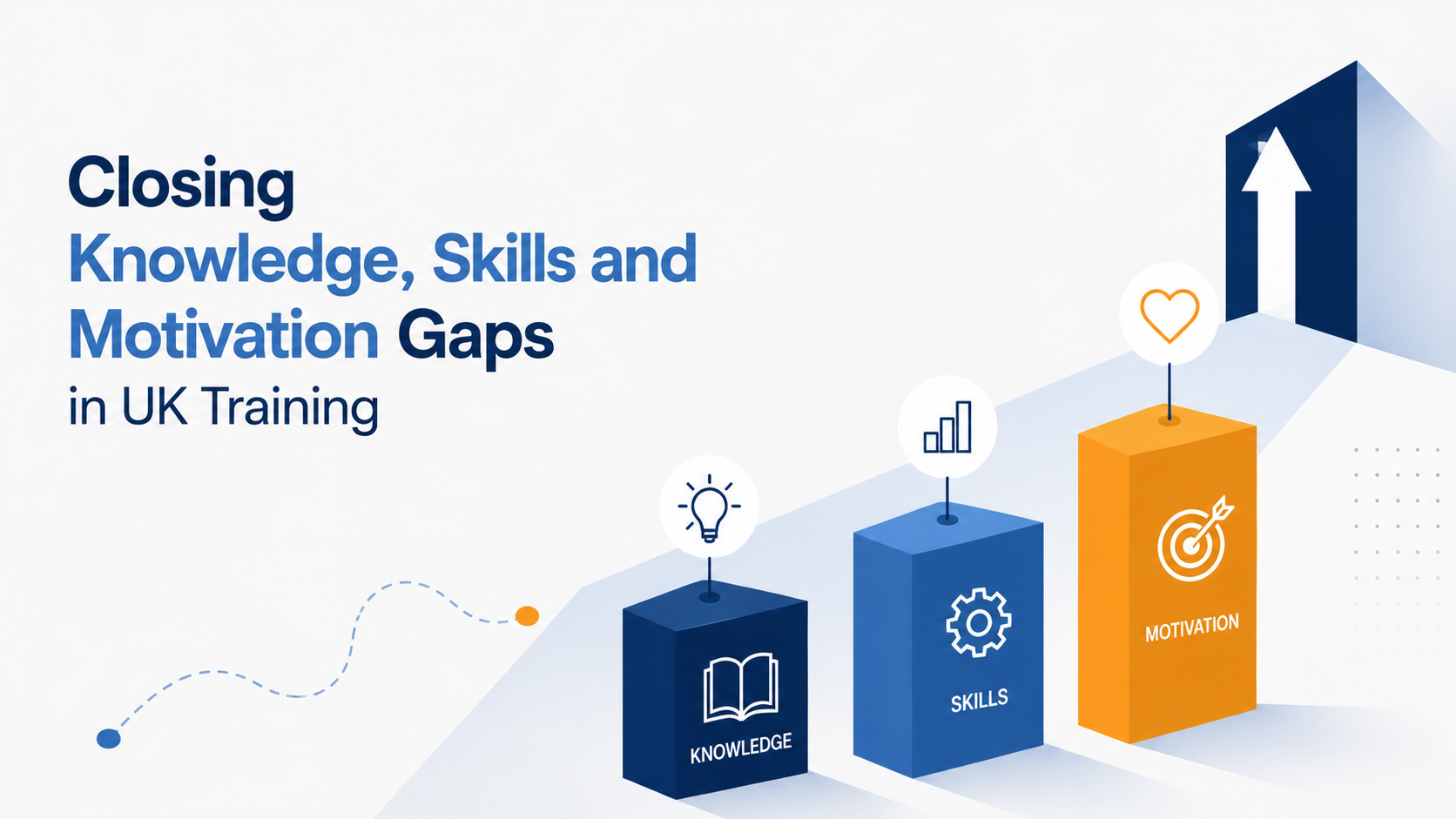
    Most workplace learning challenges fall into one of three areas. People either need new knowledge, they need to build practical skills, or they need stronger motivation to put what they already know into practice. Identifying which of these applies will shape every decision you make about the course, from the content to the activities and assessments.

    When Employees Need Better Knowledge

    A knowledge gap exists when learners need information they do not currently have. This often happens during onboarding, when introducing new products or services, or when communicating changes to legislation, internal policies, or business procedures.

    However, providing facts alone rarely changes workplace performance. Employees are much more likely to remember information when they understand how it applies to their day-to-day responsibilities.

    For example, a sales team does not simply need a list of product features. They need to understand which customer problems the product solves, which conversations it supports, and how those benefits can be explained confidently during a sales meeting. Knowledge becomes more valuable when learners can see how to use it in realistic situations.

    Skills Require Practice, Not Just Information

    One of the most common mistakes in digital learning is treating skills as though they are simply another form of knowledge.

    A useful way to tell the difference is to ask whether learners can perform successfully immediately after receiving the information. If they need repeated practice before becoming competent, the gap is one of skill rather than knowledge.

    Presentation techniques, leadership conversations, customer service, software systems and safety procedures all require learners to apply what they have learnt. Reading about these activities is only the starting point. Confidence develops through realistic practice, feedback and repetition.

    This is why effective custom e-learning often includes branching scenarios, simulations and interactive exercises rather than relying solely on text or video content.

    Motivation Can Be the Missing Piece

    Sometimes employees already have the knowledge and the ability to perform well, yet their behaviour does not change.

    This motivation gap is frequently overlooked because it cannot be solved simply by adding more content. The underlying issue may be uncertainty about why a change is happening, lack of confidence, resistance to new ways of working, or limited understanding of how the change benefits both the organisation and the individual.

    Employees may also lose focus over time or become disengaged if previous training felt irrelevant.

    In these situations, the learning experience should explain the purpose behind the change, demonstrate its value, and encourage participation through relevant examples and engaging interactions. When people understand the reasons for change, they are far more likely to adopt new behaviours.

    Choosing the Right Learning Approach

    Once you have identified the type of gap, selecting the appropriate learning methods becomes much easier.

    Knowledge-based learning benefits from clear explanations, practical examples and opportunities to apply information in realistic contexts.

    Skills development should include activities that allow learners to practise repeatedly before applying their learning in the workplace. Interactive scenarios, simulations and AI-powered learning tools can all help learners build confidence in a safe environment.

    Motivation-focused learning requires a different emphasis. The content should connect organisational objectives with individual benefits, explain expectations clearly and create an engaging experience that keeps learners involved from beginning to end.

    The most effective programmes often combine all three approaches because workplace performance rarely depends on a single factor.

    A UK Compliance Perspective

    Many UK organisations deliver mandatory training covering areas such as health and safety, information security and data protection. While these subjects often appear to focus on compliance, simply providing information is rarely enough.

    For example, employees handling personal information need to understand not only the principles of the UK GDPR and the Data Protection Act 2018, but also how to apply those principles in everyday situations. Similarly, health and safety training should help employees recognise hazards and make safe decisions rather than memorising regulations.

    This practical approach aligns with guidance from organisations such as the CIPD and the HSE, both of which promote learning that supports real workplace performance instead of simple knowledge recall.

    Designing Training That Delivers Results

    Successful e-learning is not measured by course completion alone. Its value comes from helping people perform better at work.

    Before creating any learning programme, spend time identifying whether the challenge is a lack of knowledge, a shortage of practical skills, or a problem with motivation. Once that question has been answered, every aspect of the learning design becomes more focused and more effective.

    Whether you are developing compliance training, leadership programmes or custom digital learning, matching the learning strategy to the actual performance gap gives learners a far better chance of applying what they have learnt and delivering measurable improvements across the organisation.

    See your own training as e-learning, free

    Send us one document and we will turn it into an interactive demo module, so you can judge the quality before you spend anything.

  • Writing Effective Learning Objectives for UK Workplace Training

    Writing Effective Learning Objectives for UK Workplace Training

    Many UK organisations invest in workplace learning with clear business goals in mind. They may want to improve compliance, develop leadership skills, reduce errors or help teams adopt new systems. Yet many training programmes fall short because employees are never told exactly what success looks like.

    That is where learning objectives make a difference. A well-written learning objective sets a clear expectation from the beginning. It explains what learners should be able to do after completing the course and gives trainers a practical way to measure whether the learning has achieved its purpose. Whether you are creating custom e-learning, delivering IOSH-approved safety training or rolling out courses through the Capytech LMS, clear objectives provide the foundation for effective learning.

    Start with the Outcome, Not the Content

    Many organisations begin by thinking about what information they want to include in a course. A better approach is to decide what learners should be capable of doing when the training finishes.

    For example, imagine a customer service programme. A vague objective might read:

    “After completing this course, you will understand good customer service.”

    Although this sounds reasonable, it is difficult to measure. How do you prove someone understands a topic?

    A stronger objective focuses on observable behaviour instead:

    “After completing this course, you will be able to resolve common customer enquiries using the organisation’s approved service process.”

    This version makes expectations clear and provides a practical standard against which performance can be assessed.

    Why Good Learning Objectives Matter

    Well-defined learning objectives benefit both learners and organisations.

    Learners understand why they are completing the training and what they are expected to achieve. This often increases engagement because the purpose of the course is obvious from the outset.

    For course designers, learning objectives help shape every decision. They influence the content, activities, assessments and scenarios that appear throughout the programme, reducing unnecessary material and keeping the course focused.

    They also make it easier to evaluate return on investment. When objectives describe measurable behaviours, organisations can compare employee performance before and after training instead of relying only on completion rates.

    What Makes a Strong Learning Objective?

    Effective learning objectives share several characteristics.

    They are specific enough that learners know exactly what success looks like. They use straightforward language that avoids misunderstanding and focuses on a single outcome. They are realistic, taking account of the learner’s experience and available time. Most importantly, they can be measured through observation, assessment or practical application.

    If an objective tries to cover too many skills, it is usually better to divide it into several smaller objectives. This approach works particularly well in modern microlearning programmes, where each short module focuses on one measurable outcome before moving to the next.

    A Practical Method for Writing Learning Objectives

    Creating effective objectives becomes much easier when you follow a logical process.

    Begin by understanding the organisational goal. Perhaps the business wants managers to conduct better performance reviews or reduce workplace incidents. That business objective should inform the training, but it should not become the learning objective itself.

    Next, think about the learners. Consider their existing knowledge, daily responsibilities and the level of improvement that is realistic.

    Finally, describe one behaviour the learner should demonstrate after training. Choose language that can be observed or assessed rather than words that describe internal understanding.

    Using Bloom’s Taxonomy to Choose Better Action Verbs

    Bloom’s Taxonomy remains one of the most widely used frameworks for writing learning objectives. Originally developed by educational psychologist Benjamin Bloom and later revised, it helps instructional designers match objectives to different levels of learning.

    Each level suggests action verbs that are easier to assess than broad terms such as “know” or “understand”.

    The six levels are:

    Remember focuses on recalling information, such as company procedures or safety rules. Multiple-choice assessments often work well for this level.

    Understand involves explaining ideas or describing processes. Learners might summarise a policy or explain how a product works.

    Apply asks learners to use new knowledge in practical situations. For example, they may complete a task using newly introduced software or follow a revised operating procedure.

    Analyse requires learners to examine information, identify patterns or compare options. A manager interviewing candidates or reviewing workplace data would be working at this level.

    Evaluate involves making informed judgements. Learners may assess risks, review business performance or recommend improvements based on evidence.

    Create represents the highest level, where learners produce something original. This could include writing a project plan, designing a customer journey or preparing a marketing proposal.

    Selecting the right action verb makes objectives clearer and makes assessment much easier.

    Align Learning Objectives with UK Workplace Requirements

    Many UK organisations deliver training that supports legal or professional responsibilities. In these situations, learning objectives should reflect the standards employees are expected to meet in their roles.

    For example, compliance programmes may support responsibilities under the UK GDPR and the Data Protection Act 2018, while health and safety training may reinforce HSE guidance. Leadership programmes often align with frameworks promoted by the CIPD, helping organisations develop consistent management capability.

    Connecting learning objectives to recognised UK standards helps learners understand why the training matters and provides managers with meaningful measures of success.

    Write Objectives Before Building the Course

    One of the most common mistakes in e-learning development is writing learning objectives after the content has already been created.

    The opposite approach produces better results. Define the objectives first, then build every activity, assessment and scenario around them.

    This keeps the course focused and avoids adding content that does not contribute to the intended outcome. It also makes future updates easier because every part of the programme has a clear purpose.

    Whether you are developing a custom e-learning solution or delivering training through the Capytech LMS, strong learning objectives provide a clear direction from the first planning meeting through to learner assessment.

    Final Thoughts

    Learning objectives may only take a short time to write, but they influence every stage of course development. They give learners a clear destination, help designers make better content decisions and allow organisations to measure whether training has delivered real improvements.

    When objectives are specific, measurable and centred on learner performance, workplace training becomes easier to evaluate and far more likely to produce lasting results.

    See your own training as e-learning, free

    Send us one document and we will turn it into an interactive demo module, so you can judge the quality before you spend anything.