Martyn's Law Training Courses for Every Role in Your Venue
Online Martyn's Law training for staff, stewards, managers and senior individuals. Everyone starts with the free Home Office ACT Awareness course, then takes short courses for their role, built around your own public protection procedures and recorded for every person.
Which Martyn's Law Training Does Each Role Need?
Everyone needs to know your procedures and their part in them. People with more responsibility need more. This is the standard programme; we shape the stages and courses around your venues and your roles.
| Role | Courses | Time |
|---|---|---|
| Everyone, including agency and casual staff | Free ACT Awareness, then Foundation: Martyn's Law explained, Procedures in practice | about 45 min plus about 1 hour |
| Stewards, front of house, door and bar teams | Everything above, plus Ready: Event-day readiness, Front of house: responding | plus about 50 min |
| Duty managers, supervisors and security leads | Foundation, plus Lead: Making the call, Running drills and exercises | plus about 75 min |
| Responsible person, designated senior individual, compliance leads | Foundation, plus Accountable: The duty holder and senior individual, Records and inspection readiness | plus about 70 min |
| Everyone, every year | Annual refresher | about 20 min |
The Act has no statutory training duty, but the Home Office statutory guidance says staff should know your procedures and how they relate to their role, and that public-facing roles may need role-specific training. Without it, showing your procedures are appropriate is likely to be difficult. Not sure which tier applies? Use our free Martyn's Law tier checker.
Start With the Free Awareness Course
Counter Terrorism Policing's ACT Awareness e-learning is free on ProtectUK and aimed at staff in venues and public spaces. ProtectUK also offers ACT for Education, ACT Security for security operatives and Faith Security Training for places of worship. Every member of your team should take ACT Awareness, and the Home Office guidance says it is not mandatory to pay for third-party training.
We load ACT Awareness into your learning platform and track it with everything else. What a free national course cannot do is teach your procedures in your building: which doors to close, who makes the call to invacuate and where your staff gather. That is what the Academy courses are for.
Martyn's Law Academy Course Outlines
Eight short courses in four stages, plus a yearly refresher. Every course is made of lessons of 5 to 10 minutes, ends with a knowledge check and is built around your own procedures.
- Foundationabout 25 min · 5 lessons
Martyn's Law explained
Everyone, including agency and casual staff
What the law is for and what it asks of your venue, so every member of staff knows why the procedures matter and what part they play.
- Why Martyn's Law exists
- Standard and enhanced premises
- What the law asks of your venue
- Your part as a member of staff
- Who is accountable, and to whom
- Foundationabout 35 min · 6 lessons
Procedures in practice
Everyone, including agency and casual staff
The four public protection procedures, and how each one works in your building.
- The four procedures
- Evacuation: getting people out
- Invacuation: bringing people in
- Lockdown: securing the building
- Communicating in an incident
- Knowing your own plan
- Readyabout 20 min · 5 lessons
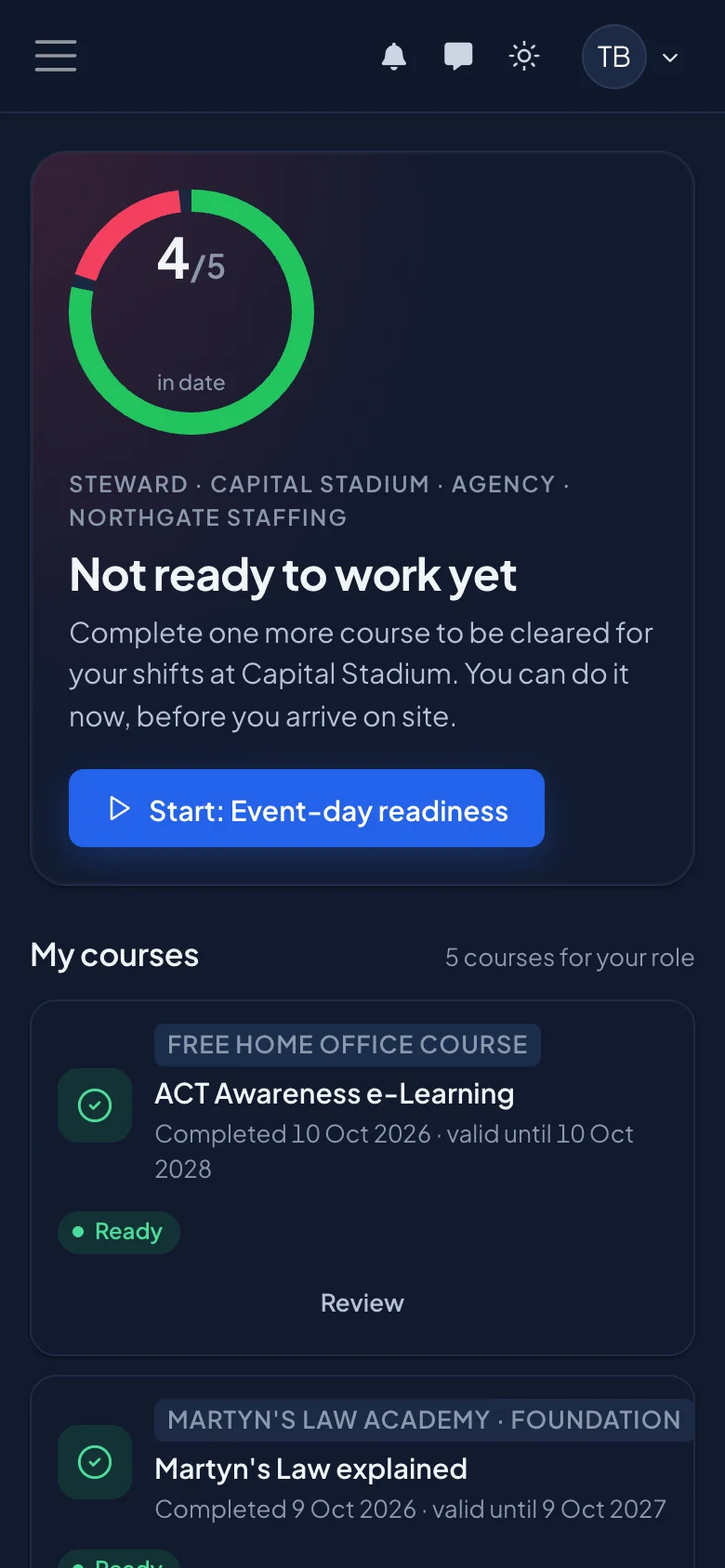
Event-day readiness
Stewards, front of house, door and bar teams
What a steward or casual worker needs before a shift: their post, their routes and how to raise the alarm.
- Your pre-shift briefing
- Your post, routes and muster points
- Radios, codes and reporting lines
- Spotting and reporting concerns
- When the plan is triggered
- Readyabout 30 min · 6 lessons
Front of house: responding
Stewards, front of house, door and bar teams
For customer-facing staff: moving from noticing something to acting on it, and looking after the public.
- From noticing to acting
- Approaching and engaging safely
- Reporting clearly and quickly
- Talking to the public in an incident
- Supporting vulnerable visitors
- After the incident
- Leadabout 40 min · 6 lessons
Making the call
Duty managers, supervisors and security leads
Deciding fast with incomplete information: which procedure to trigger, who has the authority and how to record it.
- The first ten minutes
- Evacuate, invacuate or lockdown?
- Decision authority and the cascade
- Working with the emergency services
- Deciding with incomplete information
- Recording your decisions
- Leadabout 35 min · 6 lessons
Running drills and exercises
Duty managers, supervisors and security leads
How to plan, run and debrief tabletop exercises and live drills, and keep the record.
- Why testing matters
- Choosing the right exercise
- Planning a tabletop exercise
- Running a live drill safely
- Debrief and lessons learned
- Recording exercises as evidence
- Accountableabout 40 min · 6 lessons
The duty holder and senior individual
Responsible person, designated senior individual, compliance leads
What the law expects of the people who are accountable for a premises or event.
- The responsible person
- Standard and enhanced duties
- The designated senior individual
- The SIA: notification and enforcement
- Penalties and personal liability
- Governance and board reporting
- Accountableabout 30 min · 5 lessons
Records and inspection readiness
Responsible person, designated senior individual, compliance leads
Keeping the records that show what you have done, ready for contact with the regulator.
- What records the law expects
- Training records that stand up
- Documenting measures and procedures
- Preparing for contact with the SIA
- Reviewing and improving
- Every yearabout 20 min · 4 lessons
Annual refresher
Everyone
A short yearly update for everyone that renews Foundation.
- What has changed this year
- Procedures recap
- Scenario check
- Renew Foundation
A Module About Your Own Building
Every course can end with a short module for each venue: your routes, doors, muster points and who makes the call. We build it from the documents you hold anyway, such as your procedures, site plans and role list, in days rather than months.
- Built from your own procedures and plans, never a generic building
- Agency and casual staff train on their phone before they arrive
- Updated when your procedures, layout or roles change
Want staff to walk the routes before the day? We can also build a browser-based 3D version of your venue.
Online Training That Fits Shift Work
Short lessons, any device
Lessons of 5 to 10 minutes on a phone, tablet or computer, so staff can finish before a shift.
On our LMS or yours
Published as SCORM 1.2, SCORM 2004 or xAPI for your own platform, or run on the Capytech LMS.
A record for every learner
Completion, scores and dates for each person, and a certificate with a check code.
Readiness by venue
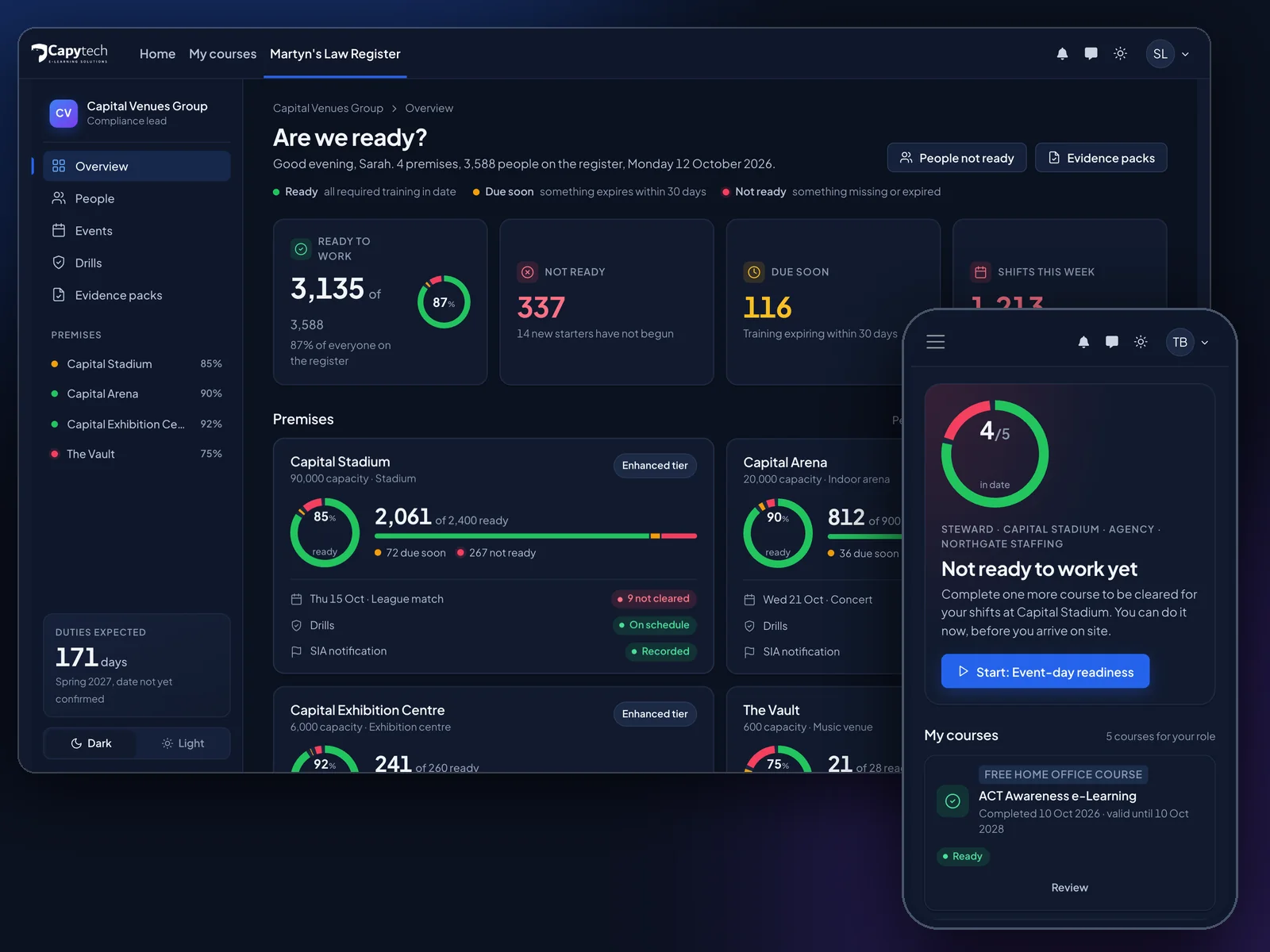
On the Capytech LMS, the Martyn's Law Register shows who is cleared for each event, logs drills and builds evidence packs.
A refresher every year
A short annual refresher renews Foundation and covers anything that has changed.
Translated on request
Courses can be translated for staff who work in other languages, with every version updated together.
Practice in the Setting Your Staff Work In
Optional packs of about 20 minutes, each with two branching scenarios and a check. Ask us about other settings, including schools, colleges and places of worship.
- Stadiums and arenasMatch days, concourses, crowd flow and large casual workforces
- Hospitality and night-timeBars, clubs and hotels, late hours and door teams
- Retail and shopping centresShared spaces, tenants and centre management
- Visitor attractionsMuseums, galleries and venues with mixed visitors
- Healthcare estatesLarge public sites that cannot simply close
From Your Procedures to Trained Staff
- 1
Send us your documents
Your procedures, site plans, muster points, who decides what, and a list of staff roles. One remote session fills any gaps.
- 2
We build and set up
Courses for each role with your venue modules, loaded with ACT Awareness on your platform or ours. Days, not months.
- 3
Staff train, you see the records
People train on any device, and you see who has finished, who is due and who has not started.
Capytech is a training and technology company. We do not survey buildings or write your procedures. If you need that, bring in a security specialist and we build the training from what they produce.
Martyn's Law Training Course Questions
What venue operators, security leads and HR teams ask before they choose a course.
What is Martyn's Law training?
Training that helps staff play their part in a venue's public protection procedures under the Terrorism (Protection of Premises) Act 2025. Everyone should start with the free ACT Awareness course. Staff then need to know your own procedures and their role in them, and managers and senior people need to know how to make decisions, run drills and keep records.
Is there a free Martyn's Law course?
Yes. Counter Terrorism Policing's ACT Awareness e-learning is free on ProtectUK, along with ACT for Education, ACT Security and Faith Security Training. We load ACT Awareness into your learning platform and track it alongside our courses. The free courses are general, so they cannot teach your own procedures or your building.
Is Martyn's Law training mandatory?
The Act has no statutory training duty for either tier. The Home Office's statutory guidance says staff should know your public protection procedures and how they relate to their role, and that if they have not been informed or trained it is likely to be difficult to show your procedures are appropriate. For enhanced tier premises and qualifying events, it says you should keep a record of the training staff have had. Our Martyn's Law training guide covers this in detail.
How long does Martyn's Law training take?
ACT Awareness takes about 45 minutes. Foundation takes about an hour, and each role course is 20 to 40 minutes, made of short lessons of 5 to 10 minutes. A steward would typically spend under three hours in total, and a short refresher each year.
Do staff get a certificate?
Yes. On the Capytech LMS each learner gets a certificate with a check code, and you see completion, scores and dates for every person. If you run the courses on your own learning platform, it records them in the same way.
How often should staff repeat Martyn's Law training?
The Act does not set a frequency. We recommend a short refresher every year, and updates whenever your procedures, layout or roles change. New starters, agency and casual staff should complete their training before their first shift.
Can we run the courses on our own LMS?
Yes. The courses are published as SCORM 1.2, SCORM 2004 or xAPI for any standard learning platform. If you also want readiness by venue, event clearance and drill records, use them on the Capytech LMS with the Martyn's Law Register.
Will the courses make our venue compliant?
No course can do that. The Home Office guidance gives the example of a venue offered a course costing thousands of pounds that claims to make attendees compliant, which decides it does not need it. Only the SIA decides whether premises comply. The courses help your people know your procedures and their part in them, and give you a record of who has been trained.
When does Martyn's Law come into force?
The Security Industry Authority expects the Act to come into force in spring 2027 and will confirm the exact date in advance. Premises already in scope will then have three months to notify the SIA.
See the Courses on Example Venues
Book a 30 minute demo. We will show you the courses as a steward and a duty manager see them, the records you get, and tell you straight how quickly your venues could be set up. No charge, no obligation.
General information, not legal advice. Only the SIA decides whether premises comply.
Their understanding of our business is deep, and their service levels are always stellar.
 Cyber Essentials certified. Hosted in the UK. Based in Cambridge. Capytech UK Ltd, company number 17157950.