
Many UK organisations invest heavily in digital learning, yet employees still click through modules with little enthusiasm. Completion rates may look healthy, but genuine engagement is often much harder to achieve. Whether you’re delivering compliance training, onboarding new starters or developing leadership programmes, the challenge is the same. People learn more effectively when they genuinely want to learn.
One framework that continues to influence instructional design is Malone’s Theory of Intrinsically Motivating Instruction. Although it was first introduced in the early 1980s, its principles remain highly relevant for modern workplace learning. For organisations using custom e-learning, AI-powered learning tools or immersive digital experiences, the theory provides practical guidance for creating learning that people actively enjoy rather than simply complete.
Why Malone’s Theory Still Matters
Thomas Malone originally developed his theory after studying what made early video games engaging. His research explored why people willingly invested time solving increasingly difficult challenges simply because the experience itself was enjoyable.
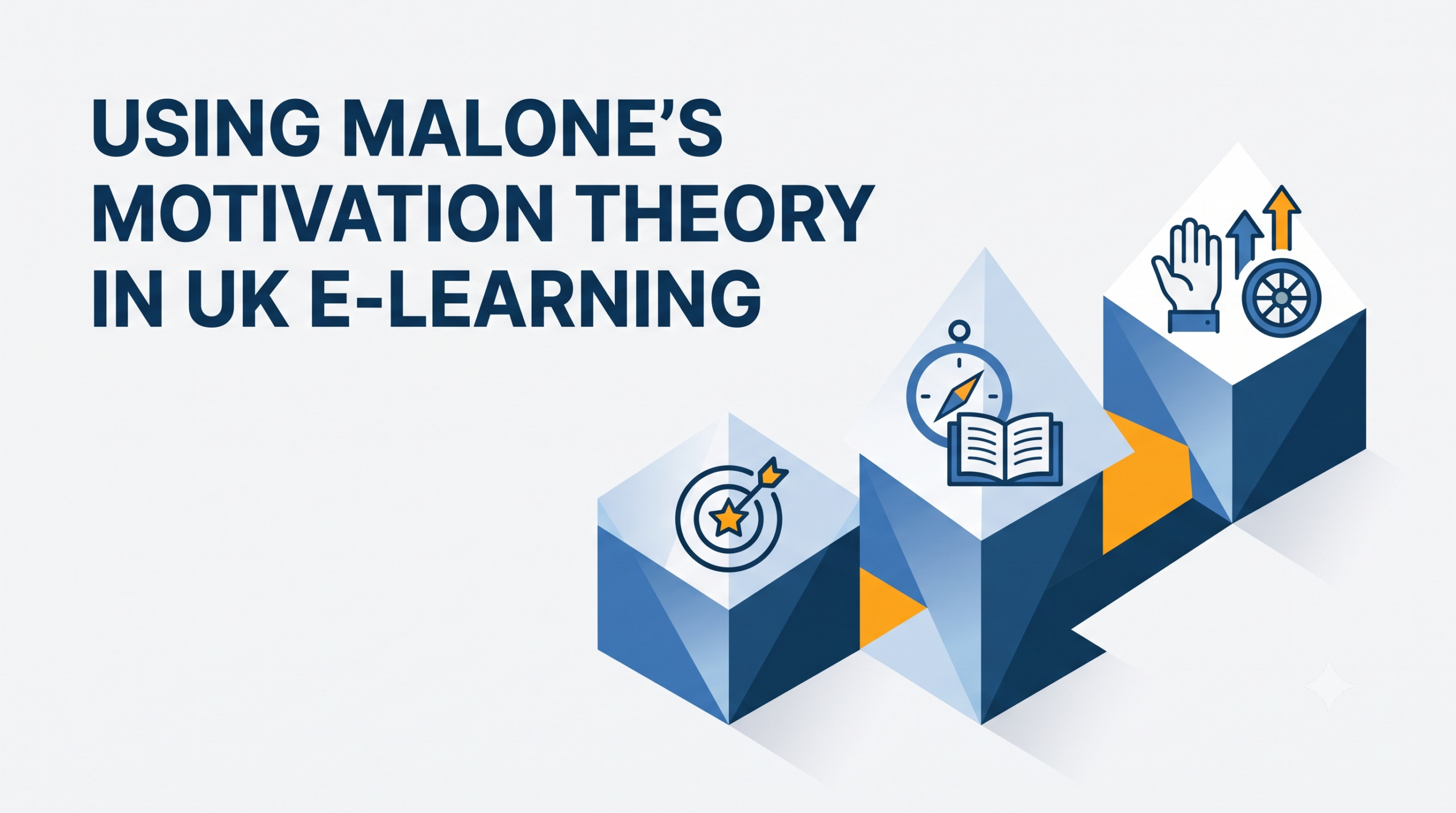
That thinking translates surprisingly well into workplace learning. Instead of relying on external incentives alone, Malone argued that instruction should motivate learners from within. His framework centres on three connected ideas: curiosity, challenge and fantasy.
Although technology has changed dramatically since the theory was published, these three principles remain highly effective when designing digital learning.
Sparking Curiosity Before Delivering Content
Curiosity is often the first opportunity to capture a learner’s attention. If people immediately understand every answer, there is little reason to stay engaged. Good learning design creates questions before it provides solutions.
Malone divides curiosity into sensory and cognitive elements. Sensory curiosity comes from presenting information in visually interesting ways, while cognitive curiosity encourages learners to think, predict and solve problems.
In e-learning, this might include interactive scenarios, branching decisions, short video sequences, realistic simulations or puzzles that encourage learners to investigate rather than simply read.
AI-powered learning tools can also adapt questions based on learner performance, helping maintain interest without making activities repetitive. Rather than presenting information as a static presentation, the learner becomes an active participant throughout the course.
Creating the Right Level of Challenge
Challenge is another essential ingredient of intrinsic motivation. Learning should never feel impossible, but it should require genuine effort.
Malone describes three important aspects of challenge. Learners need achievable goals, they need to understand exactly what success looks like, and they need regular feedback throughout the experience.
These principles fit naturally into self-paced digital learning. A well-designed module gradually increases complexity as confidence grows. Early activities introduce core concepts before moving towards more realistic workplace situations.
Learning objectives should be introduced clearly at the beginning of each module and revisited during the course. This helps learners recognise their own progress and understand why each activity matters.
Feedback is equally important. Modern e-learning allows organisations to provide immediate responses to quizzes, practical exercises and decision-making scenarios. AI can also identify common mistakes across large learner groups, helping Learning and Development teams improve future training while giving individuals personalised guidance.
Making Learning Feel Real
The word “fantasy” can sound unusual in a business setting, but Malone was not suggesting every course should resemble a computer game.
Instead, fantasy refers to creating meaningful situations where learners can apply knowledge in realistic contexts. When people can imagine themselves using a skill at work, motivation naturally increases.
For example, a cybersecurity course might place learners in the role of an employee responding to a suspected phishing attack. A management programme could ask learners to handle difficult conversations with team members. Health and safety training may require participants to identify hazards before an incident occurs.
These scenarios help learners connect theory with practice. Rather than memorising information for an assessment, they begin thinking about how they would respond in their own workplace.
Custom e-learning makes this particularly effective because scenarios can reflect an organisation’s actual procedures, terminology and working environment.
Applying the Theory Across UK Organisations
Many UK employers are already moving towards learning experiences that reflect Malone’s principles, even if they do not explicitly reference the theory.
An NHS Trust may use realistic patient scenarios during clinical training. A local authority might develop interactive safeguarding exercises instead of relying solely on policy documents. Financial services organisations increasingly use branching simulations to help staff practise regulatory decisions before encountering them with customers.
These approaches encourage employees to think, make decisions and experience realistic consequences within a safe learning environment.
For organisations investing in digital learning, the objective should be more than simply meeting compliance requirements. Learning should build confidence and encourage better workplace behaviour long after the course has been completed.
Supporting UK Learning Standards
For UK employers, learner engagement is only one part of effective training. Digital learning should also support wider organisational objectives and meet relevant standards where appropriate.
Learning programmes may contribute towards professional development recognised by bodies such as the CIPD, support health and safety responsibilities under HSE guidance, or reinforce internal policies aligned with UK GDPR and the Data Protection Act 2018.
Motivating learning experiences are therefore not simply about increasing completion rates. They also help employees retain knowledge, apply it consistently and demonstrate competence in real working situations.
Bringing Malone’s Ideas into Modern E-Learning
Today’s learning technologies provide far more opportunities than were available when Malone first published his research.
Interactive branching scenarios, AI tutors, adaptive assessments, immersive simulations and collaborative learning environments all support the principles of curiosity, challenge and meaningful application.
The technology itself is not the objective. The goal is designing learning that encourages people to think, explore and solve problems.
When organisations combine thoughtful instructional design with modern digital learning tools, employees become active participants rather than passive observers. That is where lasting learning begins.
At Capytech, we apply these instructional design principles when developing custom e-learning, AI-powered learning experiences and the Capytech LMS solutions for UK organisations. By focusing on learner motivation alongside business objectives, organisations can create training that delivers measurable improvements in engagement, knowledge retention and workplace performance.
See your own training as e-learning, free
Send us one document and we will turn it into an interactive demo module, so you can judge the quality before you spend anything.