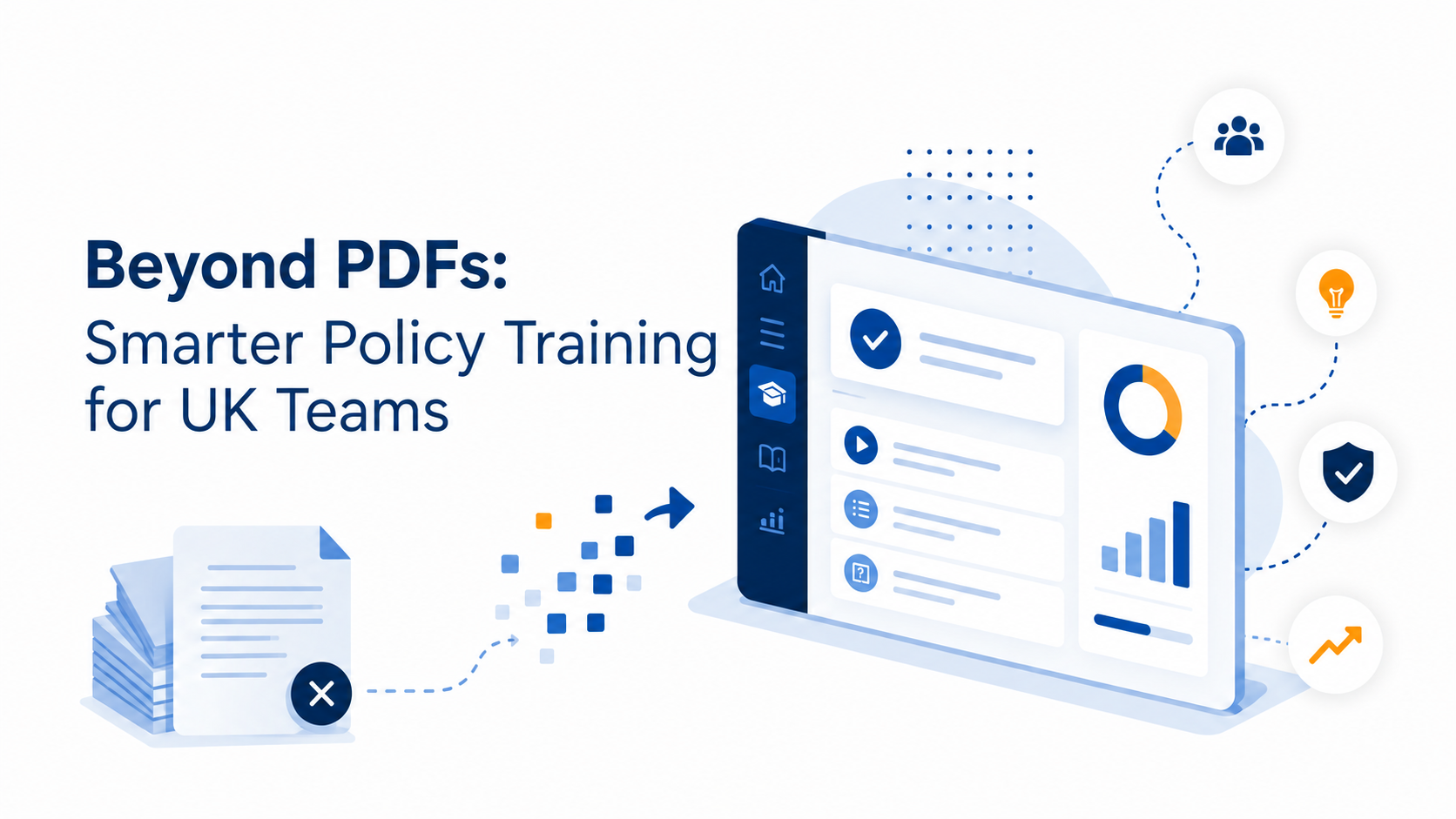

Most UK organisations still rely on the same approach when updating company policies. A long PDF lands in everyone’s inbox on Monday morning, followed by a request to reply with “read and understood”. By Friday, HR has a folder full of email confirmations, but very little confidence that anyone has actually absorbed the information.
The problem becomes more serious when policies cover health and safety, data handling, safeguarding, or compliance. A signed acknowledgement is not the same as understanding. If an incident happens later, organisations may struggle to show that employees genuinely learnt what was expected of them.
Why Passive Reading Rarely Works
People do not retain information well when they are expected to sit through pages of formal text without interaction. A 40-page policy document competes with emails, meetings, deadlines, and everyday distractions. Most employees skim sections, jump to the final page, or save the file for “later” and never return to it.
This creates a weak point for the organisation. The document exists, but there is no reliable way to measure whether staff understood the content or could apply it in a real situation.
Interactive digital learning changes that behaviour. Instead of asking employees to passively consume information, it asks them to participate. Short learning sections, scenario-based questions, and quick knowledge checks help learners stay focused and improve recall.
Turning Policies Into Learning Experiences
Modern e-learning does far more than convert a PDF into slides with buttons. A well-designed FastTrack module restructures information so employees can process it in manageable sections.
An IT security policy, for example, can become an interactive exercise where staff identify phishing attempts and choose the correct response. A safeguarding procedure can include branching scenarios that test decision-making under pressure. Health and safety guidance can be presented as a visual walkthrough of a workplace environment rather than a block of text.
This matters because people learn more effectively when content feels relevant to their role. Employees are far more likely to remember a realistic workplace scenario than a paragraph of legal wording.
Capytech’s FastTrack approach focuses on making compliance content practical and visually engaging without losing the accuracy of the original policy.
The Reporting Advantage HR Teams Actually Need
One of the biggest limitations of PDF distribution is the lack of evidence. Sending an email proves distribution, not understanding.
With SCORM-compliant learning modules delivered through platforms such as the Capytech LMS, organisations can track meaningful learning data. HR and compliance teams can see who completed the training, how long learners spent on each section, and which questions caused difficulty.
That insight helps organisations improve policies over time. If large numbers of employees misunderstand a specific section, the issue may not be staff behaviour at all. The wording itself may need simplifying.
More importantly, organisations gain a measurable audit trail. Completion records and assessment scores provide evidence that training took place and that employees achieved the required standard.
UK Compliance Expectations Are Changing
Across the UK, regulators and employers increasingly expect evidence-based training rather than tick-box acknowledgement exercises.
Under the Health and Safety Executive guidance, employers are responsible for providing adequate information, instruction, and training to staff. The same principle applies to data protection responsibilities under the UK GDPR and the Data Protection Act 2018.
For sectors such as healthcare, education, construction, and financial services, proving employee understanding is becoming just as important as issuing the policy itself.
A local authority, NHS Trust, or large employer facing an investigation may need to demonstrate not only that guidance existed, but also that staff completed relevant learning and passed assessments linked to it.
This is where trackable digital learning provides far stronger evidence than an archived email thread.
Better Learning Reflects Better Workplace Culture
Employees notice when organisations invest effort into communication and training. A poorly formatted PDF sent without context often feels like an administrative exercise. Interactive learning feels more intentional.
That difference shapes engagement. Staff are more likely to take compliance seriously when the training is clear, relevant, and professionally presented.
Visual content, practical examples, and concise learning journeys also respect employees’ time. Rather than forcing staff through lengthy documents in one sitting, micro-learning allows them to complete training in shorter, manageable sessions during the working week.
For organisations managing hybrid teams across Manchester, Birmingham, London, or multiple UK offices, this flexibility is increasingly important.
From “Read and Understood” to Measurable Learning
Policies will always remain essential business documents. The question is whether organisations want employees to simply receive them or genuinely understand them.
Moving policy training into interactive e-learning creates clearer accountability, stronger reporting, and better engagement. It also reduces organisational risk by replacing assumptions with measurable evidence.
For HR leaders, compliance managers, and L&D teams, that shift is no longer a nice extra. It is becoming part of responsible workplace training practice across the UK.
Turn your policies into training people remember
Send us one policy or procedure and we will turn it into an interactive demo module, free, so you can judge the quality first.