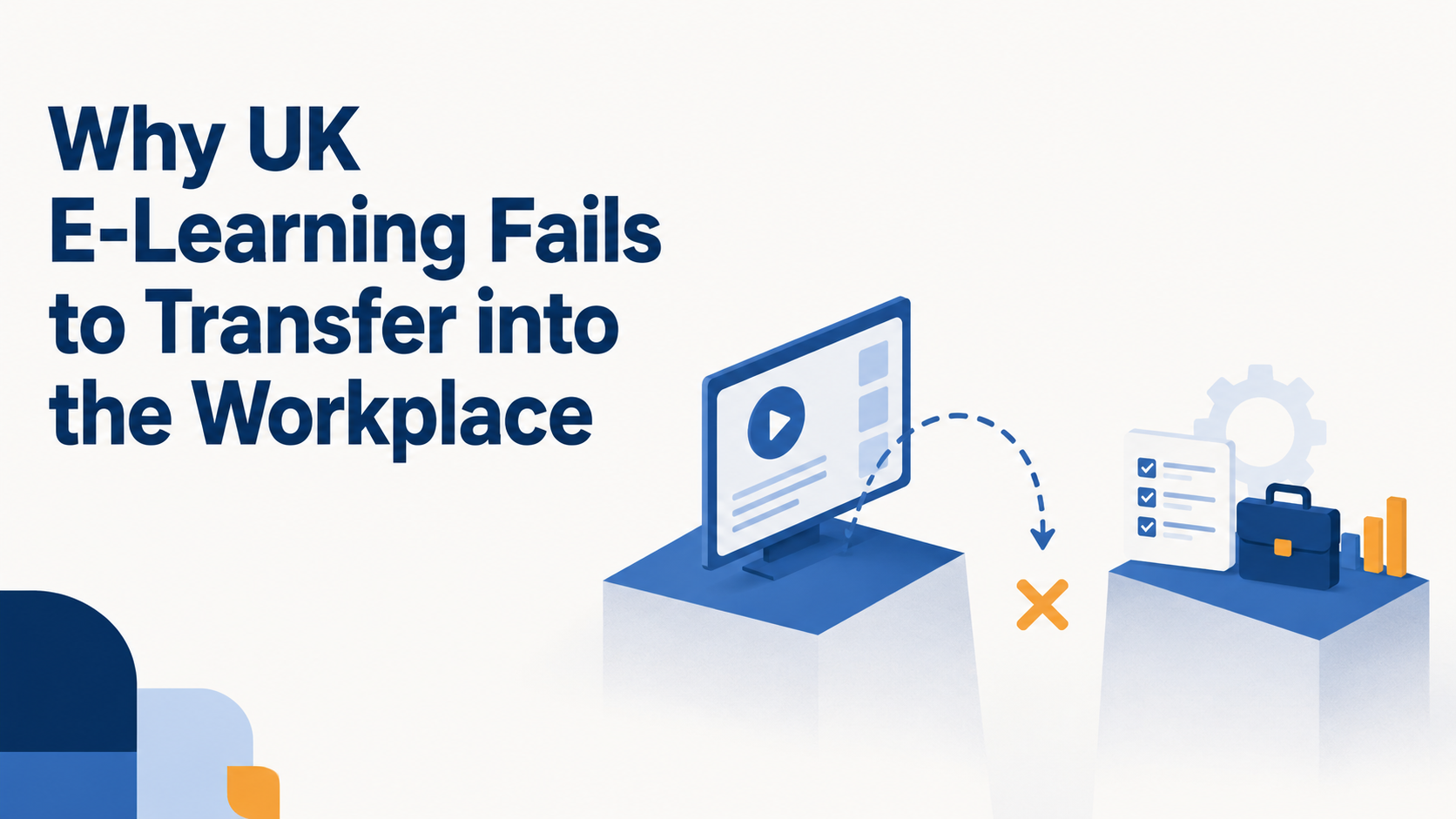

For many UK organisations, completing e-learning is easy to measure. You can see who logged in, who finished the module and who passed the assessment. The harder question comes later: does the employee actually do anything differently at work?
Imagine a new starter completing data protection training on Friday. They achieve a high score, but a few weeks later they still handle personal information in the same way as before. The course delivered knowledge, but the learning did not transfer into day-to-day behaviour. That gap matters because training only creates business value when people can use what they have learnt.
Learning transfer is the point where knowledge, skills and attitudes move from the training environment into real work. It can affect safety, compliance, productivity, customer service and performance. If your organisation is investing in e-learning, understanding why transfer breaks down should be part of the design process, not an afterthought.
Learning Transfer Starts Before the Course
A common mistake is to treat the course itself as the whole training intervention. The learner opens the module, completes the activities and passes the assessment. Everyone assumes the job is done.
In practice, successful transfer involves several connected stages. Before training, employees need to understand why the learning matters, what they are expected to achieve and how it relates to their role. During training, they need useful information, realistic examples and opportunities to practise. Afterwards, they need the time, support and opportunity to apply the new behaviour.
Over time, repeated application can turn a new skill into a normal part of the job. That is when training starts to influence performance rather than simply completion statistics.
Why Good E-Learning Can Still Fail
The most engaging course cannot compensate for poor conditions around it. Organisations often concentrate their effort on the part they can control most easily, the content. They spend time refining screens, assessments and interactions while giving less attention to what happens before and after the learner completes the course.
This creates a familiar pattern. The learner understands the course, passes the quiz and then returns to a workplace that rewards the old way of working.
For example, an employee may learn a new process through an interactive scenario but have no access to the required system when they return to their desk. A manager may complete leadership training but have no time allocated for coaching conversations. A safety course may explain the correct procedure, while the workplace lacks the equipment needed to follow it.
The problem is not necessarily the quality of the course. The wider learning environment has not been designed to support transfer.
Remove the Barriers That Stop People Applying Learning
Learners can resist training for reasons that have little to do with the content itself. They may not see a personal benefit, lack confidence, worry about making mistakes or believe that the training conflicts with their priorities.
The first step is to understand the barrier. Is the employee missing knowledge, or do they already know what to do? Are they lacking a skill, confidence or motivation? Is the requested behaviour realistic within their role?
Context matters too. A new process may look sensible during training but feel impractical when an employee is dealing with a busy workload, customer demands or competing deadlines. Training should reflect the conditions in which people will actually use the learning.
This is one reason scenario-based e-learning can be effective. Learners can practise decisions in situations that resemble their working environment, receive feedback and see the consequences of different choices before facing them on the job.
Managers Have a Major Role After Training
Line managers can make or break learning transfer. Employees are more likely to use new skills when their manager understands the purpose of the training and gives them opportunities to apply it.
That support does not need to be complicated. A manager might discuss the learning during a one-to-one, observe a new behaviour, provide feedback or agree on a practical action for the employee to try during the following week.
Managers also need the information and confidence to support the programme. If they have not been briefed, they may unintentionally undermine the training by continuing to encourage old processes or prioritising short-term output over the new behaviour.
For larger organisations, this can be built into the learning journey through manager guides, follow-up activities, reminders and reporting through an LMS such as the Capytech LMS.
Build the Workplace Conditions for Transfer
Even motivated employees cannot apply learning if the organisation does not give them a fair opportunity to do so.
Consider the practical requirements. Does the employee have access to the right software, equipment, information and documentation? Is there enough time to practise? Do policies support the behaviour being taught? Can subject matter experts or colleagues provide help when questions arise?
These questions are particularly important for compliance and safety training. A learner who completes IOSH-approved training, for example, may understand the correct approach but still need suitable workplace procedures, equipment and management support to put that knowledge into practice. Capytech currently offers IOSH-approved online safety training for UK organisations.
Training teams should therefore involve relevant stakeholders before launch. Managers, HR, subject matter experts and operational teams can identify barriers that may otherwise only become visible after the course has been completed.
Measure More Than Completion and Quiz Scores
Completion rates and assessment results are useful, but they do not prove learning transfer.
A stronger evaluation process looks at what happens after training. Depending on the objective, this could include changes in error rates, audit findings, customer feedback, safety incidents, productivity measures or manager observations.
The right measures should be linked to the original learning objective. If the aim is to improve phishing awareness, for example, the organisation could monitor reporting behaviour rather than relying only on a multiple-choice test. If the aim is better management practice, feedback from employees and managers may be more useful than a course score.
Digital learning platforms can help bring completion data and follow-up information together. AI-powered learning tools can also provide additional practice and feedback, although technology should support the learning strategy rather than replace workplace support. Capytech’s UK offering includes AI-powered learning tools and the Capytech LMS capabilities designed to support wider learning programmes.
A UK Example: From Compliance Training to Behaviour Change
Consider a local council introducing updated data protection procedures. Employees complete an e-learning module covering the UK GDPR and the Data Protection Act 2018. They pass the assessment, so the training appears successful.
However, the organisation wants more than evidence of completion. Before the course, managers explain why the changes matter and identify common risks in their teams. During the course, employees work through realistic scenarios involving personal data. Afterwards, managers reinforce the process during team meetings and check whether staff are following the updated procedures.
The organisation then reviews relevant audit findings and recurring errors. If problems remain, the learning team can identify whether another course is actually needed or whether the barrier sits elsewhere, such as unclear procedures, limited access or a lack of management support.
This approach turns e-learning from a one-off compliance task into part of a wider performance improvement process.
Make Learning Transfer Part of the Design
The most useful question is not simply, “Did employees complete the course?” It is, “What needs to happen for employees to use this learning successfully at work?”
That means designing the journey before, during and after the course. Set clear objectives, explain the reason for the training, use realistic practice, involve managers and remove practical barriers. Give learners opportunities to apply their skills, then collect evidence of whether behaviour and performance have changed.
Capytech supports UK organisations with custom e-learning, AI-powered learning tools, FastTrack development and the Capytech LMS. Its custom e-learning service includes interactive scenarios and AI-supported learning experiences, while FastTrack is designed to turn existing documents and policies into SCORM-ready e-learning quickly.
Whether the subject is compliance, leadership, cybersecurity, health and safety or professional development, successful learning transfer depends on more than good content. When the course and the workplace work together, e-learning has a much better chance of changing behaviour and delivering a measurable return on investment.
See your own training as e-learning, free
Send us one document and we will turn it into an interactive demo module, so you can judge the quality before you spend anything.