
Imagine a new employee joining an NHS Trust, local council or private business. They can read a policy, complete a quiz and score 100%, but what happens when they face the same situation at work? Knowing the information is one thing. Knowing how to use it under pressure is another.
This is where experiential learning becomes useful. David Kolb’s learning theory, first developed in the 1980s, puts experience and reflection at the centre of the learning process. While the theory and its associated learning styles have attracted criticism over the years, the underlying cycle still offers useful ideas for designing practical workplace e-learning.
Rather than treating online training as a process of reading information and answering questions, organisations can design learning around four connected activities: experiencing something, reflecting on it, making sense of it and trying again in a new situation.
What Is Kolb’s Experiential Learning Cycle?
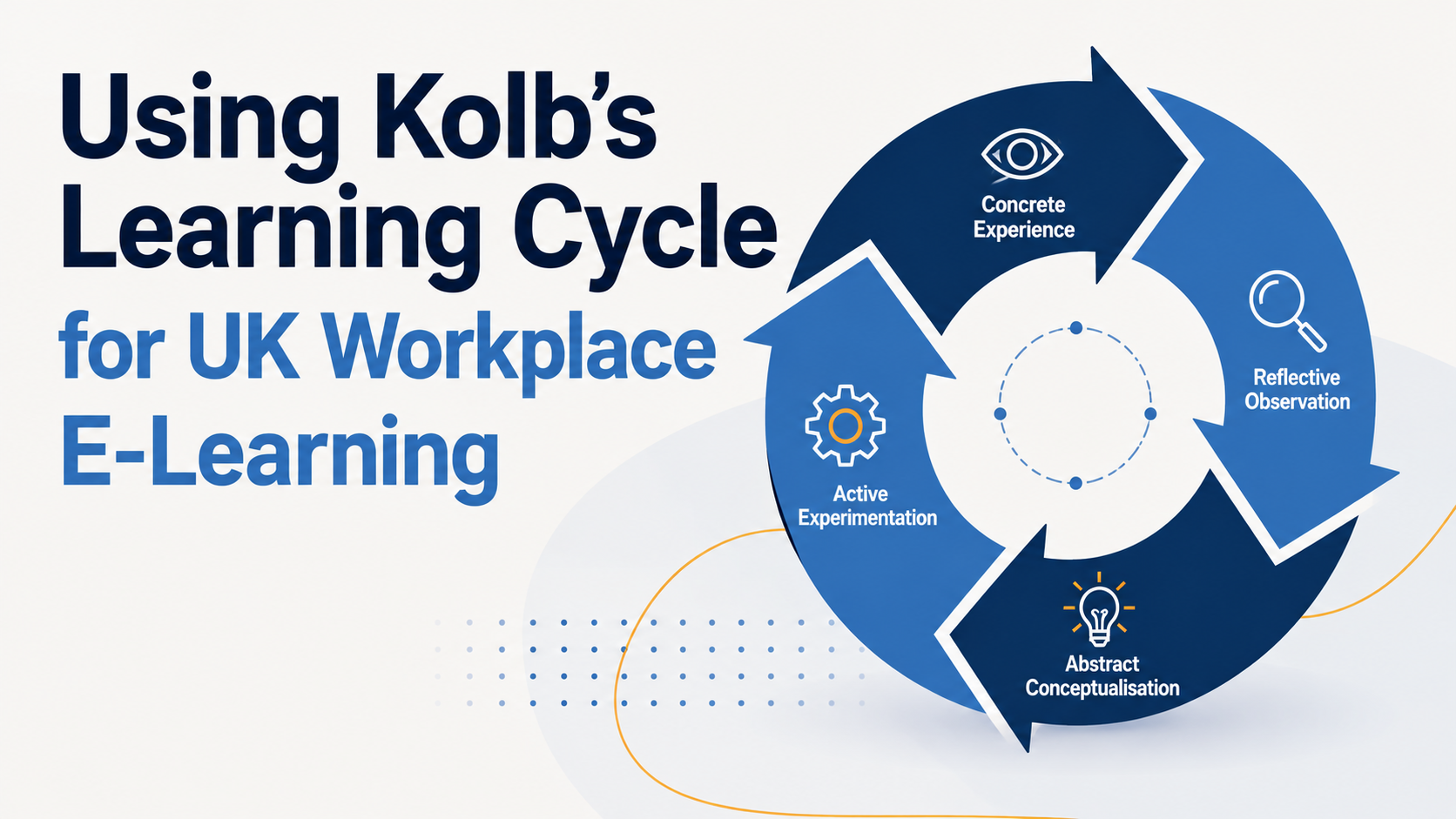
Kolb’s model describes learning as a continuous cycle rather than a single event. A learner starts with an experience, thinks about what happened, develops an understanding or principle, and then tests that understanding through further action.
The four stages are:
Concrete Experience, where the learner encounters or performs an activity.
Reflective Observation, where they consider what happened and why.
Abstract Conceptualisation, where they develop an explanation, principle or broader understanding.
Active Experimentation, where they apply that understanding to another situation.
The important point for e-learning designers is that learners do not have to stop at knowledge acquisition. Digital training can give people opportunities to practise, reflect, receive feedback and apply what they have learnt.
Start With a Realistic Learning Experience
The first stage is Concrete Experience. In a traditional setting, this could involve a practical workshop, laboratory exercise, fieldwork or workplace task.
Online learning cannot always reproduce a physical environment, but it can create realistic experiences through well-designed digital activities.
A safety course, for example, might place an employee in a simulated workplace and ask them to identify hazards. A customer service programme could present a difficult conversation and ask the learner to decide how to respond. A management course might put a new supervisor into a scenario involving poor performance or team conflict.
Video, animation, interactive exercises and branching scenarios can all help create this experience. Capytech’s custom e-learning approach can also incorporate AI-powered scenarios and interactive practice, allowing learners to make decisions rather than simply watch a presentation.
For UK organisations, this could be particularly useful when training involves situations that are difficult, expensive or risky to reproduce in real life.
Give Learners Time to Think About What Happened
Experiencing a scenario is only the beginning. Kolb’s second stage, Reflective Observation, asks learners to consider the experience and examine their own decisions.
What went well? What could have been handled differently? Which part of the situation was difficult? What information was missing?
E-learning can support this through reflective questions, written responses, discussion activities, learner journals and facilitated forums. A course might ask an employee to explain why they selected a particular response before showing them an expert explanation.
Social learning can add another dimension. Learners can compare their approaches with colleagues, discuss different outcomes and receive guidance from a tutor or subject matter expert.
This is especially useful in management, leadership and behavioural training, where there may not be one simple answer to a workplace problem.
Turn Reflection Into Understanding
The third stage, Abstract Conceptualisation, is where the learner begins to form a broader understanding from the experience.
Instead of simply remembering that one answer was correct, they start to understand the principle behind it.
For example, a learner who has completed a difficult employee conversation might begin to recognise the importance of preparation, active listening and clear communication. A learner completing safety training might identify patterns that help them recognise hazards before an incident occurs.
Digital learning can support this process with explanations, expert commentary, tutorials, reference materials and interactive activities. The aim is to help learners connect their experience with a wider concept that they can use elsewhere.
This is also where instructional design matters. Content should not simply tell learners what they should know. It should help them understand why the knowledge matters and how it relates to their role.
Put the Learning Into Practice
Active Experimentation is the point at which the learner tests their new understanding.
This could be as simple as completing another scenario with different circumstances. It could also involve a more complex simulation in which decisions lead to different outcomes.
Consider a manager who has just completed training on handling difficult conversations. Rather than ending the module with a multiple-choice test, the next activity could present a different employee situation and ask the manager to choose an approach.
The learner can then see the consequences of that decision, receive feedback and try again.
Gamification can strengthen this stage by introducing challenges, scores, progress indicators or scenario-based goals. Used thoughtfully, these elements can make practice more engaging without turning the learning into a game for its own sake.
Capytech’s custom e-learning services support features such as branching scenarios, gamification and AI-supported learning experiences, making this type of practical application possible within digital training.
A UK Workplace Example: From Compliance to Behaviour
Consider a UK organisation introducing workplace health and safety training.
A conventional online course might explain the relevant procedures, show a few videos and finish with a knowledge test. That approach can confirm whether employees remember information, but it may not show whether they can apply it.
A Kolb-inspired approach could begin with a realistic workplace scenario. The learner identifies a hazard and chooses what to do. They then review the consequences of their decision and reflect on what they might have missed.
The course introduces the relevant safety principles and explains why the correct approach matters. The learner then faces a new scenario and applies those principles again.
For health and safety programmes, this practical approach can sit alongside formal requirements and recognised training. Capytech provides online IOSH-approved safety training for UK organisations, with digital delivery allowing employees to complete learning without always requiring a classroom session.
The same principle can apply to leadership, customer service, data protection and other areas where workplace behaviour matters as much as knowledge.
Kolb and Modern UK E-Learning Platforms
A learning cycle also becomes easier to manage when the technology supports more than course completion.
An LMS can provide the central environment for delivering activities, recording progress and identifying where learners need additional support. Capytech’s UK LMS offering includes features such as AI scenario creation, learner analytics, mobile access and support for different learning environments.
For example, an organisation could use an LMS to deliver a scenario-based module, record assessment results, provide additional learning to employees who need it and track completion across departments.
AI-powered learning tools can add further interaction. An AI Tutor can answer learner questions, while AI-driven scenarios can give employees opportunities to practise decisions in a more conversational setting.
The technology should support the learning objective, though. Adding AI or gamification simply because it is available does not automatically make a course better. The experience still needs to reflect what learners actually need to do in their jobs.
Where Kolb’s Model Works Best
Kolb’s cycle is particularly relevant when learners need to apply knowledge rather than simply recall it.
It can work well for leadership development, customer service, workplace safety, compliance, technical procedures and other subjects where decisions and behaviour are important.
It is also useful for blended learning. An online module could provide the initial scenario and theory, followed by a workshop where employees discuss their experiences and practise the skill with colleagues. The learning platform can then provide follow-up activities to reinforce the behaviour.
For organisations supporting continuing professional development, this creates a stronger connection between formal training and everyday work.
Is Kolb’s Theory Still Useful?
Kolb’s learning theory should not be treated as a perfect formula for how every individual learns. The learning-style element of the wider model has been questioned, and learners should not necessarily be placed into fixed categories.
The more useful lesson is the emphasis on learning through experience, reflection, understanding and practice.
For UK L&D teams, that provides a practical way to ask a simple question: does this training give employees enough opportunity to do something with what they have learnt?
A course can contain accurate information and still have little effect on workplace behaviour. Adding realistic scenarios, reflection, explanation and repeated practice can make the connection between training and performance much stronger.
Whether an organisation is developing bespoke e-learning, delivering IOSH-approved safety training or managing learning through an LMS, Kolb’s cycle can provide a useful framework for thinking about that connection.
The goal is not to follow the model rigidly. It is to design learning that gives people a chance to experience, think, understand and practise, then take those lessons back into their working lives.
See your own training as e-learning, free
Send us one document and we will turn it into an interactive demo module, so you can judge the quality before you spend anything.