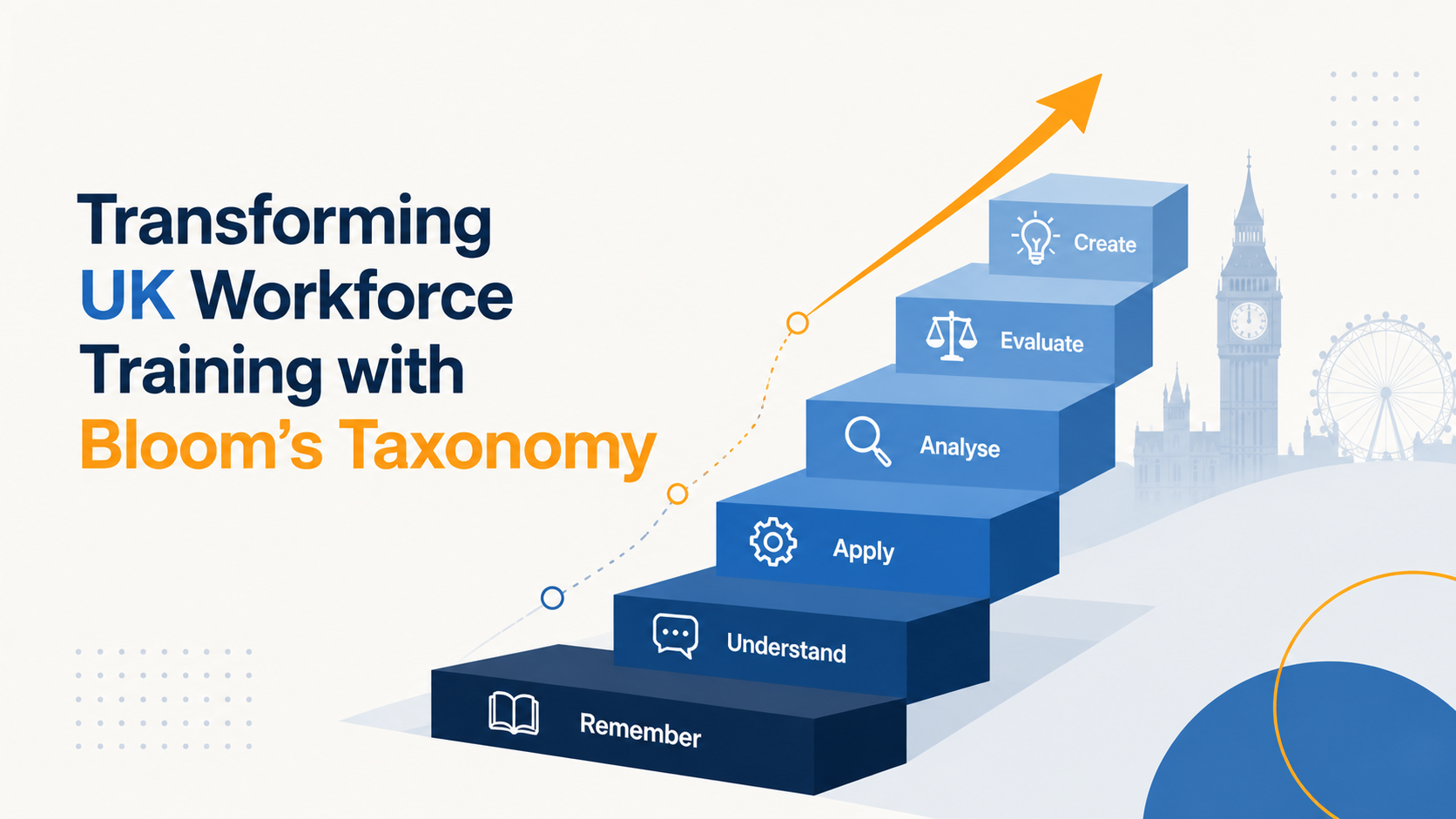

Welcome to the second installment in our guide to key instructional design frameworks for digital learning. In this post, we explore Bloom’s Taxonomy, a foundational pedagogical model widely used across the UK education and corporate sectors. From FTSE 100 businesses in London to NHS Trusts and regional councils, structuring training around clear cognitive steps is essential for building real workplace capability.
UK organisations face continuous pressure to reskill employees, ensure compliance with evolving domestic standards, and deliver measurable ROI on learning programs. By aligning digital content with Bloom’s Taxonomy, learning teams can move beyond simple tick-box exercises. This approach creates structured pathways that turn basic recall into practical, on-the-job competence.
Understanding the Framework: Six Levels of Learning
Created in 1956 and revised in 2001, the model outlines six progressive stages of cognitive development. Learners build mastery at lower tiers before moving to advanced applications.
- Remembering: Retrieving relevant facts, definitions, or core information.
- Understanding: Grasping the meaning of material and explaining concepts in context.
- Applying: Using knowledge in new situations, tasks, or realistic scenarios.
- Analysing: Breaking down information to explore relationships and underlying causes.
- Evaluating: Making informed judgements based on criteria and standards.
- Creating: Combining elements to generate new ideas, workflows, or solutions.
The primary goal in corporate training is to move employees past mere recall and understanding. High-performing organisations rely on higher-tier skills to drive innovation, improve risk management, and foster sharper critical thinking.
How Bloom’s Taxonomy Enhances Course Development
As a structured development framework, this model helps instructional designers craft target learning outcomes. Clear objectives ensure digital training directly matches both learner requirements and business goals.
The framework also offers a reliable benchmark for measuring training performance. By matching assessment strategies directly to the intended cognitive level, organisations gain clearer insights into true skill acquisition.
Flexible Implementation Across Skill Levels
Although the stages build on one another sequentially, employees do not always need to start at the bottom. Experienced staff often already possess foundational knowledge.
In these cases, digital modules should skip basic retention exercises and focus directly on analysis, evaluation, and problem-solving.
Breaking Down the Cognitive Levels in Digital Learning
Level 1: Remembering
This foundational stage focuses on information retention. In digital training, key tools include clear text summaries, diagrams, explanatory audio, and knowledge-check quizzes. Typical outcomes include recalling internal policies, health and safety guidelines, or product details.
Level 2: Understanding
Understanding goes beyond basic memory. It requires staff to interpret what information means for their daily roles. Interactive modules, contextual examples, and practical summaries help bridge this gap, enabling staff to explain or compare core concepts accurately.
Level 3: Applying
Effective corporate training aims to influence real-world behaviour. At this stage, learners put theory into practice. Branching scenarios and practical simulations allow staff to apply procedures, use software systems, or handle routine customer interactions safely.
Level 4: Analysing
Analysis requires a deeper examination of complex topics. Advanced scenarios help learners break down multi-step problems, identify root causes, and compare alternative approaches. This level is vital for roles requiring sound technical decisions or risk assessments.
Level 5: Evaluating
At the evaluation stage, staff assess situations and make sound judgements without straightforward answers. Training at this level presents nuanced challenges, requiring learners to justify their choices against industry standards, internal guidelines, or legal constraints.
Level 6: Creating
The highest level challenges learners to synthesise their knowledge to build original solutions. Digital activities at this tier prompt users to draft new strategies, refine team workflows, or design process improvements that boost operational efficiency.
Aligning Bloom’s Taxonomy with UK Compliance and Apprenticeships
In the UK, integrating this framework helps align corporate training with formal regulatory standards. For instance, mandatory updates on UK GDPR, the Data Protection Act 2018, or HSE safety regulations require more than surface memory. Staff must understand concepts deeply enough to apply them correctly and prevent regulatory breaches.
Furthermore, organisations using the UK Apprenticeship Levy or offering TQUK-accredited programmes can use Bloom’s Taxonomy to map training modules directly to required Knowledge, Skills, and Behaviours (KSBs). This ensures smooth compliance during internal reviews and Ofsted inspections.
Maximising Impact Beyond Digital Modules
To get the best results from this model, digital modules should form part of a broader learning strategy. Combining custom digital courses with mentor support, practical workplace tasks, and platforms like the Capytech LMS creates a complete environment for continuous development.
See your own training as e-learning, free
Send us one document and we will turn it into an interactive demo module, so you can judge the quality before you spend anything.