
Good workplace learning does more than help people remember information. It should give employees the confidence to apply new knowledge, solve problems, make informed decisions, and improve the way they work every day. That is why many UK organisations use instructional design frameworks that focus on measurable learning outcomes rather than simply delivering content.
Bloom’s Taxonomy remains one of the most widely recognised models for achieving this. Whether you are developing compliance training for an NHS Trust, onboarding new employees in a growing business, or creating leadership programmes for a national organisation, the framework provides a practical way to structure learning that builds competence over time.
What Is Bloom’s Taxonomy?
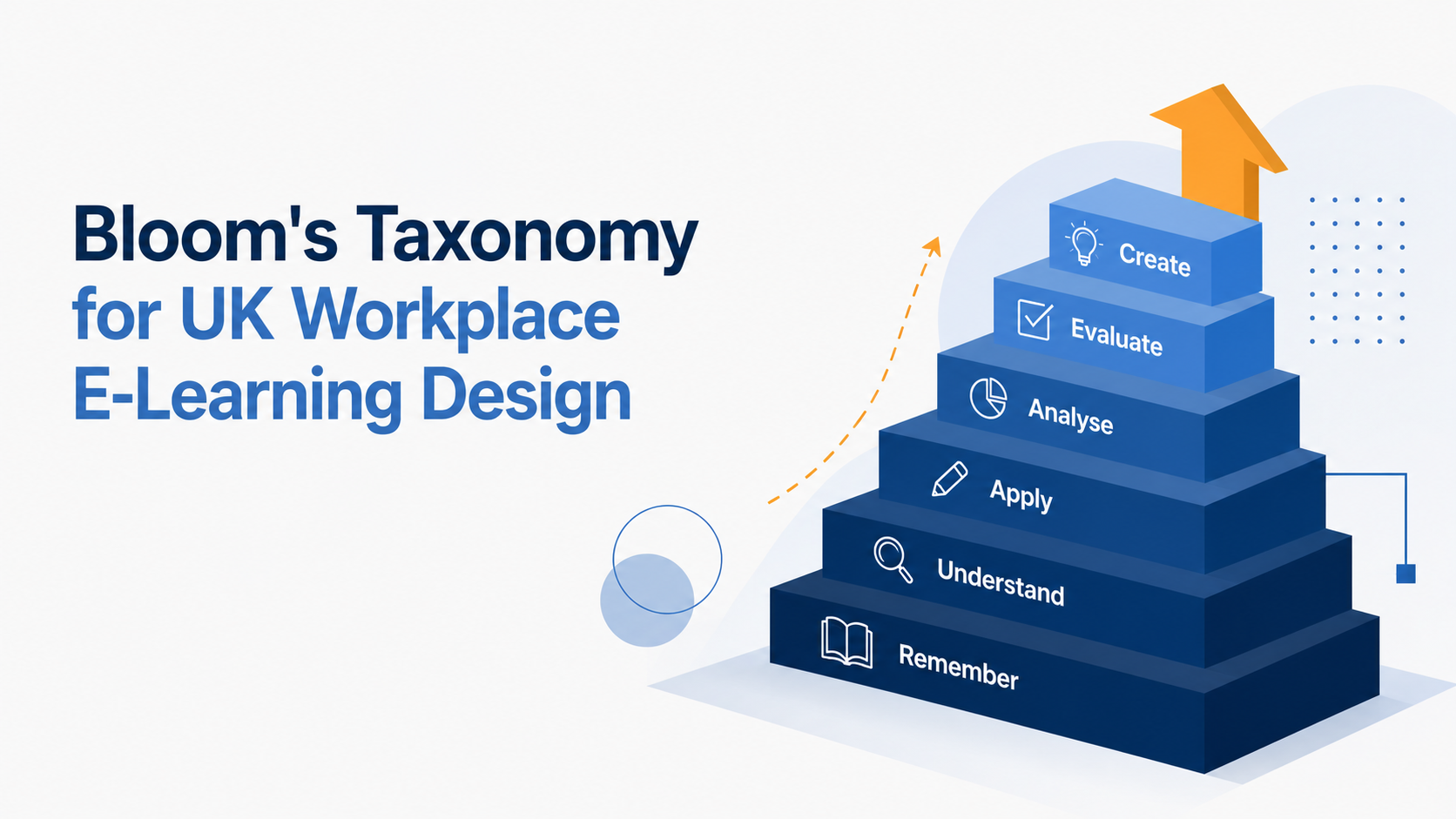
Originally introduced in 1956 and revised in 2001, Bloom’s Taxonomy categorises learning into six progressive levels. Each stage represents a deeper level of understanding and capability, helping instructional designers create courses that move learners beyond memorising facts.
The six stages are remembering, understanding, applying, analysing, evaluating, and creating.
Although these stages are often presented as a hierarchy, they should not be viewed as a rigid sequence. Experienced employees may already possess the knowledge required at the earlier stages, allowing training to focus on higher-order thinking and workplace performance.
For organisations investing in custom e-learning, Bloom’s Taxonomy offers a reliable structure for defining learning objectives, selecting suitable activities, and measuring success.
Start With Clear Learning Outcomes
One of the biggest strengths of Bloom’s Taxonomy is its ability to shape meaningful learning objectives.
Rather than creating content because information needs to be shared, instructional designers begin by asking what learners should actually be able to do once the course is complete. This keeps training aligned with business objectives and helps organisations evaluate whether learning has translated into improved performance.
For example, an induction programme should not simply expect employees to recall company policies. It should prepare them to apply those policies confidently in day-to-day situations.
Building Knowledge That Lasts
The first two levels, remembering and understanding, establish the foundations for future learning.
Remembering focuses on retaining essential facts, terminology and procedures. Interactive media, short videos, diagrams and knowledge checks all help reinforce memory.
Understanding moves learners beyond recall. At this stage they should be able to explain concepts in their own words, compare ideas, summarise information and recognise why procedures matter.
Making content relevant is especially important here. Employees are more likely to retain knowledge when examples reflect realistic workplace situations rather than abstract theory.
Turning Learning Into Practical Skills
The third level, applying, is where training begins to influence workplace behaviour.
Learners use their knowledge to complete tasks, follow procedures or solve familiar problems. Scenario-based learning is particularly effective because it mirrors situations employees are likely to encounter in their roles.
A customer service adviser, for example, might practise responding to difficult conversations. A finance employee could complete realistic exercises based on internal approval processes. The objective is to build confidence before employees face these situations in real working environments.
Developing Critical Thinking
As learners become more capable, Bloom’s Taxonomy encourages them to think more critically.
The analysing stage asks learners to identify patterns, examine evidence and determine why something has happened. Rather than following instructions, they investigate problems and identify relationships between different pieces of information.
Evaluating builds on this by requiring learners to make informed judgements. Employees compare options, justify recommendations and explain the reasoning behind their decisions, even when there is no single correct answer.
These higher-order skills are particularly valuable in leadership development, project management, healthcare, risk management and professional services, where sound judgement often matters as much as technical knowledge.
Supporting Innovation Through Creation
The highest level of Bloom’s Taxonomy is creating.
Here, learners combine everything they have learnt to produce something new. That could involve designing a process, writing guidance, improving a workflow, proposing a new service or developing training materials for colleagues.
For organisations investing in long-term capability, this stage represents genuine learning transfer. Employees are no longer following established processes. They are contributing ideas that improve the organisation itself.
Applying Bloom’s Taxonomy in UK Organisations
Many UK employers combine Bloom’s Taxonomy with practical workplace learning rather than relying solely on digital courses.
Blended learning programmes often include mentoring, coaching, workplace practice and collaborative projects alongside e-learning. This approach supports continuous development while allowing employees to apply new knowledge in real situations.
It also aligns well with guidance promoted by professional bodies such as the CIPD, which encourages organisations to measure learning through improved capability and business outcomes rather than course completion alone.
For regulated sectors, including health and social care, construction and financial services, this approach helps ensure employees can demonstrate competence, not simply complete mandatory training.
Bloom’s Taxonomy and Compliance Training
Compliance training often receives criticism because employees see it as a box-ticking exercise. Bloom’s Taxonomy helps change that mindset.
For example, training covering the UK GDPR and the Data Protection Act 2018 should not end with learners remembering legal definitions. Employees should understand how the legislation applies to their role, recognise potential risks, analyse realistic scenarios and make appropriate decisions when handling personal information.
The same principle applies to health and safety training, safeguarding, equality training and cyber security awareness. Effective learning prepares employees to respond correctly when real situations arise, not simply answer multiple-choice questions.
This is one reason many organisations pair frameworks such as Bloom’s Taxonomy with interactive custom e-learning, AI-powered learning tools and practical workplace activities that reinforce decision-making over time.
Why Bloom’s Taxonomy Still Matters
Despite being developed decades ago, Bloom’s Taxonomy continues to provide a practical framework for designing effective workplace learning.
Its value lies in keeping training focused on outcomes rather than content alone. Instead of asking what information should be included, instructional designers ask what learners should be capable of doing afterwards.
For organisations developing custom e-learning, implementing the Capytech LMS, or introducing AI-powered learning experiences, Bloom’s Taxonomy provides a proven structure that supports measurable learning, improved workplace performance and continuous professional development.
When combined with thoughtful instructional design and opportunities for real-world practice, it helps transform training from a one-off event into lasting organisational capability.
See your own training as e-learning, free
Send us one document and we will turn it into an interactive demo module, so you can judge the quality before you spend anything.