
Every successful workplace learning programme begins with a simple question. Why do employees need this training in the first place?
Many organisations invest significant time and budget into e-learning without first identifying the real performance issue they are trying to solve. The result is often a course that delivers information but fails to change behaviour or improve performance. Whether you are training new starters, supporting compliance, or introducing new processes, understanding the gap you are trying to close should always come before designing the learning experience.
Start by Identifying the Real Performance Gap
When someone is not performing as expected, the answer is not always more training. In many cases, people already know what to do but choose not to do it, or they understand the theory but have not developed the confidence to apply it consistently.
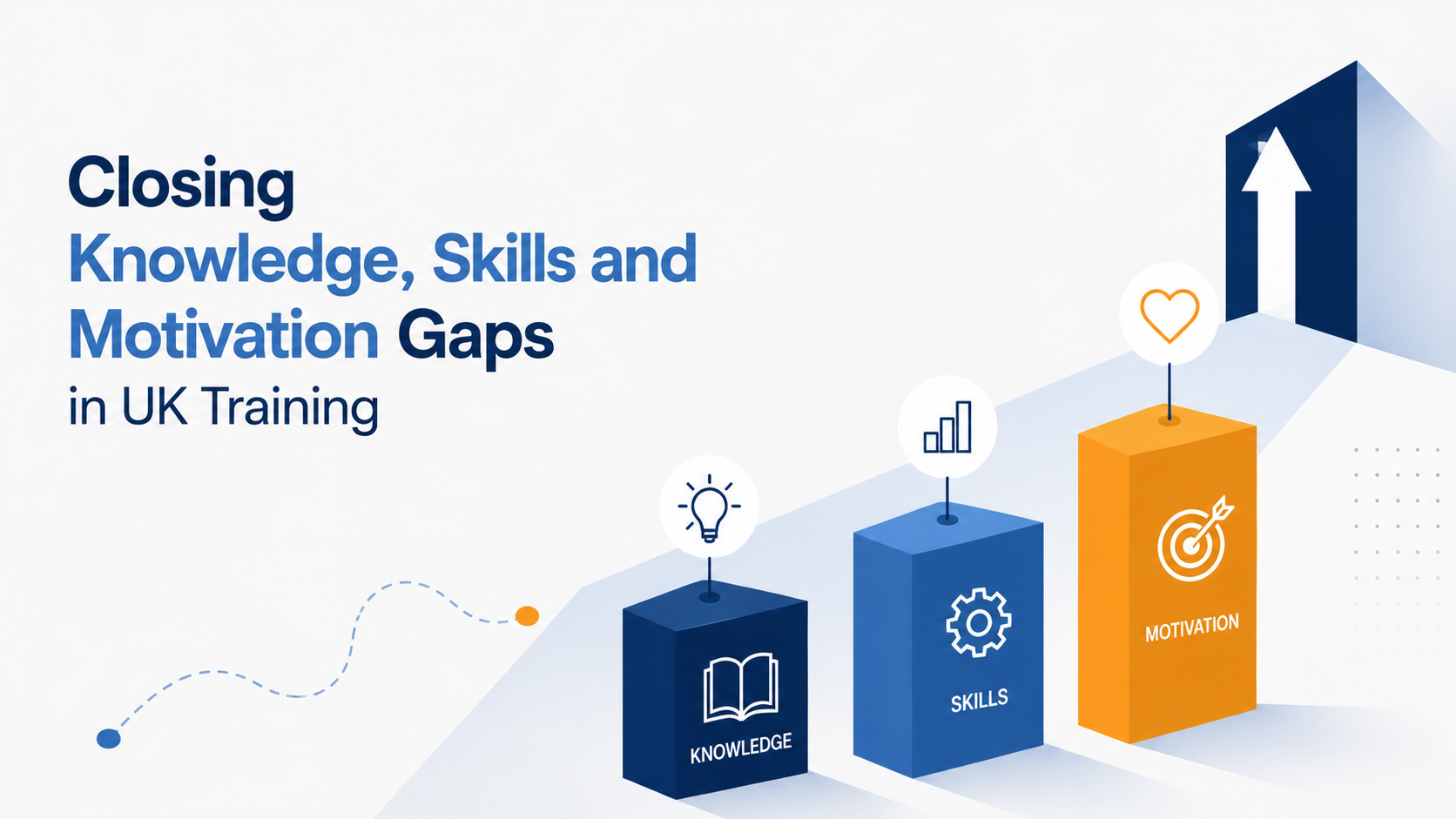
Most workplace learning challenges fall into one of three areas. People either need new knowledge, they need to build practical skills, or they need stronger motivation to put what they already know into practice. Identifying which of these applies will shape every decision you make about the course, from the content to the activities and assessments.
When Employees Need Better Knowledge
A knowledge gap exists when learners need information they do not currently have. This often happens during onboarding, when introducing new products or services, or when communicating changes to legislation, internal policies, or business procedures.
However, providing facts alone rarely changes workplace performance. Employees are much more likely to remember information when they understand how it applies to their day-to-day responsibilities.
For example, a sales team does not simply need a list of product features. They need to understand which customer problems the product solves, which conversations it supports, and how those benefits can be explained confidently during a sales meeting. Knowledge becomes more valuable when learners can see how to use it in realistic situations.
Skills Require Practice, Not Just Information
One of the most common mistakes in digital learning is treating skills as though they are simply another form of knowledge.
A useful way to tell the difference is to ask whether learners can perform successfully immediately after receiving the information. If they need repeated practice before becoming competent, the gap is one of skill rather than knowledge.
Presentation techniques, leadership conversations, customer service, software systems and safety procedures all require learners to apply what they have learnt. Reading about these activities is only the starting point. Confidence develops through realistic practice, feedback and repetition.
This is why effective custom e-learning often includes branching scenarios, simulations and interactive exercises rather than relying solely on text or video content.
Motivation Can Be the Missing Piece
Sometimes employees already have the knowledge and the ability to perform well, yet their behaviour does not change.
This motivation gap is frequently overlooked because it cannot be solved simply by adding more content. The underlying issue may be uncertainty about why a change is happening, lack of confidence, resistance to new ways of working, or limited understanding of how the change benefits both the organisation and the individual.
Employees may also lose focus over time or become disengaged if previous training felt irrelevant.
In these situations, the learning experience should explain the purpose behind the change, demonstrate its value, and encourage participation through relevant examples and engaging interactions. When people understand the reasons for change, they are far more likely to adopt new behaviours.
Choosing the Right Learning Approach
Once you have identified the type of gap, selecting the appropriate learning methods becomes much easier.
Knowledge-based learning benefits from clear explanations, practical examples and opportunities to apply information in realistic contexts.
Skills development should include activities that allow learners to practise repeatedly before applying their learning in the workplace. Interactive scenarios, simulations and AI-powered learning tools can all help learners build confidence in a safe environment.
Motivation-focused learning requires a different emphasis. The content should connect organisational objectives with individual benefits, explain expectations clearly and create an engaging experience that keeps learners involved from beginning to end.
The most effective programmes often combine all three approaches because workplace performance rarely depends on a single factor.
A UK Compliance Perspective
Many UK organisations deliver mandatory training covering areas such as health and safety, information security and data protection. While these subjects often appear to focus on compliance, simply providing information is rarely enough.
For example, employees handling personal information need to understand not only the principles of the UK GDPR and the Data Protection Act 2018, but also how to apply those principles in everyday situations. Similarly, health and safety training should help employees recognise hazards and make safe decisions rather than memorising regulations.
This practical approach aligns with guidance from organisations such as the CIPD and the HSE, both of which promote learning that supports real workplace performance instead of simple knowledge recall.
Designing Training That Delivers Results
Successful e-learning is not measured by course completion alone. Its value comes from helping people perform better at work.
Before creating any learning programme, spend time identifying whether the challenge is a lack of knowledge, a shortage of practical skills, or a problem with motivation. Once that question has been answered, every aspect of the learning design becomes more focused and more effective.
Whether you are developing compliance training, leadership programmes or custom digital learning, matching the learning strategy to the actual performance gap gives learners a far better chance of applying what they have learnt and delivering measurable improvements across the organisation.
See your own training as e-learning, free
Send us one document and we will turn it into an interactive demo module, so you can judge the quality before you spend anything.