
Many UK organisations are investing more in digital learning, whether they are onboarding new employees, delivering compliance training or supporting professional development. Yet successful e-learning is about much more than attractive content. Without a structured design process, even well-produced courses can fail to improve knowledge or change behaviour.
That is why instructional design models remain an important part of learning and development. Among the best known is the ADDIE model, a practical framework that helps organisations plan, build, deliver and improve learning programmes. Although it has existed for decades, it continues to support modern e-learning projects across both the public and private sectors.
Why instructional design still matters
Instructional design is the process of creating learning experiences that help people gain knowledge and apply it in their day-to-day work. Effective learning does not happen by chance. Every decision, from course structure to assessment methods, should support a clear learning objective.
Rather than following guesswork, learning teams use instructional design models to organise the development process. ADDIE remains one of the most widely recognised because it provides a logical framework while allowing flexibility throughout a project.
What does ADDIE stand for?
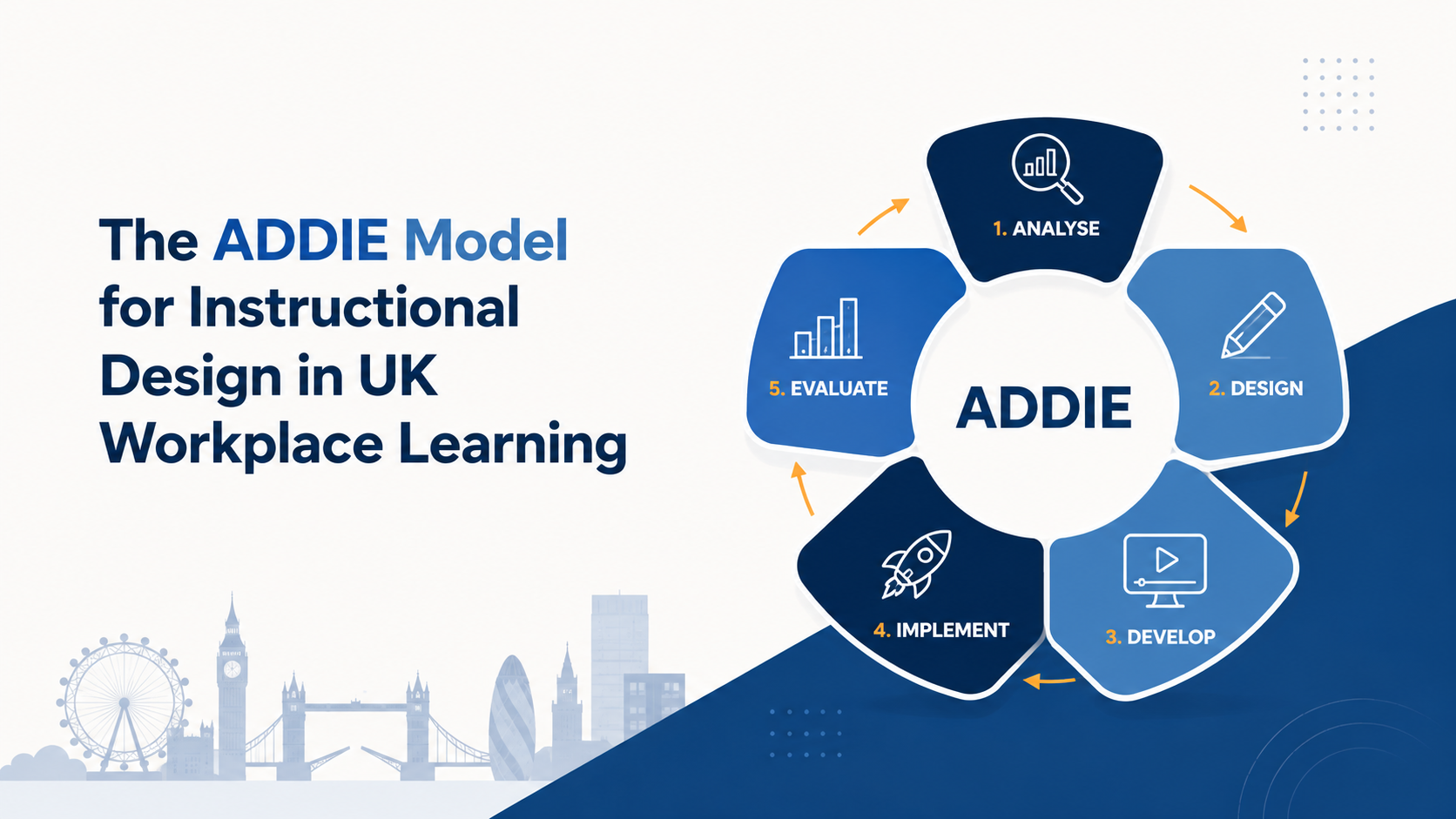
ADDIE represents five connected stages of instructional design:
Analyse
Design
Develop
Implement
Evaluate
Although these stages are often shown in sequence, they are not intended to be completed only once. Most modern learning projects revisit earlier stages as new information becomes available, making ADDIE compatible with iterative development methods.
Starting with analysis
Strong e-learning begins with understanding the problem that needs solving. Before any content is written, organisations should identify the skills gap, define measurable learning objectives and understand what learners already know.
This stage also involves understanding the audience. Employees in an NHS Trust, for example, will have different learning needs and expectations from staff working in a manufacturing business or local council. Their experience, motivation and working environment should all influence the final course design.
Analysis should also consider how success will be measured. Whether the aim is improved compliance, better customer service or increased productivity, learning outcomes need to support wider organisational goals.
Many organisations also assess internal capability during this phase. Deciding which work should be completed in-house and which elements are better delivered by a specialist e-learning partner can save both time and cost.
Designing an effective learning experience
Once the objectives are clear, attention turns to designing the learning journey.
Subject matter experts help ensure technical accuracy, while instructional designers create the overall structure, learner flow and assessment strategy. This is also the stage where decisions are made about learning approaches, such as microlearning, blended learning or scenario-based activities.
Existing training resources may be suitable for updating rather than replacing entirely. New visual assets, videos, animations or interactive elements can then be produced where required. Wireframes, storyboards and prototypes help gather feedback before full development begins, reducing unnecessary revisions later.
Bringing the course to life
The development phase transforms the design into a working e-learning course.
Content is written, interactive exercises are created and assessments are built into the learner experience. Practical scenarios, knowledge checks and quizzes all help reinforce learning and encourage learners to apply what they have learnt.
Quality assurance also becomes a priority at this stage. Courses should be tested across different browsers, devices and accessibility settings to ensure learners receive a consistent experience.
For organisations developing bespoke learning programmes, this is often where AI-powered learning tools can support faster content production while maintaining instructional quality. Platforms such as the Capytech LMS can also simplify course management, learner tracking and reporting once development is complete.
Rolling out training successfully
A well-designed course still needs careful implementation.
Learners need clear communication about why the training matters, how it supports their role and what is expected of them. Managers and senior leaders often play an important role by encouraging participation and reinforcing learning after completion.
Some organisations begin with a pilot group before launching to the wider workforce. Feedback from early users can identify usability issues or content improvements before a full rollout.
It is also important to remove barriers that could prevent successful completion, whether those involve technical access, digital confidence or scheduling training around operational demands.
Measuring success and improving future learning
Evaluation should not be treated as the final box to tick. Instead, it provides evidence that helps improve both the current course and future learning projects.
Completion rates and quiz scores offer useful information, but they tell only part of the story. Organisations should also look for changes in workplace behaviour, operational performance and business outcomes. Learner feedback adds valuable context, but measurable improvements against the original objectives provide the strongest indication of success.
Many organisations continue monitoring performance weeks or months after training to understand whether knowledge has been retained and applied in practice.
ADDIE in a UK learning and compliance environment
UK organisations often need to balance learning quality with regulatory responsibilities. During the analysis and design stages, it is sensible to consider how learner information will be collected, stored and reported in line with the UK GDPR and the Data Protection Act 2018.
For regulated sectors, learning content may also need to align with guidance from bodies such as the HSE, Ofqual or the CIPD, depending on the subject area. Building these requirements into the project from the beginning reduces the need for significant revisions later.
Where organisations are delivering workplace safety programmes, structured instructional design also supports the development of high-quality IOSH-approved safety training that is both engaging and compliant.
Is ADDIE still relevant?
Some people argue that ADDIE belongs to a more traditional approach to learning design because agile development encourages continuous iteration rather than fixed project stages.
In practice, however, the two approaches work well together. Few learning teams follow ADDIE as a strict linear process. Instead, they revisit earlier stages whenever testing, stakeholder feedback or learner insights suggest improvements.
The framework simply provides a logical order for making decisions. It ensures learning objectives come before content creation, learner needs are understood before development begins, and evaluation informs future improvements.
A practical framework that continues to deliver
The popularity of ADDIE comes from its simplicity rather than rigid rules. It gives organisations a reliable structure for planning learning projects while leaving enough flexibility to adapt throughout development.
Whether you are creating compliance training, leadership programmes or technical learning, the ADDIE model helps keep learners, business objectives and measurable outcomes at the centre of every decision. Combined with custom e-learning, modern learning platforms and AI-supported development, it remains one of the most effective frameworks for producing learning that delivers lasting results.
See your own training as e-learning, free
Send us one document and we will turn it into an interactive demo module, so you can judge the quality before you spend anything.