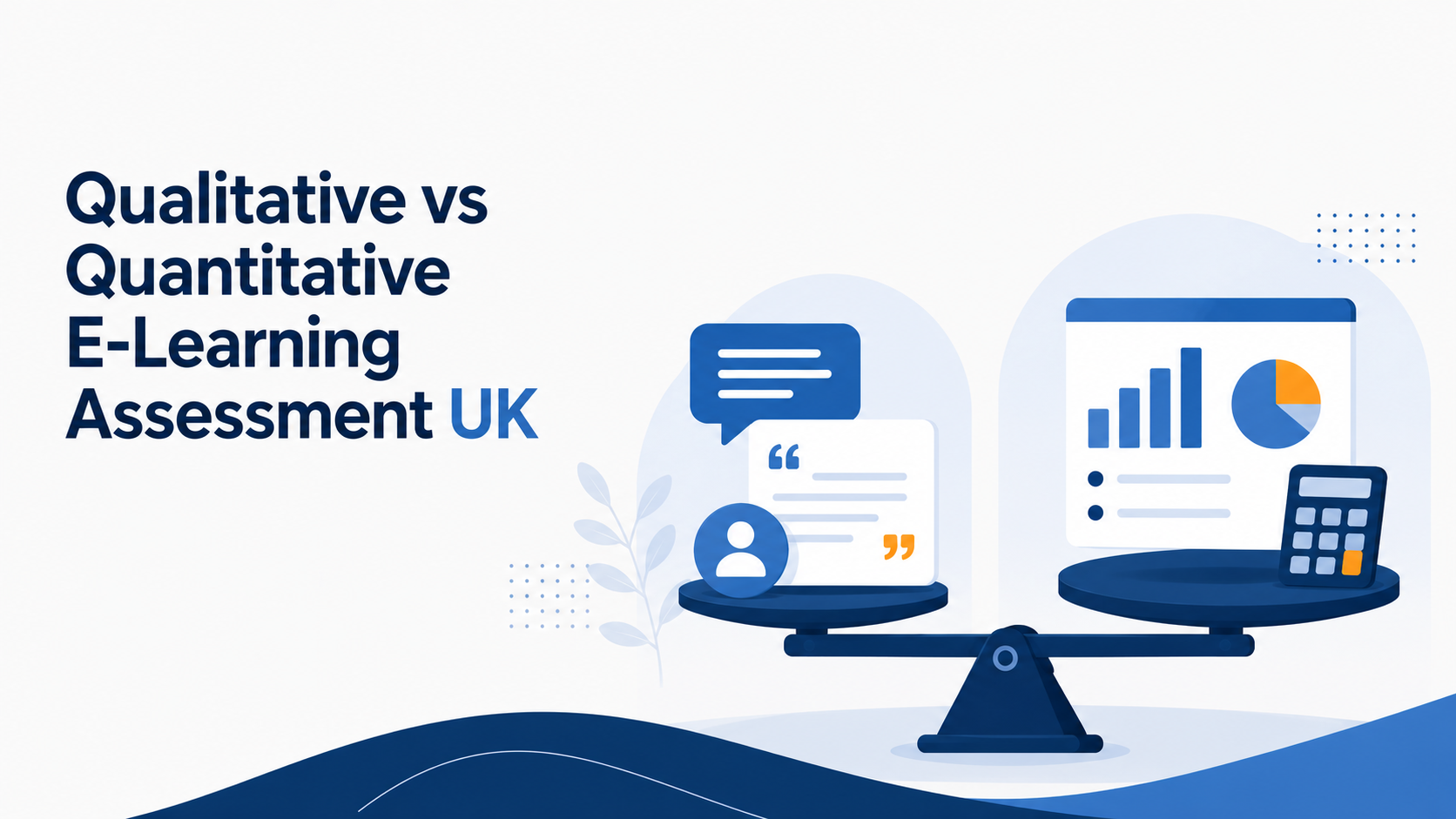

Measuring whether workplace learning has made a real difference is about more than checking whether employees passed a quiz. UK organisations are increasingly expected to demonstrate that training leads to better performance, improved compliance, and lasting behaviour change. That means looking beyond test scores alone.
Whether you are delivering compliance training, onboarding, leadership development or health and safety programmes, choosing the right assessment methods makes a significant difference. The strongest learning strategies combine numerical evidence with practical observations, giving employers a clearer picture of what learners know and how effectively they apply it at work.
Understanding the Two Main Types of Assessment
E-learning assessments generally fall into two broad categories: quantitative and qualitative.
Quantitative assessments measure performance using numbers or measurable outcomes. They answer questions such as how many learners passed a course, what average score was achieved, or whether a business target improved after training.
Qualitative assessments take a different approach. Rather than assigning a score, they explore how learners think, make decisions and apply their knowledge in realistic situations. This provides context that numbers alone cannot always capture.
Most organisations benefit from using both approaches together rather than treating them as alternatives.
When Quantitative Assessments Work Best
Quantitative assessment is familiar to most learners because it forms the basis of many online courses. Multiple choice quizzes, knowledge checks and final tests all produce measurable results that are easy to record and compare.
Other quantitative measures can include course completion rates, learner satisfaction ratings, customer service metrics, sales performance or reductions in workplace incidents after training has been introduced.
The main advantages are straightforward. Results are consistent, objective and simple to analyse across large groups. They also make it easier to compare departments, locations or different training programmes over time. Because the data is measurable, organisations can identify trends and demonstrate progress against learning objectives.
Why Qualitative Assessment Adds More Context
Passing a test does not always mean someone can perform confidently in a real workplace situation. This is where qualitative assessment becomes valuable.
Scenario-based activities, workplace observations, project work and manager feedback all help assess how learners apply their knowledge. Instead of asking for one correct answer, these methods explore judgement, decision-making and problem-solving.
For example, a customer service adviser may achieve full marks in an online assessment but still struggle when handling a difficult customer. Observing real interactions or reviewing recorded calls provides a richer understanding of their capability than a percentage score alone.
Qualitative assessment also encourages meaningful feedback from learners, helping organisations understand how training supports day-to-day work rather than simply whether participants enjoyed the course.
Combining Both Approaches Produces Better Results
The most effective learning programmes rarely rely on a single assessment method.
A compliance course might finish with an online quiz to confirm learners understand legal responsibilities. Several weeks later, managers could observe workplace behaviour to see whether those responsibilities are being followed consistently. Together, these assessments measure both knowledge and practical application.
The same principle applies across leadership development, digital skills, sales training and health and safety programmes. Quantitative data shows whether learning has been completed successfully, while qualitative evidence demonstrates whether it has made a difference.
Using both methods also helps learning teams identify where further coaching or support may be needed.
A Familiar UK Example
Learning to drive provides an easy way to understand why both assessment styles matter.
Before receiving a driving licence, learners must pass the theory test. This measures their knowledge of road signs, traffic rules and safe driving practices using a numerical score. It is an essential part of the process.
However, passing the theory test alone does not prove someone can drive safely. The practical driving test assesses observation, judgement, awareness and decision-making in real traffic conditions. An examiner evaluates performance throughout the journey rather than relying solely on right or wrong answers.
Corporate learning follows much the same pattern. Employees often need to demonstrate both knowledge and competence before training objectives can truly be considered achieved.
Meeting UK Learning and Compliance Expectations
Many UK organisations operate in sectors where demonstrating competence is just as important as recording course completion. Employers delivering health and safety training, regulated industry programmes or mandatory compliance learning often need evidence that staff can apply what they have learnt in practice.
Frameworks supported by organisations such as the CIPD and guidance from the HSE encourage employers to evaluate whether learning has changed workplace behaviour, not simply whether training has been completed. For learning teams, this makes a balanced assessment strategy increasingly valuable.
Modern learning platforms can support this by combining quizzes with manager reviews, workplace observations, learner reflections and performance data, allowing organisations to build a more complete picture of learning effectiveness.
Building Better E-Learning Assessments
When designing an e-learning programme, assessment should be planned alongside the learning experience rather than added at the end.
A well-designed course may include knowledge checks throughout the content, a scored assessment on completion, realistic scenarios that test judgement, learner feedback and follow-up reviews with line managers. Business metrics can then be analysed over time to measure whether the training has delivered the intended outcomes.
Platforms such as Capytech LMS also make it easier to gather multiple forms of assessment in one place, helping organisations monitor learner progress while supporting continuous improvement.
Final Thoughts
There is no single assessment method that answers every question about learning success.
Quantitative assessments provide clear, measurable evidence that learners have understood key concepts. Qualitative assessments reveal whether that knowledge has influenced behaviour and performance in the workplace.
By combining both approaches, UK organisations gain a more accurate understanding of training effectiveness, allowing them to improve learning programmes and demonstrate greater value from their investment in workplace development.
See your own training as e-learning, free
Send us one document and we will turn it into an interactive demo module, so you can judge the quality before you spend anything.