Across the UK, many L&D teams are facing the same quiet problem. Training programmes look busy on paper, completion rates are high, and feedback scores sit comfortably above four stars. Yet when it comes to real-world performance, the impact is often unclear.
Take a typical scenario in a services firm or an NHS Trust. Staff complete mandatory modules, pass the knowledge checks, and move on. But when a difficult customer interaction or compliance decision arises, the confidence just is not there. The gap between knowing and doing remains.
That gap is exactly where AI is starting to make a difference.
For years, digital learning followed a predictable pattern. Build content, upload it to the LMS, track completions, and revisit it once a year. The issue is simple. None of those steps prove that learning has actually taken place or that behaviour has changed.
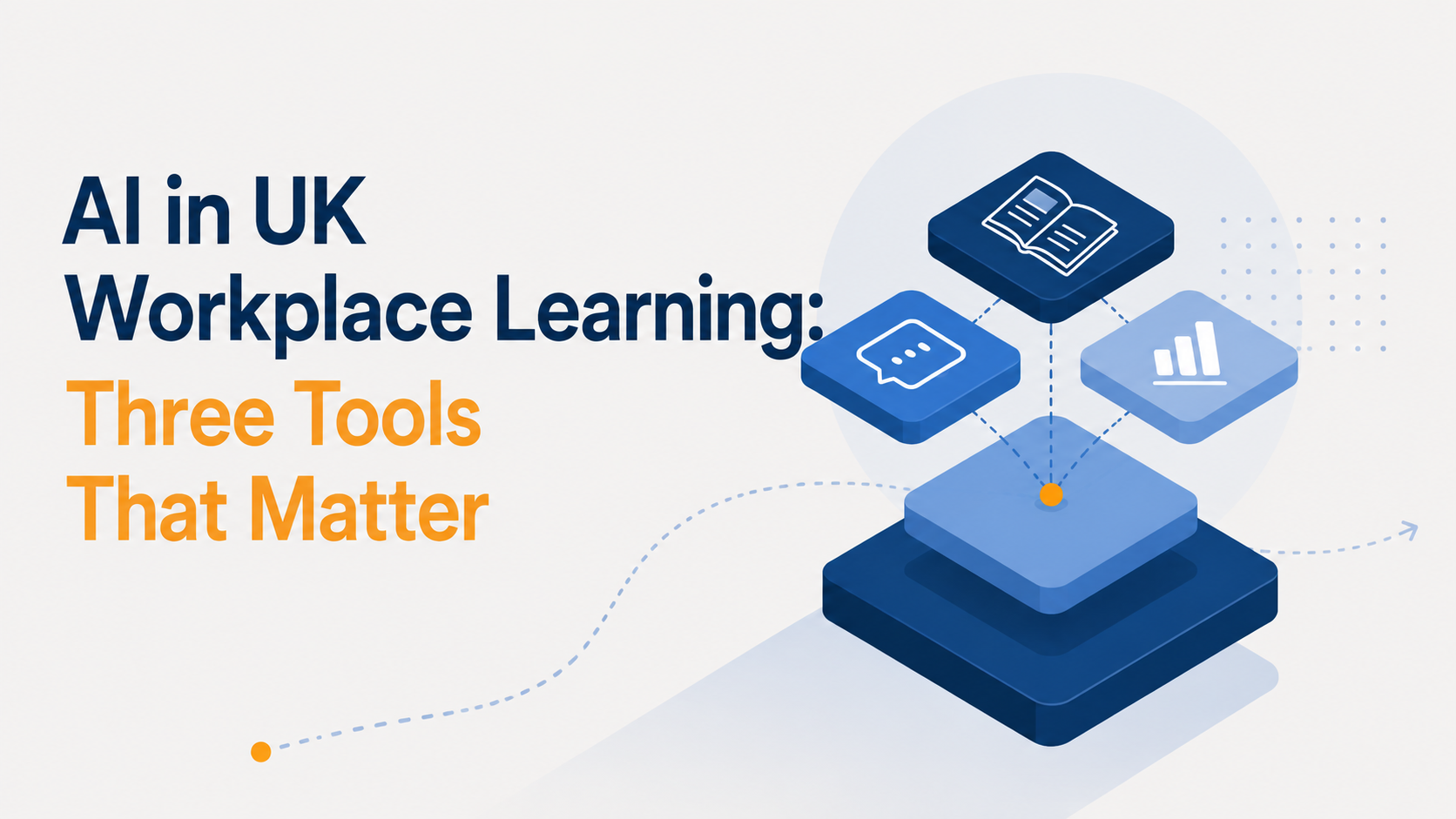
At Capytech, after more than a decade of building custom e-learning, we kept seeing the same issues surface. Learners get stuck with no support, feedback lacks depth, and organisations have little visibility into whether people can apply what they have learnt. So we built three AI-driven tools to address those gaps directly.
Learning Support That Meets People Where They Are
The moment a learner becomes confused is often the moment learning breaks down. In most systems, there is nowhere to turn. People either guess, skip ahead, or disengage.
Our AI Tutor is designed to sit inside the module itself. It acts as a contextual support layer, allowing learners to ask questions as they go. The key difference is that it is trained on the organisation’s own content, not generic internet data.
If someone is working through a compliance module aligned with UK GDPR and the Data Protection Act 2018, the answers they receive are grounded in the exact policies and interpretations the organisation has approved.
This approach also works well across diverse UK workforces. Whether someone prefers to ask a question in plain English or needs clearer, simplified explanations, the experience adapts without requiring multiple versions of the same course.
For L&D teams, the real value sits behind the scenes. Every interaction is captured and can be reviewed. You can see where learners hesitate, what they are asking, and which parts of the content create friction. Instead of relying on end-of-course surveys, you get live insight into actual learning behaviour.
Turning Feedback Into Something You Can Use
Most feedback forms tell you very little. “Clear and informative” might sound positive, but it does not help you improve anything.
Reflect AI changes how feedback is gathered. Rather than presenting a static survey, it holds a short, structured conversation with the learner at the end of a module. If someone says the course was useful, it follows up. What exactly helped? Which part felt irrelevant? What would they change?
This matters because it mirrors how real conversations work. People often need prompting to articulate useful feedback.
The system then analyses responses across individuals and cohorts. Patterns become visible quickly. You might find that a leadership module resonates strongly with one team but feels too generic for another. Or that a compliance topic consistently causes confusion.
The result is a much tighter feedback loop. Instead of waiting for an annual review cycle, updates can be made within days. Over time, content improves continuously rather than in large, infrequent revisions.
From Knowledge Checks to Real-World Practice
Passing a quiz does not mean someone is ready to apply a skill. This is especially true in areas like leadership, customer service, and safety.
Scenario Coach focuses on this exact challenge. It places the learner into a realistic, AI-driven conversation. For example, a manager might need to address poor performance with a team member, or a customer service adviser might need to handle a complaint that is escalating.
The interaction unfolds naturally. The AI responds to tone, phrasing, and approach. If the learner is too direct, the conversation may become defensive. If they handle it well, the situation improves.
As the scenario progresses, the system tracks multiple factors. It looks at how the conversation evolves, whether key points are addressed, and how communication style influences the outcome. At the end, the learner receives structured feedback that goes far beyond a pass or fail.
This type of practice is particularly useful for organisations working towards standards recognised by bodies like the CIPD or delivering IOSH-aligned safety training. It allows learners to practise judgement and communication in a safe environment before applying those skills in real situations.
A UK-Specific Perspective on Data and Compliance
Any discussion about AI in learning needs to address data responsibility. In the UK, this means aligning with the UK GDPR and the Data Protection Act 2018.
These tools are designed with that context in mind. Learner interactions can be anonymised, access is controlled, and organisations retain full ownership of their data. This is especially important for public sector organisations, local councils, and regulated industries where governance standards are high.
There is also a growing expectation from bodies like the CIPD that L&D should demonstrate measurable impact. AI-driven insights support that shift by providing evidence of learning effectiveness, not just activity.
Moving Beyond Completion Metrics
What connects these tools is not the technology itself, but the data they generate.
For the first time, L&D teams can clearly see where learners struggle, how content performs, and whether people can apply what they have learnt in realistic situations. This changes the conversation internally.
Instead of reporting that 95 percent of staff completed a module, you can show whether the training improved decision-making, communication, or compliance outcomes.
That shift matters. It aligns learning more closely with business performance, which is where it has always been expected to sit.
Built Around Your Organisation, Not a Template
Every organisation has its own context, whether that is a council managing public services, a healthcare provider, or a FTSE-listed business. Off-the-shelf content rarely captures those nuances.
Capytech’s approach is fully bespoke. AI tools are trained on your materials, aligned to your objectives, and integrated into your wider learning ecosystem, including platforms like the Capytech LMS or Fasttrack.
The result is not just better learning content, but a system that evolves with your organisation.
See How It Works in Practice
We have recorded a full walkthrough of these tools in action. It shows how they fit into real training scenarios and how organisations are using them to improve outcomes.
If you are exploring how AI could fit into your learning strategy, it is worth seeing what is now possible.
Train your whole team to use AI safely
The Capytech AI Academy gives every employee practical, safe AI skills in short lessons, available in any language.